Grupo de Investigación de Reumatología (GIR), Unidad de Proteómica, INIBIC - Complejo Hospitalario Universitario de A Coruña, SERGAS, Universidad de A Coruña, A Coruña, Spain.
The Maastricht Multimodal Molecular Imaging Institute (M4I), Division of Imaging Mass Spectrometry, Maastricht University, The Netherlands.
Mol Cell Proteomics. 2020 Apr;19(4):574-588. doi: 10.1074/mcp.RA119.001821. Epub 2020 Jan 24.
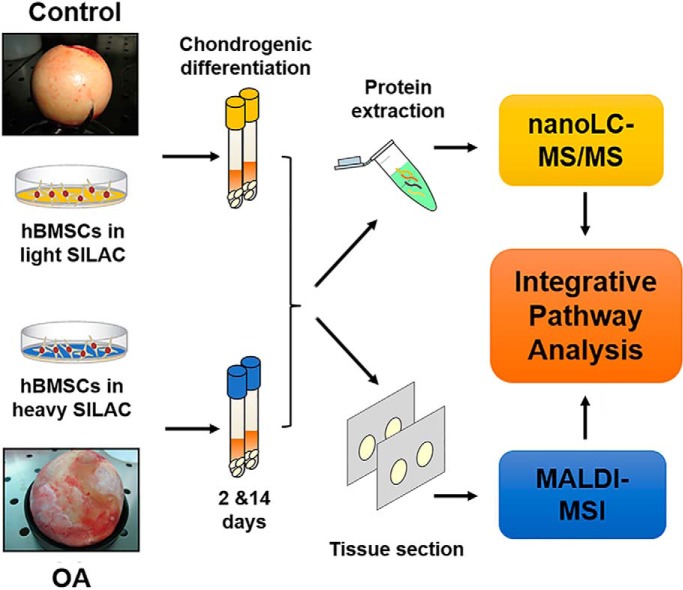
In osteoarthritis (OA), impairment of cartilage regeneration can be related to a defective chondrogenic differentiation of mesenchymal stromal cells (MSCs). Therefore, understanding the proteomic- and metabolomic-associated molecular events during the chondrogenesis of MSCs could provide alternative targets for therapeutic intervention. Here, a SILAC-based proteomic analysis identified 43 proteins related with metabolic pathways whose abundance was significantly altered during the chondrogenesis of OA human bone marrow MSCs (hBMSCs). Then, the level and distribution of metabolites was analyzed in these cells and healthy controls by matrix-assisted laser desorption/ionization mass spectrometry imaging (MALDI-MSI), leading to the recognition of characteristic metabolomic profiles at the early stages of differentiation. Finally, integrative pathway analysis showed that UDP-glucuronic acid synthesis and amino sugar metabolism were downregulated in OA hBMSCs during chondrogenesis compared with healthy cells. Alterations in these metabolic pathways may disturb the production of hyaluronic acid (HA) and other relevant cartilage extracellular matrix (ECM) components. This work provides a novel integrative insight into the molecular alterations of osteoarthritic MSCs and potential therapeutic targets for OA drug development through the enhancement of chondrogenesis.
在骨关节炎(OA)中,软骨再生的损伤可能与间充质基质细胞(MSCs)的软骨形成分化缺陷有关。因此,了解 MSC 软骨形成过程中的蛋白质组学和代谢组学相关分子事件,可以为治疗干预提供替代靶点。在这里,基于 SILAC 的蛋白质组学分析鉴定出了 43 种与代谢途径相关的蛋白质,其丰度在 OA 人骨髓间充质干细胞(hBMSCs)的软骨形成过程中发生了显著改变。然后,通过基质辅助激光解吸/电离质谱成像(MALDI-MSI)分析这些细胞和健康对照中的代谢物水平和分布,在分化的早期阶段识别出特征性的代谢组学图谱。最后,整合途径分析表明,与健康细胞相比,OA hBMSCs 在软骨形成过程中 UDP-葡萄糖醛酸合成和氨基糖代谢下调。这些代谢途径的改变可能会干扰透明质酸(HA)和其他相关软骨细胞外基质(ECM)成分的产生。这项工作通过增强软骨形成,为 OA 药物开发提供了 OA 骨髓间充质干细胞分子改变的新的综合见解和潜在的治疗靶点。