Clinical Microbiology and Infectious Diseases, School of Pathology, Faculty of Health Sciences, University of the Witwatersrand, Johannesburg, 2193, South Africa.
Infection Control, Charlotte Maxeke Johannesburg Academic Hospital, National Health Laboratory Service, Johannesburg, 2193, South Africa.
Sci Rep. 2020 Jan 24;10(1):1162. doi: 10.1038/s41598-020-58203-3.
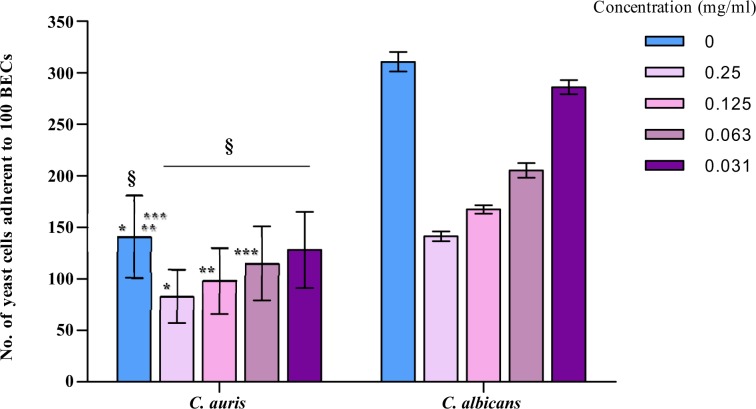
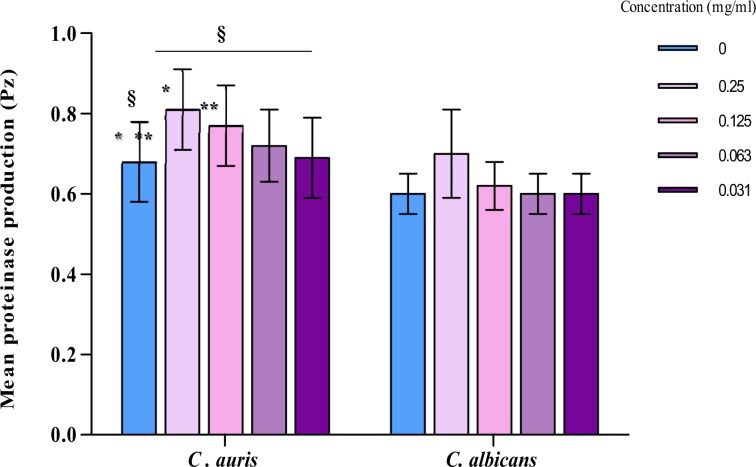
Emergence of Candida auris has been described as a global health threat due to its ability to cause invasive infections with high mortality rate and multidrug resistance. Novel drugs and therapies are required to target this organism and its pathogenicity. Anti-virulence approach and combination therapy have been proposed as alternatives in recent years. This study evaluated the virulence factors in C. auris, combination antifungal activity of phenolic compounds with antifungal drugs and determined effect of the most active compound on positive pathogenicity markers of C. auris. Antifungal susceptibility profile of 25 clinical isolates of C. auris against antifungal agents as well as against phenolic compounds was obtained using CLSI guidelines. Combination of the most active phenolic compound with antifungal drugs was determined. Effect of carvacrol on the virulence factors was also studied. Carvacrol was the most active phenol with median MIC of 125 µg/ml and its combination with fluconazole, amphotericin B, nystatin and caspofungin resulted synergistic and additive effects in 68%, 64%, 96% and 28%, respectively. Combination also reduced the MIC values of the drugs. All test strains showed adherence ability to epithelial cells and 96% of strains produced proteinase. None of the strains produced hyphae and phospholipase. At low concentrations, carvacrol significantly inhibited the adherence ability and proteinase production (both p < 0.01). Carvacrol has antifungal and anti-virulence activity against C. auris. It also showed an enhanced antifungal activity in combination with antifungal agents. Therefore it has potential to be developed into a novel antifungal agent.
耳念珠菌的出现被描述为一种全球健康威胁,因为它能够引起具有高死亡率和多药耐药性的侵袭性感染。需要新型药物和疗法来针对这种生物及其致病性。近年来,抗毒力方法和联合治疗已被提议作为替代方法。本研究评估了耳念珠菌的毒力因子,研究了酚类化合物与抗真菌药物联合的抗真菌活性,并确定了最活跃的化合物对耳念珠菌阳性致病性标志物的影响。采用 CLSI 指南获得了 25 株临床分离株对抗真菌药物以及对酚类化合物的抗真菌药敏谱。确定了最活跃的酚类化合物与抗真菌药物的组合。还研究了香芹酚对毒力因子的影响。香芹酚是最活跃的酚类化合物,其 MIC50 为 125μg/ml,与氟康唑、两性霉素 B、制霉菌素和卡泊芬净联合使用时,协同和相加作用分别为 68%、64%、96%和 28%。联合用药还降低了药物的 MIC 值。所有测试菌株均显示出对上皮细胞的粘附能力,96%的菌株产生蛋白酶。没有菌株产生菌丝和磷脂酶。在低浓度下,香芹酚显著抑制粘附能力和蛋白酶的产生(均 p<0.01)。香芹酚对耳念珠菌具有抗真菌和抗毒力活性。它与抗真菌药物联合使用时也显示出增强的抗真菌活性。因此,它有可能被开发成一种新型的抗真菌药物。