Systems Bioinformatics, Amsterdam Institute for Molecules, Medicines & Systems, Vrije Universiteit Amsterdam, Amsterdam, The Netherlands.
Department of Mathematics, Vrije Universiteit Amsterdam, Amsterdam, The Netherlands.
PLoS Comput Biol. 2020 Jan 27;16(1):e1007559. doi: 10.1371/journal.pcbi.1007559. eCollection 2020 Jan.
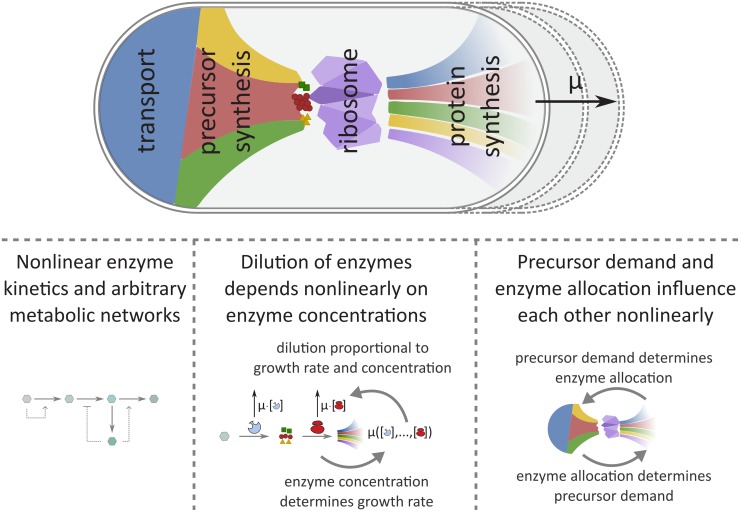
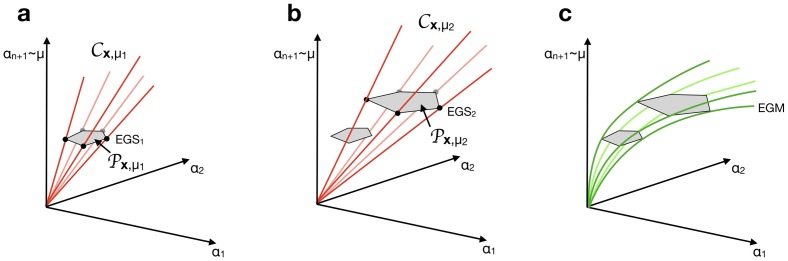
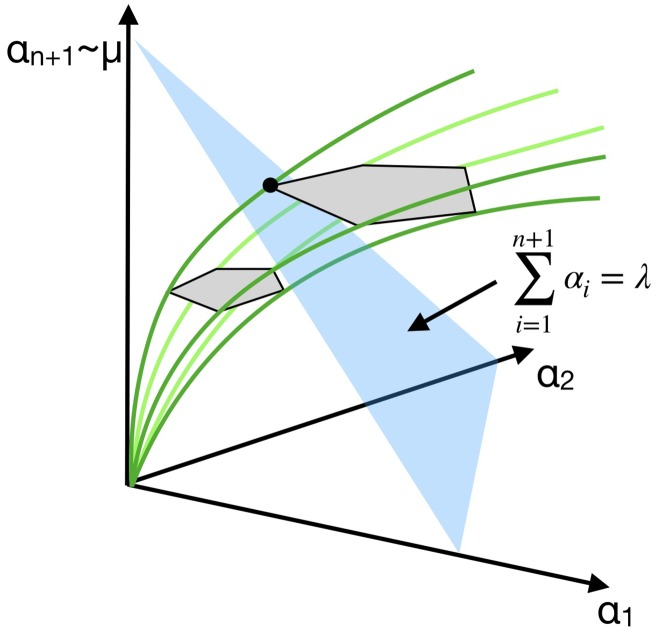
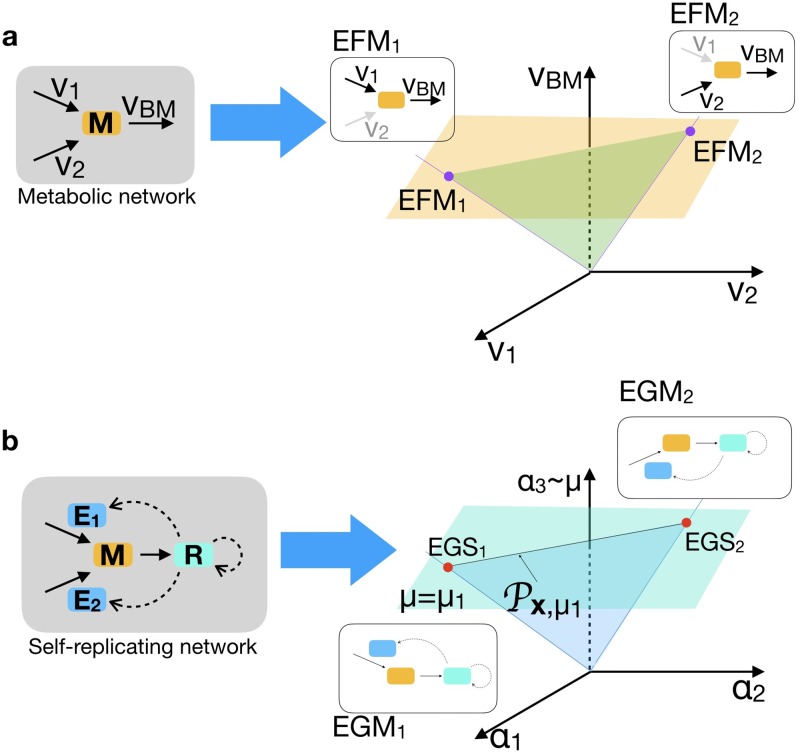
In this paper we try to describe all possible molecular states (phenotypes) for a cell that fabricates itself at a constant rate, given its enzyme kinetics and the stoichiometry of all reactions. For this, we must understand the process of cellular growth: steady-state self-fabrication requires a cell to synthesize all of its components, including metabolites, enzymes and ribosomes, in proportions that match its own composition. Simultaneously, the concentrations of these components affect the rates of metabolism and biosynthesis, and hence the growth rate. We here derive a theory that describes all phenotypes that solve this circular problem. All phenotypes can be described as a combination of minimal building blocks, which we call Elementary Growth Modes (EGMs). EGMs can be used as the theoretical basis for all models that explicitly model self-fabrication, such as the currently popular Metabolism and Expression models. We then use our theory to make concrete biological predictions. We find that natural selection for maximal growth rate drives microorganisms to states of minimal phenotypic complexity: only one EGM will be active when growth rate is maximised. The phenotype of a cell is only extended with one more EGM whenever growth becomes limited by an additional biophysical constraint, such as a limited solvent capacity of a cellular compartment. The theory presented here extends recent results on Elementary Flux Modes: the minimal building blocks of cellular growth models that lack the self-fabrication aspect. Our theory starts from basic biochemical and evolutionary considerations, and describes unicellular life, both in growth-promoting and in stress-inducing environments, in terms of EGMs.
在本文中,我们试图描述一个以恒定速率自我组装的细胞可能存在的所有分子状态(表型),这取决于其酶动力学和所有反应的化学计量。为此,我们必须理解细胞生长的过程:稳态自我组装需要细胞以与其自身组成相匹配的比例合成其所有成分,包括代谢物、酶和核糖体。同时,这些成分的浓度会影响代谢和生物合成的速率,从而影响生长速率。我们在这里推导出一个描述所有解决这个循环问题的表型的理论。所有表型都可以描述为最小构建块的组合,我们称之为基本生长模式(EGM)。EGM 可以用作明确自我组装模型的所有模型的理论基础,例如当前流行的代谢和表达模型。然后,我们使用我们的理论做出具体的生物学预测。我们发现,最大生长速率的自然选择促使微生物处于最小表型复杂性的状态:当生长速率最大化时,只有一个 EGM 会活跃。只有当生长受到额外的生物物理限制(例如细胞区室的溶剂容量有限)时,才会使用一个额外的 EGM 扩展细胞的表型。这里提出的理论扩展了最近关于基本通量模式的结果:缺乏自我组装方面的细胞生长模型的最小构建块。我们的理论从基本的生化和进化考虑出发,用 EGM 来描述在促进生长和诱导应激的环境中的单细胞生命。