Kim Hyoun S, Hodgins David C, Kim Benjamin, Wild T Cameron
Department of Psychology, University of Calgary, 2500 University Drive NW, Calgary, AB T2N 1N4, Canada.
School of Public Health, University of Alberta, 11405 87 Ave, Edmonton, AB T6G 1C9, Canada.
J Clin Med. 2020 Jan 24;9(2):334. doi: 10.3390/jcm9020334.
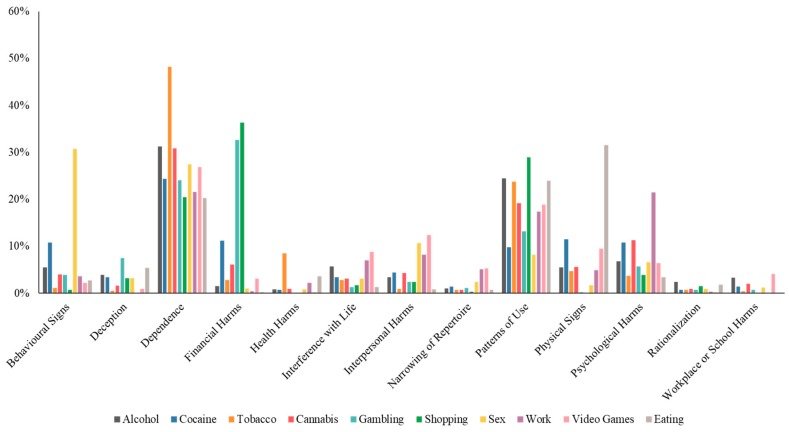
Using a transdiagnostic perspective, the present research examined the prominent indicators of substance (alcohol, cocaine, marijuana, tobacco) and behavioral (gambling, video games, sex, shopping, work, eating) addictions nominated by people with lived experiences. Specifically, we aimed to explore whether the perceived most important indicators nominated were consistent across the 10 addictions or differed based on the specific addiction. Additionally, we explored gender differences in the perceived most important indicators across addictive behaviors. A large online sample of adults recruited from a Canadian province ( = 3503) were asked to describe the most important signs or symptoms of problems with these substances and behaviors. Open-ended responses were analyzed among a subsample of 2603 respondents ( = 1562 in the past year) who disclosed that they had personally experienced a problem with at least one addiction listed above. Content analyses revealed that (e.g., craving, impairments in control) and patterns of use (e.g., frequency) were the most commonly perceived indicators for both substance and behavioral addictions, accounting for over half of all the qualitative responses. Differences were also found between substance and behavioral addictions regarding the proportion of the most important signs nominated. Consistent with the syndrome model of addiction, unique indicators were also found for specific addictive behaviors, with the greatest proportion of unique indicators found for eating. Supplemental analyses found that perceived indicators across addictions were generally gender invariant. Results provide some support for a transdiagnostic conceptualization of substance and behavioral addictions. Implications for the study, prevention, and treatment of addictions are discussed.
本研究采用跨诊断视角,考察了有实际成瘾经历者提名的物质(酒精、可卡因、大麻、烟草)和行为(赌博、电子游戏、性、购物、工作、饮食)成瘾的显著指标。具体而言,我们旨在探究所提名的被认为最重要的指标在这10种成瘾行为中是否一致,还是因具体成瘾行为而异。此外,我们还探讨了在成瘾行为中被认为最重要的指标上的性别差异。从加拿大一个省份招募了一个大型在线成人样本(n = 3503),要求他们描述这些物质和行为出现问题时最重要的迹象或症状。在2603名受访者(过去一年中有n = 1562人)的子样本中对开放式回答进行了分析,这些受访者表示他们个人至少经历过上述一种成瘾问题。内容分析表明,渴望、控制受损等体验和使用模式(如频率)是物质成瘾和行为成瘾最常被提及的指标,占所有定性回答的一半以上。在被提名的最重要迹象的比例方面,物质成瘾和行为成瘾之间也存在差异。与成瘾综合征模型一致,特定成瘾行为也有独特的指标,饮食成瘾中独特指标的比例最高。补充分析发现,各成瘾行为中被感知到的指标在性别上总体无差异。研究结果为物质成瘾和行为成瘾的跨诊断概念化提供了一些支持。文中还讨论了对成瘾研究、预防和治疗的启示。