Department of Neurology & Institute of Neurology, Rui Jin Hospital, School of Medicine, Shanghai Jiao Tong University, No.197, Rui Jin Er Road, Shanghai, 200025, China.
Department of Neurology, The First Hospital of Jiaxing, Zhejiang, 314000, China.
BMC Neurol. 2020 Jan 28;20(1):36. doi: 10.1186/s12883-020-1626-6.
To investigate the relationships between blood pressure (BP) circadian rhythms and acute cerebral infarction (ACI), silent cerebral infarction (SCI) and the severity of leukoaraiosis in hypertensive patients.
A retrospective case-control study was performed among hypertensive patients with 24-h ambulatory blood pressure monitoring (ABPM) and cranial magnetic resonance imaging (MRI).
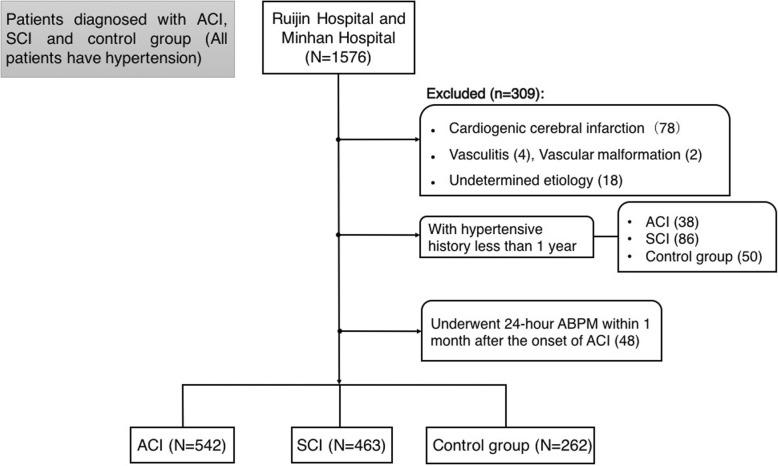
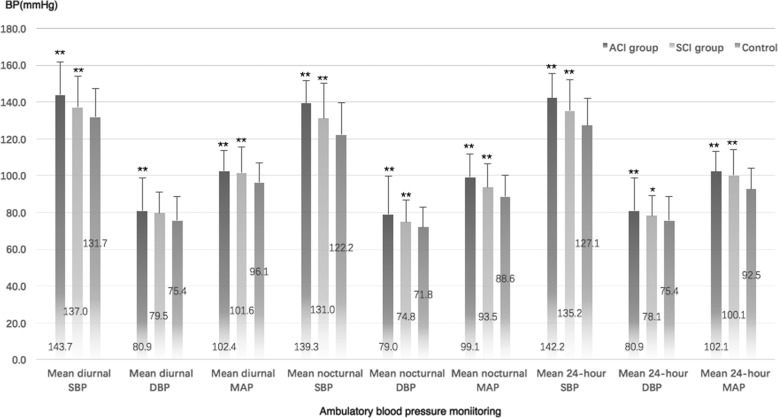
A total of 1267 patients were enrolled. Lower nocturnal blood pressure (BP) decreases were observed in ACI patients than in controls (3.3% vs 8.2%, P<0.001). Reverse-dipper pattern (RD) and non-dipper pattern (ND) were found to be independent risk factors for ACI. In ACI patients, both RD and ND BP circadian rhythms were revealed to be independent risk factors for moderate-severe leukoaraiosis. In addition, in SCI patients, RD (OR = 1.7, 95% CI, 0.9-3.0; P = 0.047) or extreme-dipper pattern (ED) (OR = 2.9, 95% CI, 1.2-7.0; P = 0.015) were found to be independent risk factors for moderate-severe leukoaraiosis. Moreover, the greater the severity of leukoaraiosis was, the higher the ratio of abnormal BP circadian rhythms.
RD and ND BP circadian rhythms might not only be relevant to the onset of ACI but also correlate with the severity of leukoaraiosis. Thus, when modulating BP with antihypertensive drugs, the BP circadian rhythms, and not merely the BP level, should warrant more attention.
探讨高血压患者血压昼夜节律与急性脑梗死(ACI)、无症状性脑梗死(SCI)及脑白质疏松症(LA)严重程度的关系。
对 1267 例行 24 小时动态血压监测(ABPM)和头颅磁共振成像(MRI)的高血压患者进行回顾性病例对照研究。
共纳入 1267 例患者。ACI 组患者夜间血压下降幅度明显低于对照组(3.3%比 8.2%,P<0.001)。反杓型(RD)和非杓型(ND)被认为是 ACI 的独立危险因素。在 ACI 患者中,RD 和 ND 昼夜节律血压均被证实是中重度 LA 的独立危险因素。此外,在 SCI 患者中,RD(OR=1.7,95%CI,0.9-3.0;P=0.047)或极度杓型(ED)(OR=2.9,95%CI,1.2-7.0;P=0.015)被认为是中重度 LA 的独立危险因素。此外,LA 越严重,异常血压昼夜节律的比例越高。
RD 和 ND 昼夜节律血压不仅与 ACI 的发生有关,而且与 LA 的严重程度相关。因此,在使用降压药物调节血压时,不仅要关注血压水平,还要关注血压昼夜节律。