Ronald O. Perelman Department of Emergency Medicine, New York University School of Medicine, 227 East 30th Street, New York, NY, 10016, USA.
NYU Langone Health, Medical Center Information Technology, New York, NY, USA.
BMC Med Inform Decis Mak. 2020 Jan 28;20(1):13. doi: 10.1186/s12911-020-1021-7.
The emergency department is a critical juncture in the trajectory of care of patients with serious, life-limiting illness. Implementation of a clinical decision support (CDS) tool automates identification of older adults who may benefit from palliative care instead of relying upon providers to identify such patients, thus improving quality of care by assisting providers with adhering to guidelines. The Primary Palliative Care for Emergency Medicine (PRIM-ER) study aims to optimize the use of the electronic health record by creating a CDS tool to identify high risk patients most likely to benefit from primary palliative care and provide point-of-care clinical recommendations.
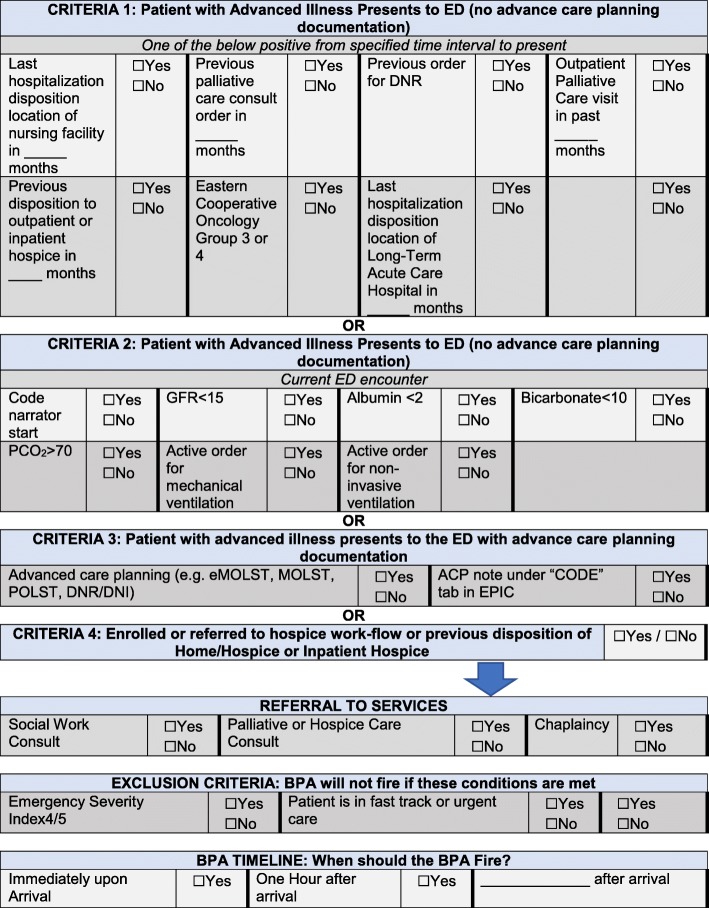
A clinical decision support tool entitled Emergency Department Supportive Care Clinical Decision Support (Support-ED) was developed as part of an institutionally-sponsored value based medicine initiative at the Ronald O. Perelman Department of Emergency Medicine at NYU Langone Health. A multidisciplinary approach was used to develop Support-ED including: a scoping review of ED palliative care screening tools; launch of a workgroup to identify patient screening criteria and appropriate referral services; initial design and usability testing via the standard System Usability Scale questionnaire, education of the ED workforce on the Support-ED background, purpose and use, and; creation of a dashboard for monitoring and feedback.
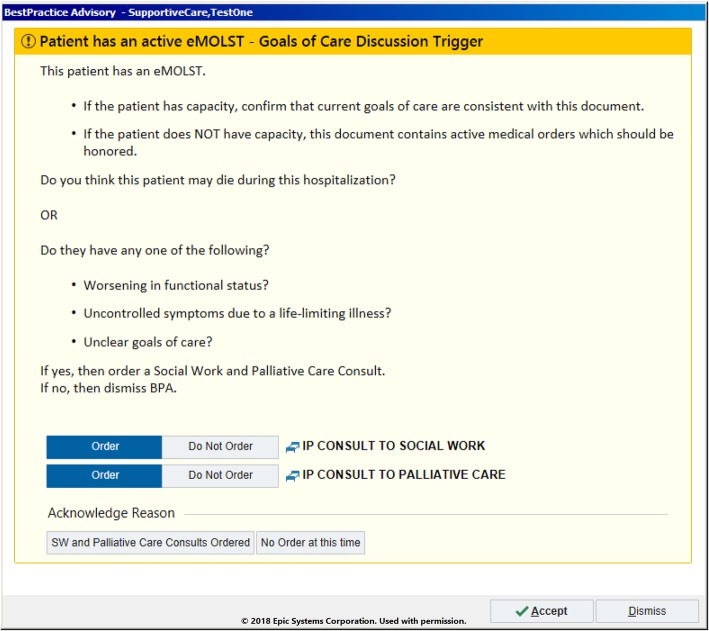
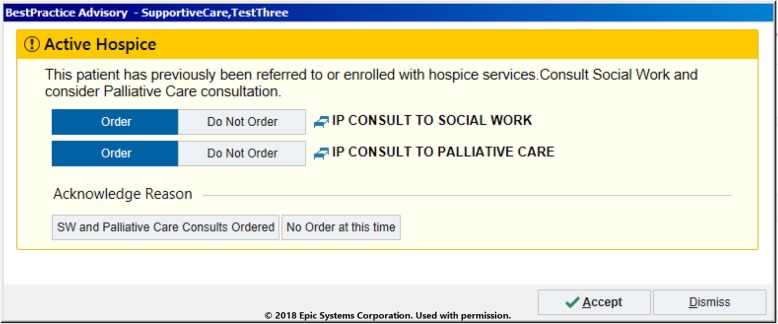
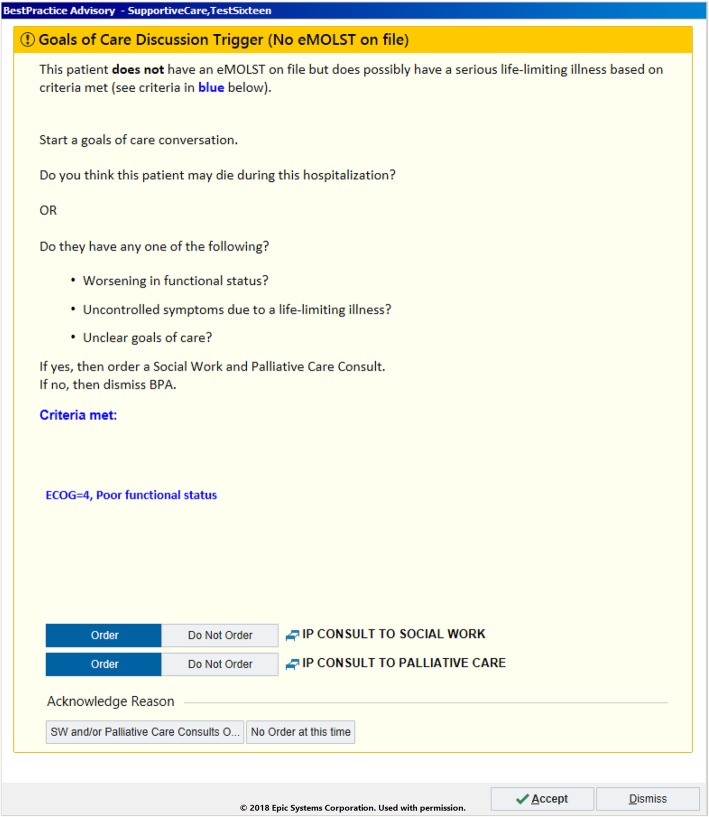
The scoping review identified the Palliative Care and Rapid Emergency Screening (P-CaRES) survey as a validated instrument in which to adapt and apply for the creation of the CDS tool. The multidisciplinary workshops identified two primary objectives of the CDS: to identify patients with indicators of serious life limiting illness, and to assist with referrals to services such as palliative care or social work. Additionally, the iterative design process yielded three specific patient scenarios that trigger a clinical alert to fire, including: 1) when an advance care planning document was present, 2) when a patient had a previous disposition to hospice, and 3) when historical and/or current clinical data points identify a serious life-limiting illness without an advance care planning document present. Monitoring and feedback indicated a need for several modifications to improve CDS functionality.
CDS can be an effective tool in the implementation of primary palliative care quality improvement best practices. Health systems should thoughtfully consider tailoring their CDSs in order to adapt to their unique workflows and environments. The findings of this research can assist health systems in effectively integrating a primary palliative care CDS system seamlessly into their processes of care.
ClinicalTrials.gov Identifier: NCT03424109. Registered 6 February 2018, Grant Number: AT009844-01.
急诊科是严重危及生命疾病患者治疗轨迹的关键环节。临床决策支持(CDS)工具的实施可以自动识别可能受益于姑息治疗的老年患者,而不是依赖提供者来识别此类患者,从而通过帮助提供者遵守指南来提高护理质量。主要姑息治疗急诊医学(PRIM-ER)研究旨在通过创建 CDS 工具来识别最有可能受益于初级姑息治疗的高风险患者,从而优化电子健康记录的使用,为患者提供床边临床建议。
作为 NYU Langone Health 罗纳德·O·佩尔曼急诊医学系机构赞助的基于价值的医学倡议的一部分,开发了一个名为急诊支持性护理临床决策支持(Support-ED)的临床决策支持工具。采用多学科方法开发 Support-ED,包括:对 ED 姑息治疗筛查工具进行范围审查;启动工作组以确定患者筛查标准和适当的转诊服务;通过标准系统可用性量表问卷进行初步设计和可用性测试、急诊工作人员对 Support-ED 背景、目的和使用的教育、以及创建用于监测和反馈的仪表板。
范围审查确定姑息治疗和快速急诊筛查(P-CaRES)调查是一种经过验证的工具,可以对其进行改编并应用于 CDS 工具的创建。多学科研讨会确定了 CDS 的两个主要目标:识别有严重生命限制疾病指标的患者,并协助转介到姑息治疗或社会工作等服务。此外,迭代设计过程产生了三个触发临床警报的特定患者场景,包括:1)当存在预先护理计划文件时,2)当患者以前有临终关怀的处置时,以及 3)当历史和/或当前临床数据点识别出严重的生命限制疾病且没有预先护理计划文件时。监测和反馈表明需要进行几次修改以提高 CDS 的功能。
CDS 可以成为实施初级姑息治疗质量改进最佳实践的有效工具。医疗系统应深思熟虑地考虑定制其 CDS,以适应其独特的工作流程和环境。这项研究的结果可以帮助医疗系统将初级姑息治疗 CDS 系统有效地无缝集成到他们的护理流程中。
ClinicalTrials.gov 标识符:NCT03424109。注册于 2018 年 2 月 6 日,资助编号:AT009844-01。