Burchill Matthew A, Goldberg Alyssa R, Tamburini Beth A Jirón
Division of Gastroenterology and Hepatology, Department of Medicine, University of Colorado Anschutz Medical Campus, School of Medicine, Aurora, CO, United States.
Section of Pediatric Gastroenterology, Hepatology and Nutrition, Digestive Health Institute, Children's Hospital Colorado, Aurora, CO, United States.
Front Physiol. 2020 Jan 14;10:1579. doi: 10.3389/fphys.2019.01579. eCollection 2019.
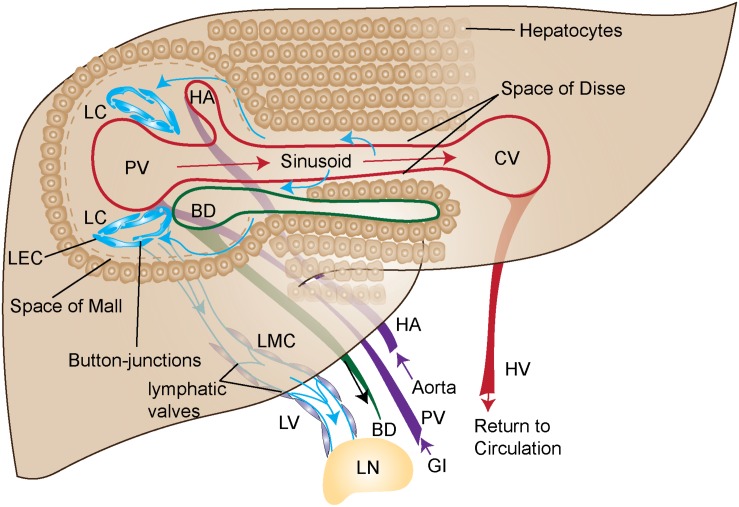
Chronic liver disease (CLD) is a global health epidemic causing ∼2 million deaths annually worldwide. As the incidence of CLD is expected to rise over the next decade, understanding the cellular and molecular mediators of CLD is critical for developing novel therapeutics. Common characteristics of CLD include steatosis, inflammation, and cholesterol accumulation in the liver. While the lymphatic system in the liver has largely been overlooked, the liver lymphatics, as in other organs, are thought to play a critical role in maintaining normal hepatic function by assisting in the removal of protein, cholesterol, and immune infiltrate. Lymphatic growth, permeability, and/or hyperplasia in non-liver organs has been demonstrated to be caused by obesity or hypercholesterolemia in humans and animal models. While it is still unclear if changes in permeability occur in liver lymphatics, the lymphatics do expand in number and size in all disease etiologies tested. This is consistent with the lymphatic endothelial cells (LEC) upregulating proliferation specific genes, however, other transcriptional changes occur in liver LECs that are dependent on the inflammatory mediators that are specific to the disease etiology. Whether these changes induce lymphatic dysfunction or if they impact liver function has yet to be directly addressed. Here, we will review what is known about liver lymphatics in health and disease, what can be learned from recent work on the influence of obesity and hypercholesterolemia on the lymphatics in other organs, changes that occur in LECs in the liver during disease and outstanding questions in the field.
慢性肝病(CLD)是一种全球范围内的健康流行病,每年在全球导致约200万人死亡。由于预计在未来十年CLD的发病率将会上升,了解CLD的细胞和分子介质对于开发新型治疗方法至关重要。CLD的常见特征包括肝脏中的脂肪变性、炎症和胆固醇积累。虽然肝脏中的淋巴系统在很大程度上被忽视了,但与其他器官一样,肝脏淋巴管被认为在协助清除蛋白质、胆固醇和免疫浸润以维持正常肝功能方面起着关键作用。在人类和动物模型中,已证明非肝脏器官中的淋巴生长、通透性和/或增生是由肥胖或高胆固醇血症引起的。虽然尚不清楚肝脏淋巴管是否会发生通透性变化,但在所有测试的疾病病因中,淋巴管的数量和大小确实会增加。这与淋巴管内皮细胞(LEC)上调增殖特异性基因一致,然而,肝脏LEC中还会发生其他转录变化,这些变化取决于特定疾病病因的炎症介质。这些变化是否会导致淋巴功能障碍或是否会影响肝功能尚未得到直接解决。在这里,我们将回顾关于健康和疾病状态下肝脏淋巴管的已知信息、从肥胖和高胆固醇血症对其他器官淋巴管影响的最新研究中可以学到的内容、疾病期间肝脏LEC中发生的变化以及该领域中尚未解决的问题。