Zhang Huapeng, Li Gongquan, Zhang Yi, Shi Jihua, Yan Bing, Tang Hongwei, Chen Sanyang, Zhang Jiakai, Wen Peihao, Wang Zhihui, Pang Chun, Li Jie, Guo Wenzhi, Zhang Shuijun
Department of Hepatobiliary and Pancreatic Surgery, The First Affiliated Hospital of Zhengzhou University, Zhengzhou, China.
Open and Key Laboratory of Hepatobiliary & Pancreatic Surgery and Digestive Organ Transplantation at Henan Universities, The First Affiliated Hospital of Zhengzhou University, Zhengzhou, China.
Front Oncol. 2020 Jan 14;9:1471. doi: 10.3389/fonc.2019.01471. eCollection 2019.
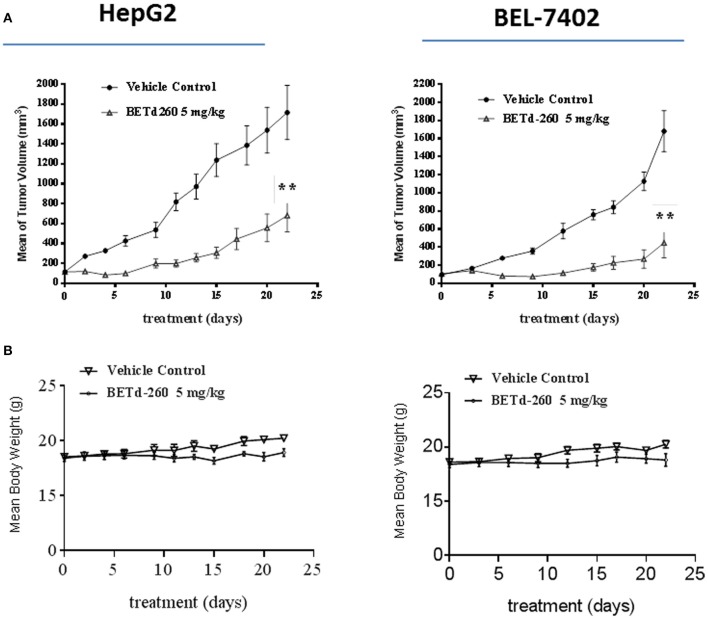
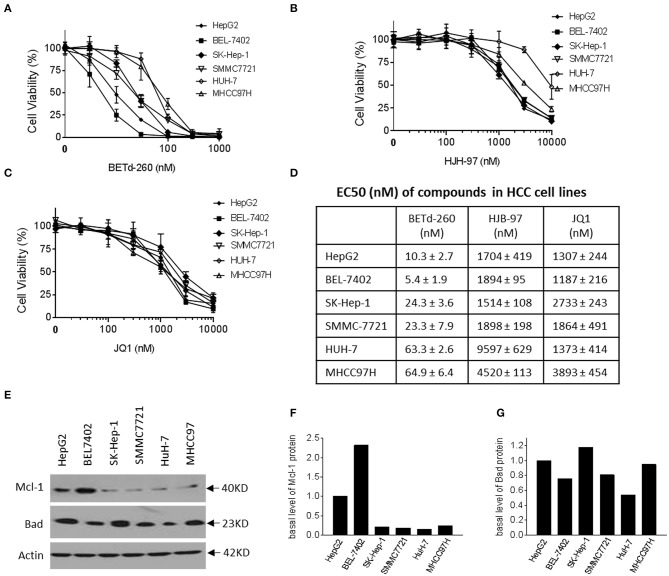
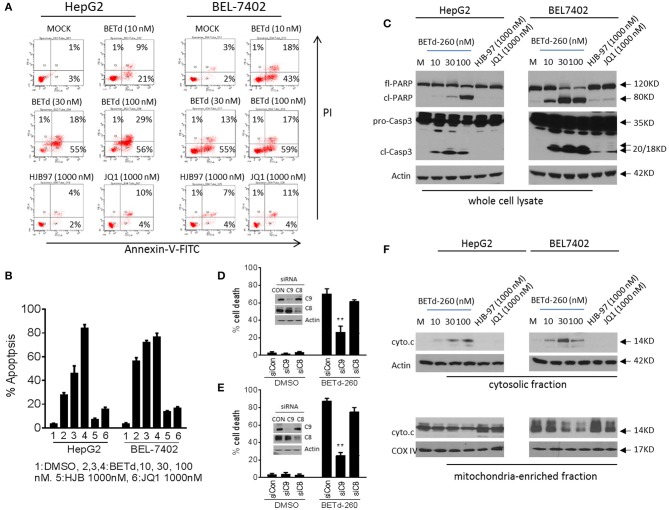
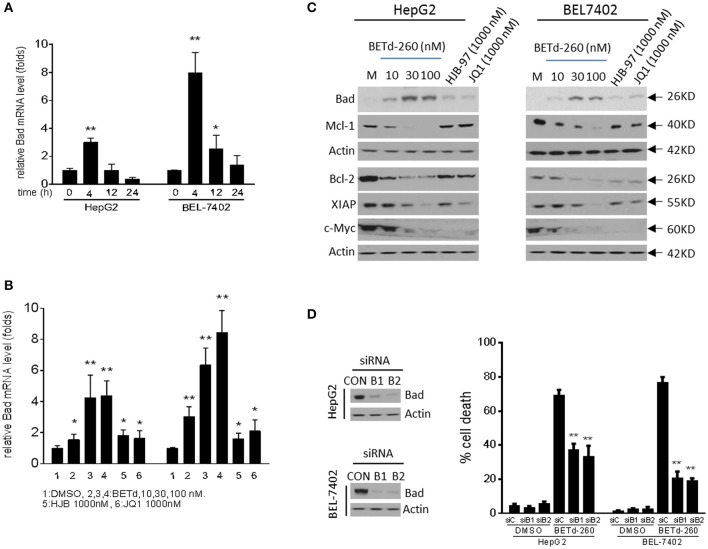
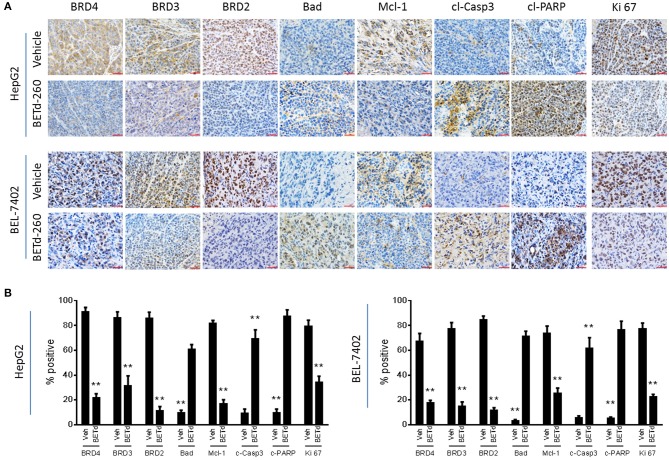
Bromodomain and extraterminal domain (BET) family proteins are epigenetic regulators involved in human malignances. Targeting BET proteins for degradation using proteolysis-targeting chimera (PROTAC) recently has drawn increasing attention in the field of cancer therapeutics. BET proteins have been found to be overexpressed in HCC cells and tumor tissues. However, the biological activity of BET-PROTACs in hepatocellular carcinoma (HCC) remains unclear. In this study, we investigated anti-HCC activity of BETd-260, a BET-PROTAC molecule using and models. BETd-260-mediated anti-HCC activity was investigated by cell viability, apoptosis assays. Efficacy was examined with a cell lines-derived HCC xenograft model in mice. Anticancer mechanism was investigated by RT-PCR, western blotting and immunohistochemical staining. BETd-260 potently suppressed cell viability and robustly induced apoptosis in HCC cells. BETd-260 reciprocally modulated the expression of several apoptotic genes in HCC cells, i.e., suppressing the expression of anti-apoptotic Mcl-1, Bcl-2, c-Myc, and X-linked inhibitor of apoptosis (XIAP), whereas increasing the expression of pro-apoptotic Bad. BETd-260 treatment led to disruption of mitochondrial membrane integrity, and triggered apoptosis via intrinsic signaling in HCC cells. BETd-260 triggered apoptosis in HCC xenograft tissue and profoundly inhibited the growth of HCC xenograft tumors in mice. Our data suggest that pharmacological targeting of BET for degradation may be a novel therapeutic strategy for the treatment of HCC.
溴结构域和额外末端结构域(BET)家族蛋白是参与人类恶性肿瘤的表观遗传调节剂。利用蛋白酶靶向嵌合体(PROTAC)靶向降解BET蛋白最近在癌症治疗领域引起了越来越多的关注。已发现BET蛋白在肝癌细胞和肿瘤组织中过表达。然而,BET-PROTACs在肝细胞癌(HCC)中的生物学活性仍不清楚。在本研究中,我们使用[具体模型1]和[具体模型2]模型研究了BET-PROTAC分子BETd-260的抗肝癌活性。通过细胞活力、凋亡检测研究了BETd-260介导的抗肝癌活性。在小鼠的细胞系来源的肝癌异种移植模型中检测了疗效。通过RT-PCR、蛋白质印迹和免疫组织化学染色研究了抗癌机制。BETd-260有效抑制肝癌细胞的活力并强烈诱导其凋亡。BETd-260相互调节肝癌细胞中几个凋亡基因的表达,即抑制抗凋亡蛋白Mcl-1、Bcl-2、c-Myc和X连锁凋亡抑制蛋白(XIAP)的表达,同时增加促凋亡蛋白Bad的表达。BETd-260处理导致线粒体膜完整性破坏,并通过肝癌细胞中的内源性信号触发凋亡。BETd-260在肝癌异种移植组织中触发凋亡,并显著抑制小鼠肝癌异种移植肿瘤的生长。我们的数据表明,靶向降解BET的药理学方法可能是治疗肝癌的一种新的治疗策略。