Department of Family Medicine, Maastricht University (CAPHRI), Maastricht, The Netherlands.
Department of Methodology and Statistics, Maastricht University (CAPHRI), Maastricht, The Netherlands.
Nicotine Tob Res. 2021 Jan 7;23(1):99-106. doi: 10.1093/ntr/ntaa024.
Financial incentives effectively increase smoking cessation rates, but it is unclear via which psychological mechanisms incentives influence quit behavior. The current study examines how receiving financial incentives for smoking cessation leads to quitting smoking and investigates several mediators and moderators of that relationship.
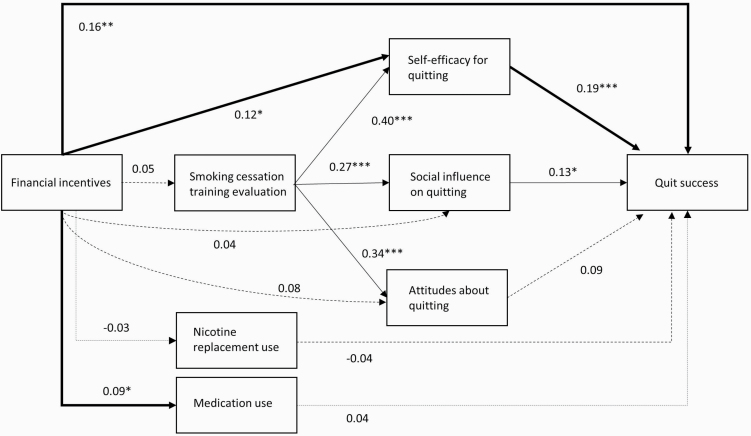
The study sample consisted of 604 tobacco-smoking employees from 61 companies in the Netherlands who completed a baseline and follow-up questionnaire. The current study is a secondary analysis from a cluster randomized trial where employees received smoking cessation group counseling at the workplace. Participants in the intervention group additionally received financial incentives of €350 in total for 12-month continuous smoking abstinence. We used a two-level path analysis to test a model that assesses the effects of financial incentives through smoking cessation program evaluation, medication use, nicotine replacement use, attitudes, self-efficacy, and social influences on quit success. We additionally tested whether an individual's reward responsiveness moderated the influence of incentives on quit success.
The effect of financial incentives on quit success was mediated by a higher self-efficacy. Financial incentives were also associated with a higher use of cessation medication. A more positive program evaluation was related to higher self-efficacy, more social influence to quit, and more positive attitudes about quitting. The results did not differ significantly by individual reward responsiveness.
The results of the current study suggest that financial incentives may be used to increase medication use and self-efficacy for quitting smoking, which offers an indirect way to increase successful smoking cessation.
(1) This is the first study investigating via which psychological pathways financial incentives for quitting smoking can lead to long-term quit success. (2) The results showed a path between financial incentives and a higher likelihood of medication use. Incentives may encourage smokers to use medication in order to increase their chance of quitting smoking and receive the reward. (3) There was a path from financial incentives to quit success via a higher self-efficacy. (4) The effects of financial incentives did not depend on individual reward responsiveness.
经济激励有效地提高了戒烟率,但目前尚不清楚激励措施通过哪些心理机制影响戒烟行为。本研究旨在探讨获得戒烟经济激励如何导致戒烟,并研究这种关系的几个中介和调节因素。
研究样本由来自荷兰 61 家公司的 604 名吸烟员工组成,他们完成了基线和随访问卷。本研究是一项集群随机试验的二次分析,其中员工在工作场所接受戒烟小组咨询。干预组的参与者还获得了总共 350 欧元的经济激励,以实现 12 个月的连续戒烟。我们使用两级路径分析来测试一个模型,该模型通过评估戒烟计划、药物使用、尼古丁替代使用、态度、自我效能和社会影响来评估经济激励对戒烟成功的影响。我们还测试了个体的奖励反应是否调节了激励对戒烟成功的影响。
经济激励对戒烟成功的影响是通过更高的自我效能来介导的。经济激励还与更高的戒烟药物使用有关。对戒烟计划的更积极评价与更高的自我效能、更多的戒烟社会影响和更积极的戒烟态度有关。奖励反应个体差异对结果没有显著影响。
本研究结果表明,经济激励可以用来增加戒烟的药物使用和自我效能,这为提高成功戒烟提供了一种间接途径。
(1)这是第一项研究,调查了戒烟经济激励可以通过哪些心理途径导致长期戒烟成功。(2)结果显示,经济激励与更高的药物使用可能性之间存在一条路径。激励可能会鼓励吸烟者使用药物,以增加他们戒烟的机会并获得奖励。(3)经济激励与自我效能之间存在一条戒烟成功的路径。(4)经济激励的效果不依赖于个体的奖励反应。