Regenerative Medicine Institute (REMEDI) at CÚRAM Centre for Research in Medical Devices, School of Medicine, National University of Ireland Galway, Galway, Ireland.
Stem Cells. 2020 May;38(5):596-605. doi: 10.1002/stem.3151. Epub 2020 Feb 3.
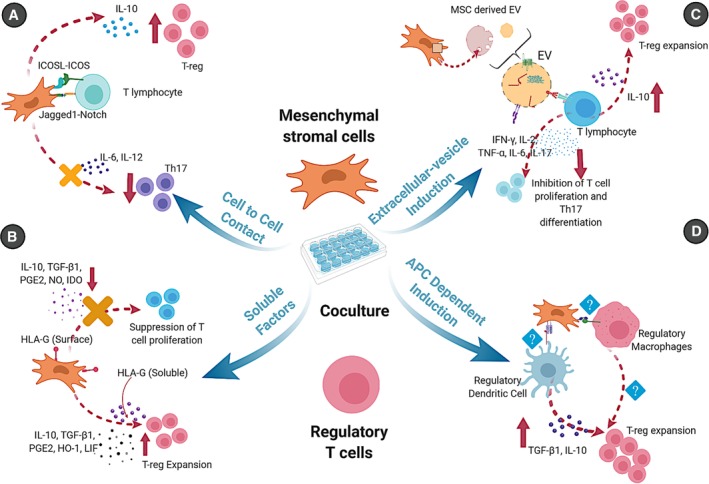
The immunomodulatory potential of mesenchymal stromal cells (MSCs) and regulatory T cells (T-reg) is well recognized by translational scientists in the field of regenerative medicine and cellular therapies. A wide range of preclinical studies as well as a limited number of human clinical trials of MSC therapies have not only shown promising safety and efficacy profiles but have also revealed changes in T-reg frequency and function. However, the mechanisms underlying this potentially important observation are not well understood and, consequently, the optimal strategies for harnessing MSC/T-reg cross-talk remain elusive. Cell-to-cell contact, production of soluble factors, reprogramming of antigen presenting cells to tolerogenic phenotypes, and induction of extracellular vesicles ("exosomes") have emerged as possible mechanisms by which MSCs produce an immune-modulatory milieu for T-reg expansion. Additionally, these two cell types have the potential to complement each other's immunoregulatory functions, and a combinatorial approach may exert synergistic effects for the treatment of immunological diseases. In this review, we critically assess recent translational research related to the outcomes and mechanistic basis of MSC effects on T-reg and provide a perspective on the potential for this knowledge base to be further exploited for the treatment of autoimmune disorders and transplants.
间充质基质细胞(MSCs)和调节性 T 细胞(T-reg)的免疫调节潜能被再生医学和细胞治疗领域的转化科学家所认可。大量的临床前研究以及有限数量的 MSC 治疗的人体临床试验不仅显示了有希望的安全性和疗效概况,还揭示了 T-reg 频率和功能的变化。然而,这种潜在重要观察背后的机制尚不清楚,因此,利用 MSC/T-reg 串扰的最佳策略仍然难以捉摸。细胞间接触、可溶性因子的产生、将抗原呈递细胞重编程为耐受性表型以及诱导细胞外囊泡(“外泌体”)已成为 MSC 产生免疫调节微环境以促进 T-reg 扩增的可能机制。此外,这两种细胞类型有可能互补彼此的免疫调节功能,组合方法可能对治疗免疫性疾病产生协同作用。在这篇综述中,我们批判性地评估了与 MSC 对 T-reg 的作用的结果和机制基础相关的最近的转化研究,并就进一步利用这一知识基础治疗自身免疫性疾病和移植的潜力提供了观点。