Advancing New Standards in Reproductive Health (ANSIRH), Bixby Center for Global Reproductive Health, Department of Obstetrics, Gynecology and Reproductive Sciences, University of California-San Francisco, Oakland, California, United States of America.
Department of Obstetrics, Gynecology and Reproductive Sciences, University of California-San Francisco, San Francisco, California, United States of America.
PLoS One. 2020 Jan 29;15(1):e0226417. doi: 10.1371/journal.pone.0226417. eCollection 2020.
To prospectively assess perceptions of abortion stigma after receiving or being denied an abortion over 5 years, the factors associated with perceived abortion stigma, and the effects of perceived abortion stigma on psychological well-being.
We recruited people seeking abortion from 30 facilities across the US, and interviewed them by phone one week post-abortion seeking, then semiannually for 5 years. We used adjusted mixed effects regression analyses to examine the abortion stigma trajectories of those who obtained an abortion near a facility's gestational age limit (Near-limits) compared to those denied an abortion because they were just over the limit and carried their pregnancies to term (Turnaway-births).
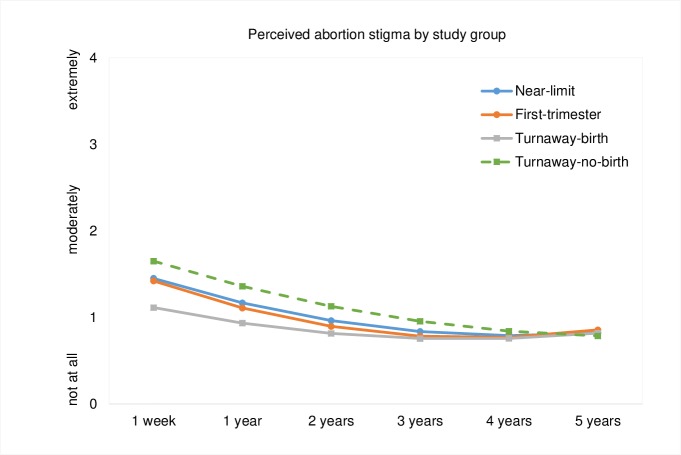
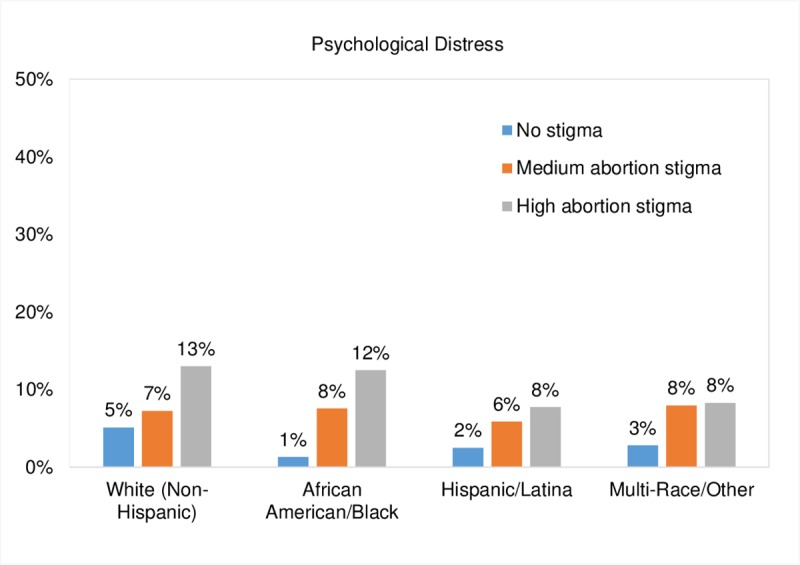
Of the 956 people recruited, we removed 28 due to ineligibility or missing data, leaving a final sample of 928. In unadjusted analyses, at one-week post-abortion seeking, over half of those seeking abortion perceived that if others knew they had sought an abortion, they would be looked down upon at least "a little bit" by people close to them (60%) or by people in their community (56%). In longitudinal adjusted analyses, people denied an abortion and who carried their pregnancies to term (Turnaway-birth group) reported significantly lower baseline perceived abortion stigma from people close to them (-0.38; 95% CI, -0.59, -0.16) and from people in their community (0.30; 95% CI, -0.52, -0.08), than Near-limits, differences that remained statistically significant for 1.5 years. Overall perceived abortion stigma declined significantly (p < .001) for both study groups. High perceived abortion stigma at baseline was associated with higher odds of experiencing psychological distress years later (adjusted Odds Ratio, 3.98; 95% CI, 1.39, 11.37).
Most people considering abortion perceive some abortion stigma, which is associated with psychological distress years later.
前瞻性评估在获得或被拒绝堕胎后 5 年内对堕胎耻辱感的认知,分析与感知堕胎耻辱感相关的因素,以及感知堕胎耻辱感对心理健康的影响。
我们在美国 30 个机构招募了寻求堕胎的人,并在堕胎后一周通过电话对他们进行了访谈,然后每半年进行一次随访,共进行了 5 年。我们使用调整后的混合效应回归分析,比较了在机构妊娠年龄限制附近获得堕胎的人(接近限制组)和因刚刚超过限制而不得不将妊娠继续至足月分娩的人(被拒绝堕胎组)的堕胎耻辱感轨迹。
在 956 名被招募的人中,我们因不符合条件或数据缺失而排除了 28 人,最终的样本量为 928 人。在未调整的分析中,在堕胎后一周寻求帮助时,超过一半的堕胎者认为,如果其他人知道他们曾寻求堕胎,他们会被身边亲近的人(60%)或社区里的人(56%)看不起。在纵向调整分析中,被拒绝堕胎并继续妊娠至足月分娩的人(被拒绝堕胎组)报告称,他们从身边亲近的人(-0.38;95%置信区间,-0.59,-0.16)和社区里的人(0.30;95%置信区间,-0.52,-0.08)那里感知到的堕胎耻辱感明显低于接近限制组,这种差异在 1.5 年内仍具有统计学意义。两组的总体堕胎耻辱感都显著下降(p<0.001)。基线时感知到的堕胎耻辱感越高,几年后经历心理困扰的几率就越高(调整后的优势比,3.98;95%置信区间,1.39,11.37)。
大多数考虑堕胎的人都认为堕胎存在一定程度的耻辱感,而这种耻辱感与几年后出现心理困扰有关。