Amsterdam UMC, University of Amsterdam, Department: Coronel Institute of Occupational Health, Netherlands Center for Occupational Diseases, Amsterdam Public Health research institute, Amsterdam, The Netherlands
Occupational Health Unit and International Centre for Rural Health, ASST of the Saints Paolo and Carlo, Milano, Italy.
Occup Environ Med. 2020 May;77(5):340-343. doi: 10.1136/oemed-2019-106168. Epub 2020 Jan 29.
To estimate the incidence of, trends in and effect of change in reporting rules on occupational diseases (ODs) in the Italian agricultural sector.
Over a 14-year period (2004-2017), ODs among Italian agricultural workers were diagnosed by physicians and reported to the National Institute for Insurance against Workplace Accidents and Occupational Diseases. OD was defined as a disease with a specific clinical diagnosis (International Classification of Diseases) and was predominantly caused by work-related factors. Trends in incidence and effects of changed eligibility criteria for reporting occupational musculoskeletal disorders (MSDs) and noise-induced hearing loss (NIHL) were estimated using a Poisson regression model.
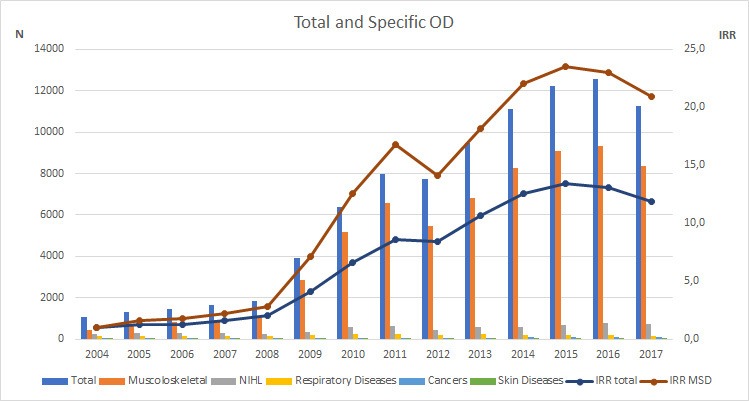
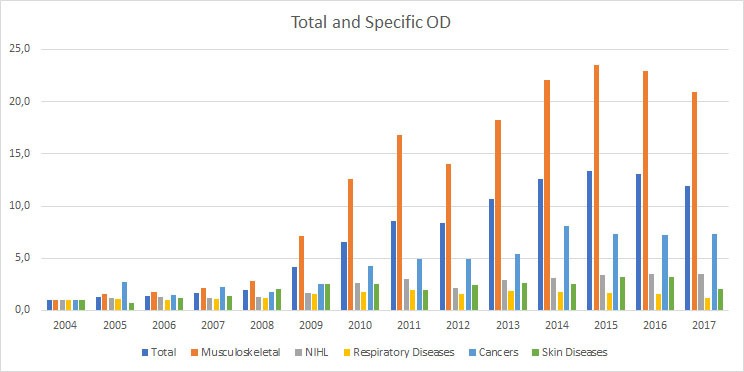
In 2017, the incidence of all ODs was 1295 per 100 000 agricultural workers. MSDs (961 per 100 000 workers) were the most frequently occurring ODs. MSDs and NIHL showed statistically significant increasing time trends, 26% and 7% annual increase, respectively, during the 2004-2017 period. There was no statistically significant change in the incidence of occupational respiratory, skin and cancer diseases during the 14-year period. After changes in reporting rules, the incidence of MSDs showed an immediate increased effect, with an incidence rate ratio (IRR) of 2.9 (95% CI 2.65 to 3.14) and a significant annual decreasing trend of -9% (95% CI -6% to -12%) over the years after the changed reporting rules (from 2008 to 2017), and an immediate effect on NIHL with an IRR of 1.3 (95% CI 1.13 to 1.53).
In total, 1.3% of the Italian agricultural workers were diagnosed in 2017 as having an OD. Over a 14-year period, the annual incidence of ODs showed a considerable increasing trend consistent with changed eligibility reporting criteria for occupational MSDs and to a lesser extent for NIHL.
评估意大利农业部门职业病(ODs)报告规则的发病率、变化趋势和变化效果。
在 14 年期间(2004-2017 年),意大利农业工人的 ODs 由医生诊断并向国家工伤保险和职业病研究所报告。OD 定义为具有特定临床诊断(国际疾病分类)的疾病,主要由与工作相关的因素引起。使用泊松回归模型估计职业肌肉骨骼疾病(MSD)和噪声性听力损失(NIHL)报告资格标准变化的发病率趋势和影响。
2017 年,所有 ODs 的发病率为每 100000 名农业工人 1295 例。MSD(每 100000 名工人 961 例)是最常见的 ODs。MSD 和 NIHL 呈统计学显著的逐年上升趋势,2004-2017 年期间分别为 26%和 7%的年增长率。14 年间,职业性呼吸道、皮肤和癌症疾病的发病率无统计学显著变化。报告规则更改后,MSD 的发病率立即显示出增加的效果,发病率比(IRR)为 2.9(95%置信区间 2.65 至 3.14),并且在更改报告规则后的几年中(从 2008 年至 2017 年),每年呈显著下降趋势-9%(95%置信区间-6%至-12%),NIHL 也有立即的影响,IRR 为 1.3(95%置信区间 1.13 至 1.53)。
总的来说,2017 年有 1.3%的意大利农业工人被诊断患有 ODs。在 14 年期间,ODs 的年发病率呈相当大的上升趋势,与职业性 MSD 和在较小程度上与 NIHL 的报告资格标准变化一致。