Fernández-Albarral Jose A, de Hoz Rosa, Ramírez Ana I, López-Cuenca Inés, Salobrar-García Elena, Pinazo-Durán María D, Ramírez José M, Salazar Juan J
Instituto de Investigaciones Oftalmológicas Ramón Castroviejo, Madrid, Spain.
Instituto de Investigaciones Oftalmológicas Ramón Castroviejo; Departamento de Inmunología, Oftalmología y ORL, Facultad de Óptica y Optometría, Madrid, Spain.
Neural Regen Res. 2020 Aug;15(8):1408-1416. doi: 10.4103/1673-5374.274325.
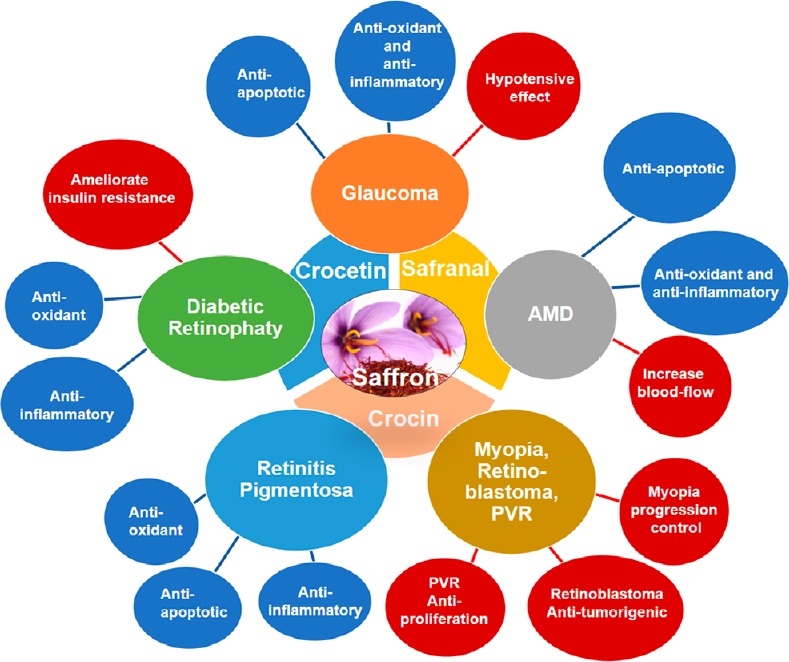
Saffron (Crocus sativus L.) has been traditionally used in food preparation and as a medicinal plant. It currently has numerous therapeutic properties attributed to it, such as protection against ischemia, as well as anticonvulsant, antidepressant, anxiolytic, hypolipidemic, anti-atherogenic, anti-hypertensive, antidiabetic, and anti-cancer properties. In addition, saffron has remarkable beneficial properties, such as anti-apoptotic, anti-inflammatory and antioxidant activities, due to its main metabolites, among which crocin and crocetin stand out. Furthermore, increasing evidence underwrites the possible neuroprotective role of the main bioactive saffron constituents in neurodegenerative diseases, such as Parkinson's and Alzheimer's diseases, both in experimental models and in clinical studies in patients. Currently, saffron supplementation is being tested for ocular neurodegenerative pathologies, such as diabetic retinopathy, retinitis pigmentosa, age-related macular degeneration and glaucoma, among others, and shows beneficial effects. The present article provides a comprehensive and up to date report of the investigations on the beneficial effects of saffron extracts on the main neurodegenerative ocular pathologies and other ocular diseases. This review showed that saffron extracts could be considered promising therapeutic agents to help in the treatment of ocular neurodegenerative diseases.
藏红花(番红花)传统上用于食品制作,并作为药用植物。目前人们认为它具有多种治疗特性,如预防局部缺血,以及抗惊厥、抗抑郁、抗焦虑、降血脂、抗动脉粥样硬化、抗高血压、抗糖尿病和抗癌特性。此外,由于其主要代谢产物,藏红花具有显著的有益特性,如抗凋亡、抗炎和抗氧化活性,其中番红花苷和西红花酸最为突出。此外,越来越多的证据支持藏红花主要生物活性成分在神经退行性疾病(如帕金森病和阿尔茨海默病)的实验模型和患者临床研究中可能具有神经保护作用。目前,正在对藏红花补充剂治疗眼部神经退行性病变(如糖尿病性视网膜病变、色素性视网膜炎、年龄相关性黄斑变性和青光眼等)进行测试,并显示出有益效果。本文全面且最新地报道了藏红花提取物对主要眼部神经退行性病变和其他眼部疾病有益作用的研究情况。该综述表明,藏红花提取物可被视为有望用于治疗眼部神经退行性疾病的治疗药物。