Fan Shengyu, Bian Yueyan, Chen Hao, Kang Yan, Yang Qi, Tan Tao
School of Sino-Dutch Biomedical and Information Engineering, Northeastern University, Shenyang, China.
Neusoft Research of Intelligent Healthcare Technology, Co. Ltd., Shenyang, China.
Front Neuroinform. 2020 Jan 10;13:77. doi: 10.3389/fninf.2019.00077. eCollection 2019.
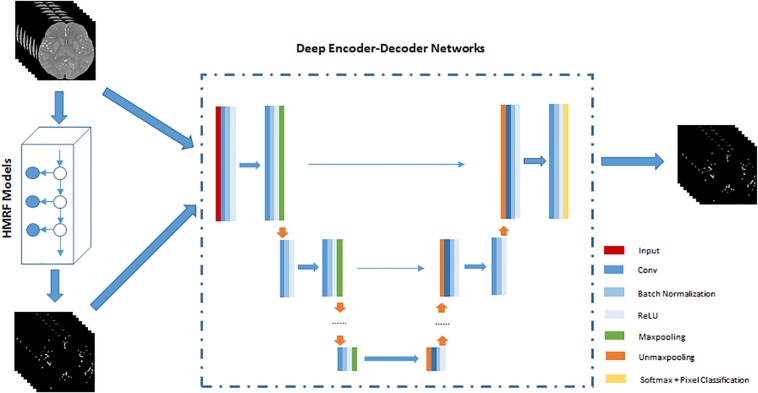
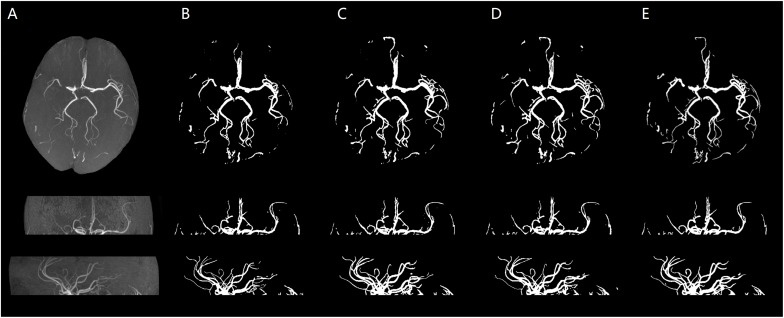
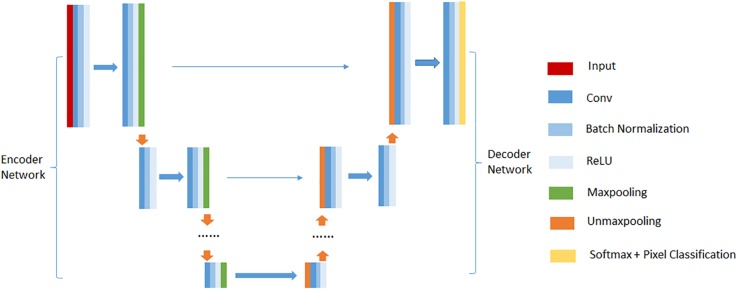
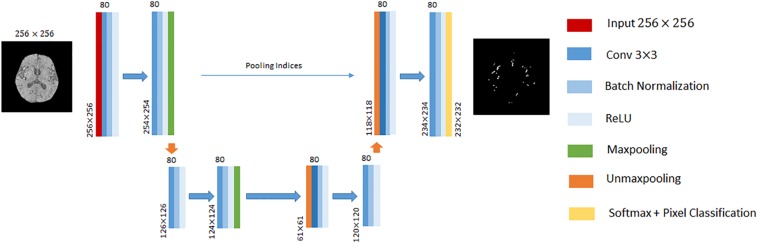
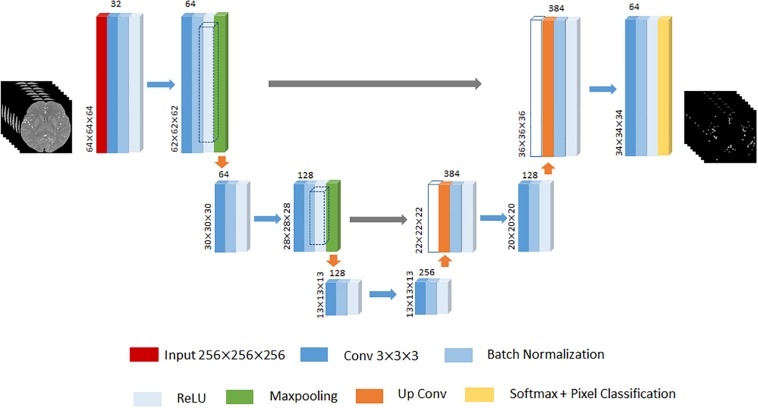
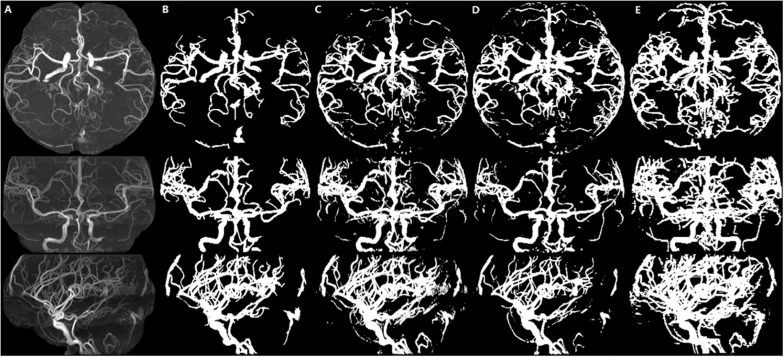
Automated cerebrovascular segmentation of time-of-flight magnetic resonance angiography (TOF-MRA) images is an important technique, which can be used to diagnose abnormalities in the cerebrovascular system, such as vascular stenosis and malformation. Automated cerebrovascular segmentation can direct show the shape, direction and distribution of blood vessels. Although deep neural network (DNN)-based cerebrovascular segmentation methods have shown to yield outstanding performance, they are limited by their dependence on huge training dataset. In this paper, we propose an unsupervised cerebrovascular segmentation method of TOF-MRA images based on DNN and hidden Markov random field (HMRF) model. Our DNN-based cerebrovascular segmentation model is trained by the labeling of HMRF rather than manual annotations. The proposed method was trained and tested using 100 TOF-MRA images. The results were evaluated using the dice similarity coefficient (DSC), which reached a value of 0.79. The trained model achieved better performance than that of the traditional HMRF-based cerebrovascular segmentation method in binary pixel-classification. This paper combines the advantages of both DNN and HMRF to train the model with a not so large amount of the annotations in deep learning, which leads to a more effective cerebrovascular segmentation method.
自动分割时间飞跃磁共振血管造影(TOF-MRA)图像中的脑血管是一项重要技术,可用于诊断脑血管系统异常,如血管狭窄和畸形。自动脑血管分割可以直接显示血管的形状、走向和分布。尽管基于深度神经网络(DNN)的脑血管分割方法已显示出卓越性能,但它们受到对大量训练数据集依赖的限制。在本文中,我们提出了一种基于DNN和隐马尔可夫随机场(HMRF)模型的TOF-MRA图像无监督脑血管分割方法。我们基于DNN的脑血管分割模型是通过HMRF的标记而非人工标注进行训练的。所提出的方法使用100张TOF-MRA图像进行训练和测试。结果使用骰子相似系数(DSC)进行评估,其值达到0.79。在二元像素分类中,训练后的模型比传统基于HMRF的脑血管分割方法具有更好的性能。本文结合了DNN和HMRF的优点,在深度学习中使用数量不那么大的标注来训练模型,从而产生了一种更有效的脑血管分割方法。