Kang Dingrong, Jacquiod Samuel, Herschend Jakob, Wei Shaodong, Nesme Joseph, Sørensen Søren J
Section of Microbiology, Department of Biology, University of Copenhagen, Copenhagen, Denmark.
Agroécologie, AgroSup Dijon, INRAE Centre Dijon, Université de Bourgogne, Université de Bourgogne Franche-Comté, Besançon, France.
Front Microbiol. 2020 Jan 10;10:3010. doi: 10.3389/fmicb.2019.03010. eCollection 2019.
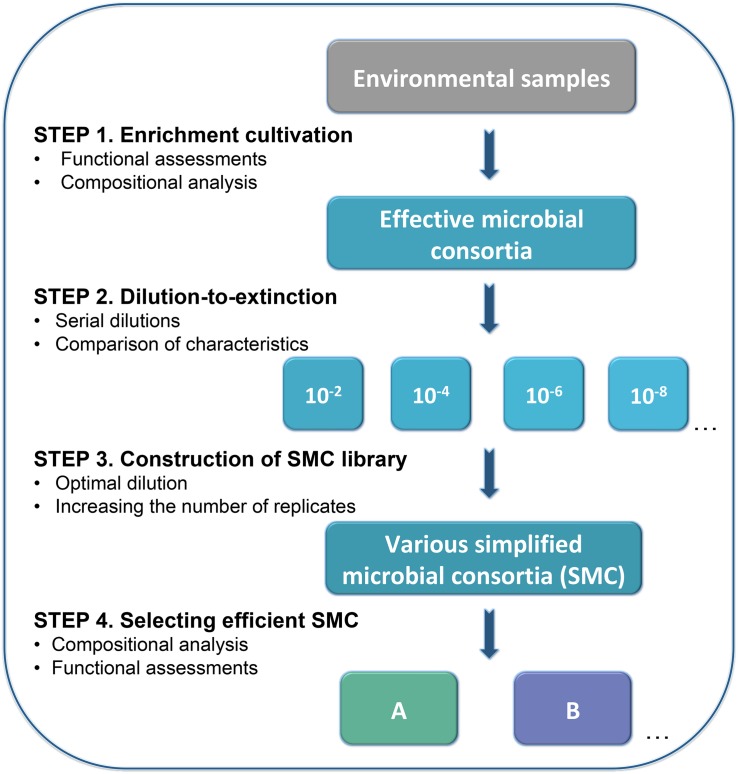
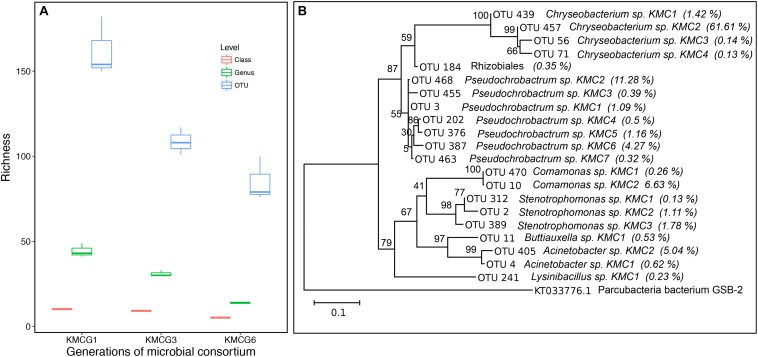
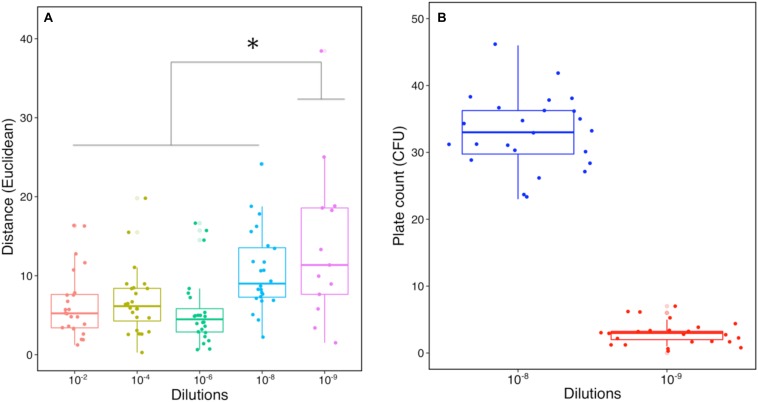
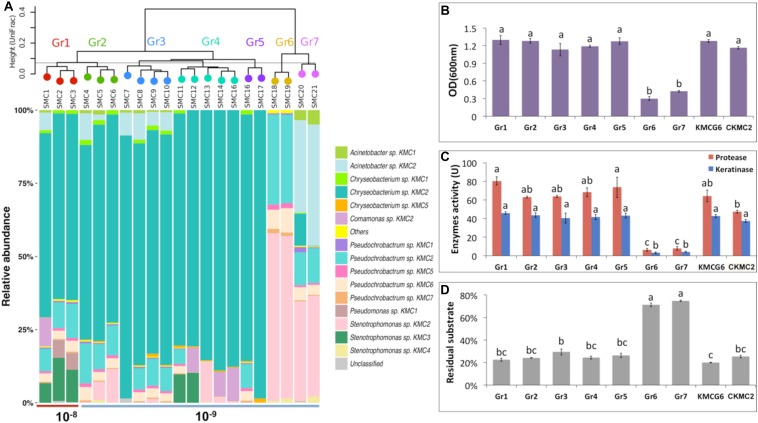
The capacity of microbes to degrade recalcitrant materials has been extensively explored for environmental remediation and industrial production. Significant achievements have been made with single strains, but focus is now going toward the use of microbial consortia owning to their functional stability and efficiency. However, assembly of simplified microbial consortia (SMC) from complex environmental communities is still far from trivial due to large diversity and the effect of biotic interactions. Here we propose a strategy, based on enrichment and dilution-to-extinction cultures, to construct SMC with reduced diversity for degradation of keratinous materials. Serial dilutions were performed on a keratinolytic microbial consortium pre-enriched from a soil sample, monitoring the dilution effect on community growth and enzymatic activities. An appropriate dilution regime (10) was selected to construct a SMC library from the enriched microbial consortium. Further sequencing analysis and keratinolytic activity assays demonstrated that obtained SMC displayed actual reduced microbial diversity, together with various taxonomic composition, and biodegradation capabilities. More importantly, several SMC possessed equivalent levels of keratinolytic efficiency compared to the initial consortium, showing that simplification can be achieved without loss of function and efficiency. This methodology is also applicable to other types of recalcitrant material degradation involving microbial consortia, thus considerably broadening its application scope.
微生物降解难降解物质的能力已在环境修复和工业生产中得到广泛探索。单菌株已取得显著成果,但由于其功能稳定性和效率,目前的重点正转向使用微生物群落。然而,由于复杂环境群落的多样性巨大以及生物相互作用的影响,从复杂环境群落中组装简化微生物群落(SMC)仍然并非易事。在此,我们提出一种基于富集和稀释至灭绝培养的策略,以构建多样性降低的 SMC 用于角蛋白类物质的降解。对从土壤样品中预富集的角蛋白分解微生物群落进行连续稀释,监测稀释对群落生长和酶活性的影响。选择合适的稀释方案(10 倍)从富集的微生物群落构建 SMC 文库。进一步的测序分析和角蛋白分解活性测定表明,获得的 SMC 显示出实际降低的微生物多样性、不同的分类组成以及生物降解能力。更重要的是,与初始群落相比,几个 SMC 具有同等水平的角蛋白分解效率,表明在不损失功能和效率的情况下可以实现简化。该方法也适用于涉及微生物群落的其他类型难降解物质降解,从而大大拓宽了其应用范围。