Serrano-Benítez Almudena, Cortés-Ledesma Felipe, Ruiz Jose F
Andalusian Center of Molecular Biology and Regenerative Medicine (CABIMER-CSIC-University of Seville-Pablo de Olavide University), Seville, Spain.
Topology and DNA breaks Group, Spanish National Cancer Research Center, Madrid, Spain.
Front Mol Biosci. 2020 Jan 10;6:153. doi: 10.3389/fmolb.2019.00153. eCollection 2019.
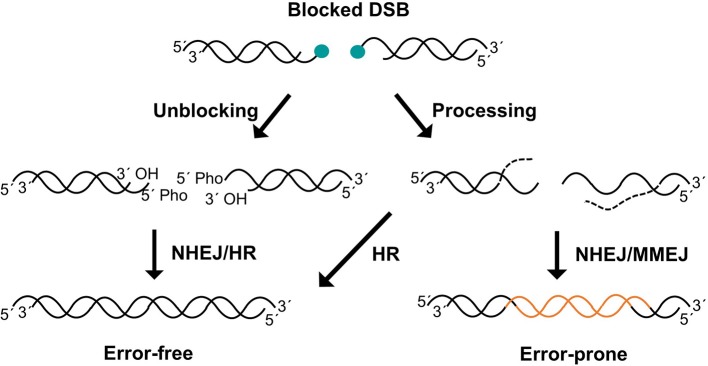
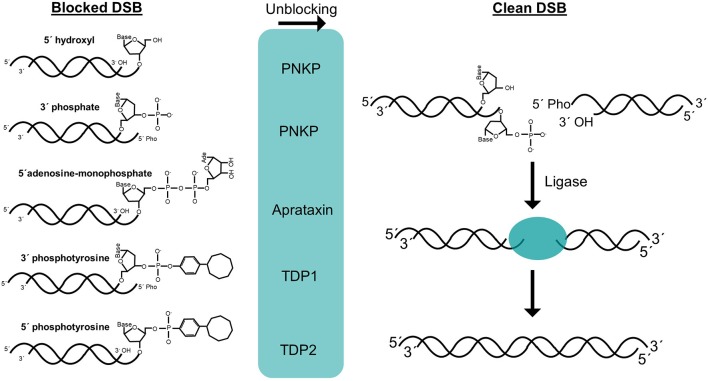
Endogenously-arising DNA double-strand breaks (DSBs) rarely harbor canonical 5'-phosphate, 3'-hydroxyl moieties at the ends, which are, regardless of the pathway used, ultimately required for their repair. Cells are therefore endowed with a wide variety of enzymes that can deal with these chemical and structural variations and guarantee the formation of ligatable termini. An important distinction is whether the ends are directly "unblocked" by specific enzymatic activities without affecting the integrity of the DNA molecule and its sequence, or whether they are "processed" by unspecific nucleases that remove nucleotides from the termini. DNA end structure and configuration, therefore, shape the repair process, its requirements, and, importantly, its final outcome. Thus, the molecular mechanisms that coordinate and integrate the cellular response to blocked DSBs, although still largely unexplored, can be particularly relevant for maintaining genome integrity and avoiding malignant transformation and cancer.
内源性产生的DNA双链断裂(DSB)在末端很少带有典型的5'-磷酸、3'-羟基基团,而无论使用何种途径进行修复,这些基团最终都是修复所必需的。因此,细胞拥有多种酶,这些酶可以处理这些化学和结构变异,并确保形成可连接的末端。一个重要的区别在于,末端是通过特定酶活性直接“解除阻碍”而不影响DNA分子及其序列的完整性,还是通过从末端去除核苷酸的非特异性核酸酶进行“加工”。因此,DNA末端结构和构型决定了修复过程、其需求,以及重要的是,其最终结果。因此,尽管在很大程度上仍未被探索,但协调和整合细胞对受阻DSB反应的分子机制,对于维持基因组完整性以及避免恶性转化和癌症可能特别重要。