Li Wenyuan, Guo Jing, Shen Yifeng, Huang Ling, Leng Bingshuang, Fan Dong, Shui Liyao, Chen Chongli
Hospital of Chengdu University of Traditional Chinese Medicine, Chengdu, Sichuan Province.
Beijing University of Chinese Medicine, Beijing, P.R. China.
Medicine (Baltimore). 2020 Jan;99(5):e18608. doi: 10.1097/MD.0000000000018608.
The number of dementia patients in the world is large, and the number of dementia patients will continue to rise in the future, which will bring a heavy social and economic burden. No interventions have been found to cure dementia. Medication can delay the progression of the disease and impose an economic burden. Some non-drug therapies often require the care of the caregiver. Probiotics, prebiotics, and synbiotics may intervene in dementia through microbiota-gut-brain axis (MGBA). However, their effectiveness and safety are still obscure and deserve further investigation. The purpose of this study is to assess the effect and safety of probiotics, prebiotics, and synbiotics in treating dementia.
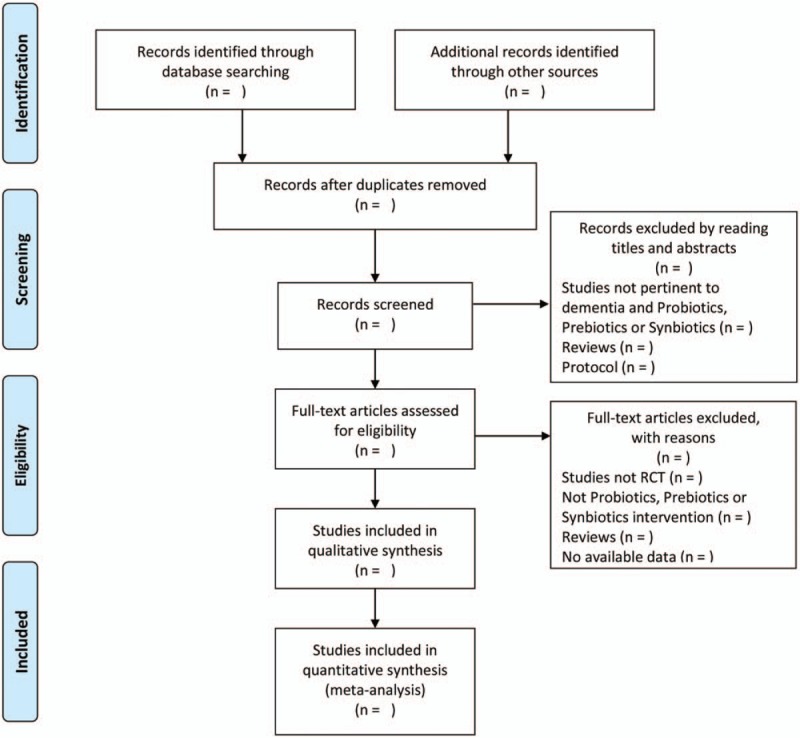
We will summarize and meta-analyze randomized controlled trials (RCTs) of probiotics, prebiotics, and synbiotics for the treatment of dementia. RCTs comparing probiotics, prebiotics, and synbiotics with blank control, placebo or conventional therapies will be included. RCTs comparing probiotics, prebiotics, and synbiotics plus conventional therapies with conventional therapies alone will also be included. The following electronic databases will be searched: PubMed, Cochrane Library, EMBASE, CNKI, CBM, VIP, and WAN FANG DATA. The methodological quality of RCTs will be assessed using the Cochrane risk assessment tool. All trials included will be analyzed according to the criteria of the Cochrane Handbook. Review Manager 5.3, R-3.5.1 software will be used for publication bias analysis. Grading of Recommendations Assessment, Development and Evaluation (GRADE) pro-GDT web solution will be used for evidence evaluation.
This review will evaluate the effects of probiotics, prebiotics, and synbiotics on cognitive function, behavioral and psychological symptoms of dementia, quality of life (QOL), functional performance in activities of daily living, and compliance with the intervention and safety in patients with dementia.
This review will provide clear evidence to assess the effectiveness and safety of probiotics, prebiotics, and synbiotics for dementia.OSF registration number: DOI 10.17605/OSF.IO/2Q3AK.
全球痴呆症患者数量众多,且未来痴呆症患者数量将持续上升,这将带来沉重的社会和经济负担。尚未发现有干预措施可治愈痴呆症。药物治疗可延缓疾病进展,但会带来经济负担。一些非药物疗法通常需要护理人员的照顾。益生菌、益生元及合生元可能通过微生物群-肠-脑轴(MGBA)干预痴呆症。然而,它们的有效性和安全性仍不明确,值得进一步研究。本研究旨在评估益生菌、益生元及合生元治疗痴呆症的效果和安全性。
我们将对益生菌、益生元及合生元治疗痴呆症的随机对照试验(RCT)进行总结和荟萃分析。将纳入比较益生菌、益生元及合生元与空白对照、安慰剂或传统疗法的RCT。还将纳入比较益生菌、益生元及合生元联合传统疗法与单纯传统疗法的RCT。将检索以下电子数据库:PubMed、Cochrane图书馆、EMBASE、中国知网、中国生物医学文献数据库、维普资讯和万方数据。将使用Cochrane风险评估工具评估RCT的方法学质量。所有纳入的试验将根据Cochrane手册的标准进行分析。将使用Review Manager 5.3、R-3.5.1软件进行发表偏倚分析。将使用推荐分级评估、制定与评价(GRADE)专业GDT网络解决方案进行证据评估。
本综述将评估益生菌、益生元及合生元对痴呆症患者认知功能、行为和心理症状、生活质量(QOL)、日常生活活动功能表现、干预依从性及安全性的影响。
本综述将为评估益生菌、益生元及合生元治疗痴呆症的有效性和安全性提供明确证据。开放科学框架(OSF)注册号:DOI 10.17605/OSF.IO/2Q3AK。