Harvard Medical School, Boston, MA 02115, USA; Biophysics Program, Harvard University, Boston, MA 02115, USA.
Structural Biology, Genentech, South San Francisco, CA, USA.
Structure. 2020 Mar 3;28(3):363-370.e3. doi: 10.1016/j.str.2019.12.002. Epub 2020 Jan 30.
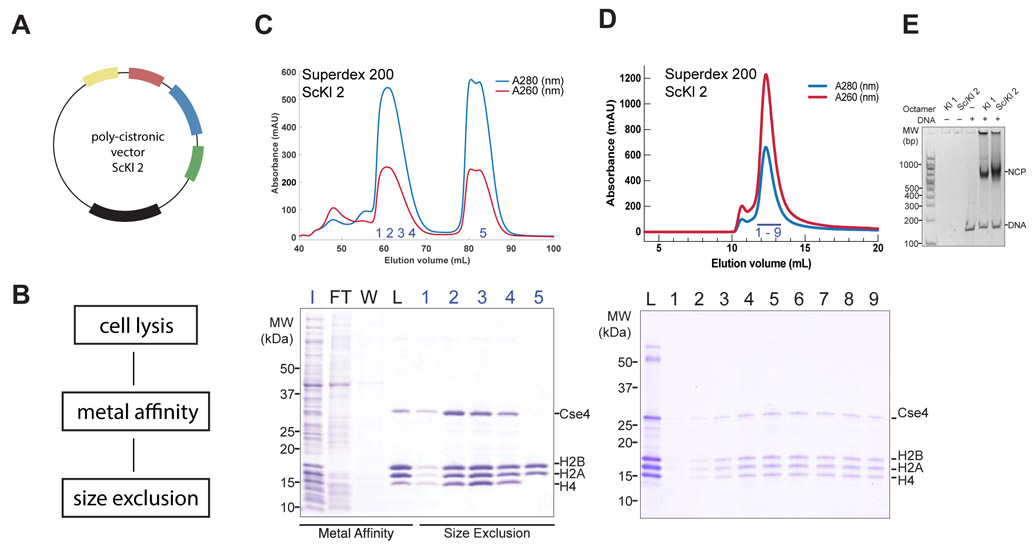
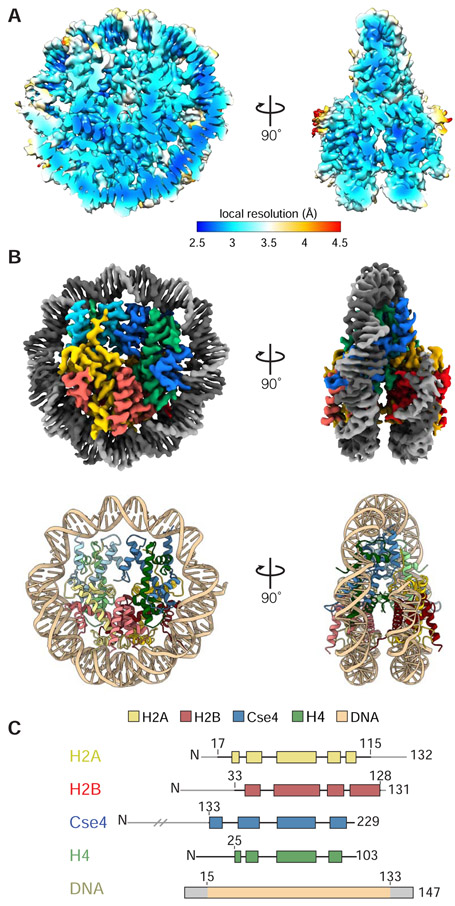
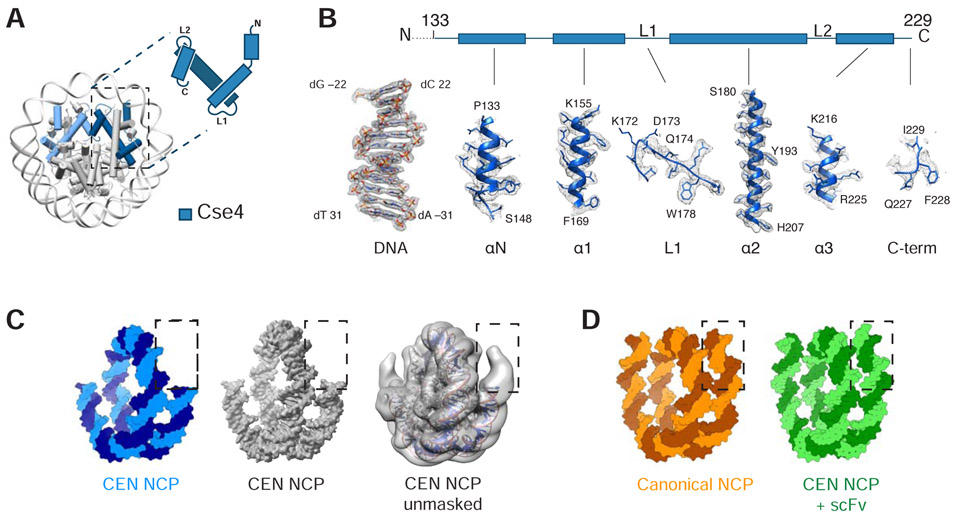
Kinetochores mediate chromosome segregation during cell division. They assemble on centromeric nucleosomes and capture spindle microtubules. In budding yeast, a kinetochore links a single nucleosome, containing the histone variant Cse4 instead of H3, with a single microtubule. Conservation of most kinetochore components from yeast to metazoans suggests that the yeast kinetochore represents a module of the more complex metazoan arrangements. We describe here a streamlined protocol for reconstituting a yeast centromeric nucleosome and a systematic exploration of cryo-grid preparation. These developments allowed us to obtain a high-resolution cryoelectron microscopy reconstruction. As suggested by previous work, fewer base pairs are in tight association with the histone octamer than there are in canonical nucleosomes. Weak binding of the end DNA sequences may contribute to specific recognition by other inner kinetochore components. The centromeric nucleosome structure and the strategies we describe will facilitate studies of many other aspects of kinetochore assembly and chromatin biochemistry.
着丝粒在细胞分裂过程中介导染色体分离。它们组装在着丝粒核小体上,并捕获纺锤体微管。在芽殖酵母中,一个着丝粒将一个包含组蛋白变体 Cse4 而不是 H3 的单个核小体与单个微管连接起来。从酵母到后生动物的大多数着丝粒成分的保守性表明,酵母着丝粒代表更复杂的后生动物排列的一个模块。我们在这里描述了一种简化的方案,用于重新组装酵母着丝粒核小体,并对低温网格制备进行了系统的探索。这些发展使我们能够获得高分辨率的 cryo-electron microscopy 重建。正如之前的工作所表明的,与经典核小体相比,与组蛋白八聚体紧密结合的碱基对更少。末端 DNA 序列的弱结合可能有助于其他内着丝粒成分的特异性识别。着丝粒核小体结构和我们描述的策略将有助于研究着丝粒组装和染色质生物化学的许多其他方面。