Grup de Genòmica, Bioinformàtica i Biologia Evolutiva (GGBE), Departament de Genètica i de Microbiologia, Universitat Autònoma de Barcelona, Bellaterra, 08193, Barcelona, Spain.
BMC Evol Biol. 2020 Jan 31;20(1):17. doi: 10.1186/s12862-020-1584-z.
Drosophila subobscura exhibits a rich inversion polymorphism, with some adaptive inversions showing repeatable spatiotemporal patterns in frequencies related to temperature. Previous studies reported increased basal HSP70 protein levels in homokaryotypic strains for a warm-climate arrangement compared to a cold-climate one. These findings do not match the similar hsp70 genomic organization between arrangements, where gene expression levels are expected to be similar. In order to test this hypothesis and understand the molecular basis for hsp70 expression, we compared basal hsp70 mRNA levels in males and females, and analysed the 5' and 3' regulatory regions of hsp70 genes in warm- and cold-climate isochromosomal O and O lines of D. subobscura.
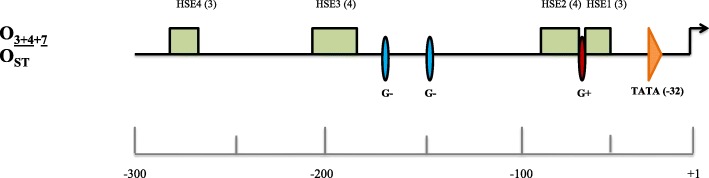
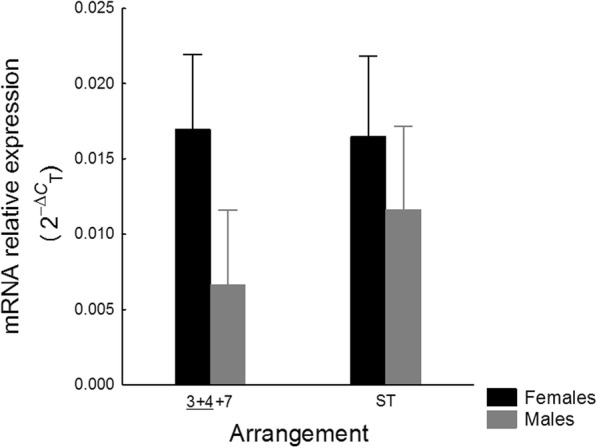
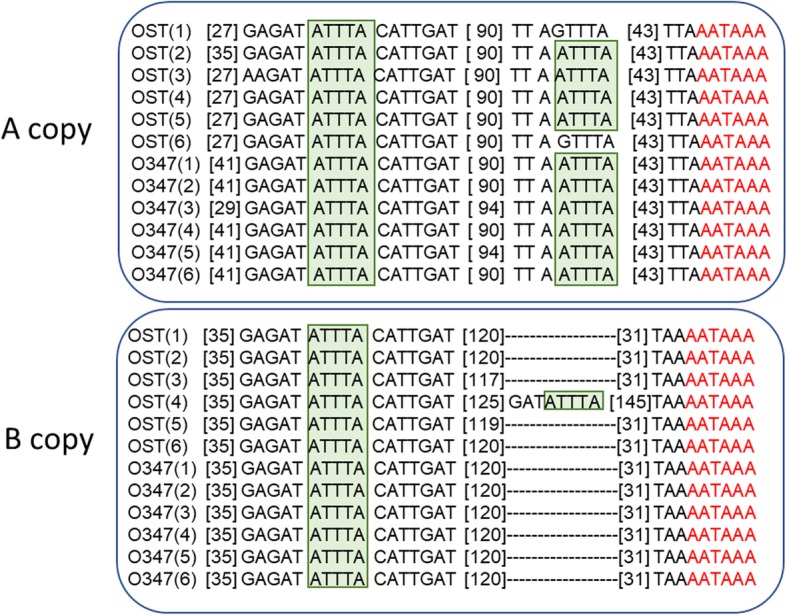
We observed comparable mRNA levels between the two arrangements and a sex-biased hsp70 gene expression. The number of heat-shock elements (HSEs) and GAGA sites on the promoters were identical amongst the O and O lines analysed. This is also true for 3' AU-rich elements where most A and B copies of hsp70 have, respectively, two and one element in both arrangements. Beyond the regulatory elements, the only notable difference between both arrangements is the presence in 3' UTR of a 14 bp additional fragment after the stop codon in the hsp70A copy in five O lines, which was not found in any of the six O lines.
The equivalent hsp70 mRNA amounts in O and O arrangements provide the first evidence of a parallelism between gene expression and genetic organization in D. subobscura lines having these arrangements. This is reinforced by the lack of important differential features in the number and structure of regulatory elements between both arrangements, despite the genetic differentiation observed when the complete 5' and 3' regulatory regions were considered. Therefore, the basal levels of hsp70 mRNA cannot account, in principle, for the adaptive variation of the two arrangements studied. Consequently, further studies are necessary to understand the intricate molecular mechanisms of hsp70 gene regulation in D. subobscura.
黑腹果蝇表现出丰富的倒位多态性,一些适应性倒位在与温度相关的频率上呈现可重复的时空模式。先前的研究报道,与冷气候排列相比,温暖气候排列的同核型菌株中基础 HSP70 蛋白水平升高。这些发现与排列之间相似的 hsp70 基因组组织不匹配,预计基因表达水平相似。为了检验这一假设并了解 hsp70 表达的分子基础,我们比较了雌雄蝇的基础 hsp70 mRNA 水平,并分析了黑腹果蝇温暖和寒冷气候等染色体 O 和 O 系中 hsp70 基因的 5'和 3'调控区。
我们观察到两种排列之间的 mRNA 水平相当,并且 hsp70 基因表达存在性别偏倚。在所分析的 O 和 O 系中,启动子上的热休克元件 (HSE) 和 GAGA 位点数量相同。在 hsp70 的 3' AU 丰富元件中也是如此,大多数 hsp70 的 A 和 B 拷贝分别在两种排列中有两个和一个元件。除了调控元件之外,两种排列之间唯一值得注意的区别是,在 hsp70A 拷贝的 3'UTR 中,在五个 O 系中有一个 14bp 的额外片段在终止密码子之后,但在六个 O 系中均未发现。
O 和 O 排列中相当的 hsp70 mRNA 量为这些排列的黑腹果蝇系中基因表达与遗传组织之间的平行性提供了第一个证据。这一点得到了强化,尽管考虑到完整的 5'和 3'调控区时观察到遗传分化,但在两种排列之间的调控元件数量和结构方面缺乏重要的差异特征。因此,hsp70 mRNA 的基础水平原则上不能解释所研究的两种排列的适应性变化。因此,需要进一步研究以了解黑腹果蝇中 hsp70 基因调控的复杂分子机制。