Eck Institute for Global Health, Dept. of Biological Sciences, University of Notre Dame, Notre Dame, IN, USA.
Molecular, Cell, and Systems Biology Department, University of California Riverside, Riverside, CA, USA.
Malar J. 2020 Jan 31;19(1):54. doi: 10.1186/s12936-020-3139-6.
Tracking and understanding artemisinin resistance is key for preventing global setbacks in malaria eradication efforts. The ring-stage survival assay (RSA) is the current gold standard for in vitro artemisinin resistance phenotyping. However, the RSA has several drawbacks: it is relatively low throughput, has high variance due to microscopy readout, and correlates poorly with the current benchmark for in vivo resistance, patient clearance half-life post-artemisinin treatment. Here a modified RSA is presented, the extended Recovery Ring-stage Survival Assay (eRRSA), using 15 cloned patient isolates from Southeast Asia with a range of patient clearance half-lives, including parasite isolates with and without kelch13 mutations.
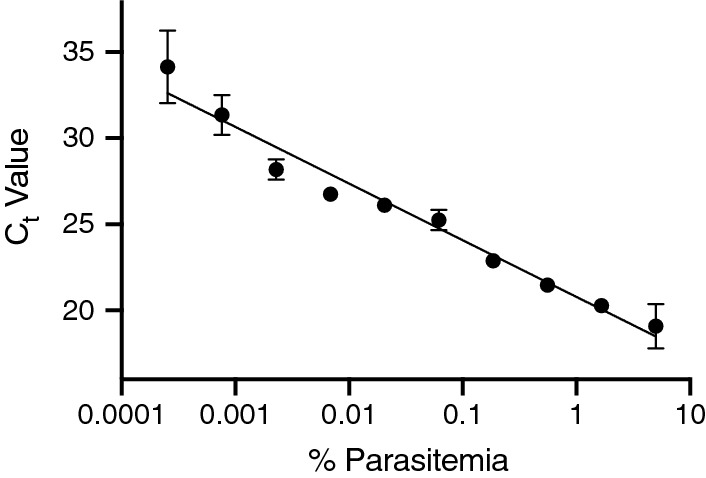
Plasmodium falciparum cultures were synchronized with single layer Percoll during the schizont stage of the intraerythrocytic development cycle. Cultures were left to reinvade to early ring-stage and parasitaemia was quantified using flow cytometry. Cultures were diluted to 2% haematocrit and 0.5% parasitaemia in a 96-well plate to start the assay, allowing for increased throughput and decreased variability between biological replicates. Parasites were treated with 700 nM of dihydroartemisinin or 0.02% dimethyl sulfoxide (DMSO) for 6 h, washed three times in drug-free media, and incubated for 66 or 114 h, when samples were collected and frozen for PCR amplification. A SYBR Green-based quantitative PCR method was used to quantify the fold-change between treated and untreated samples.
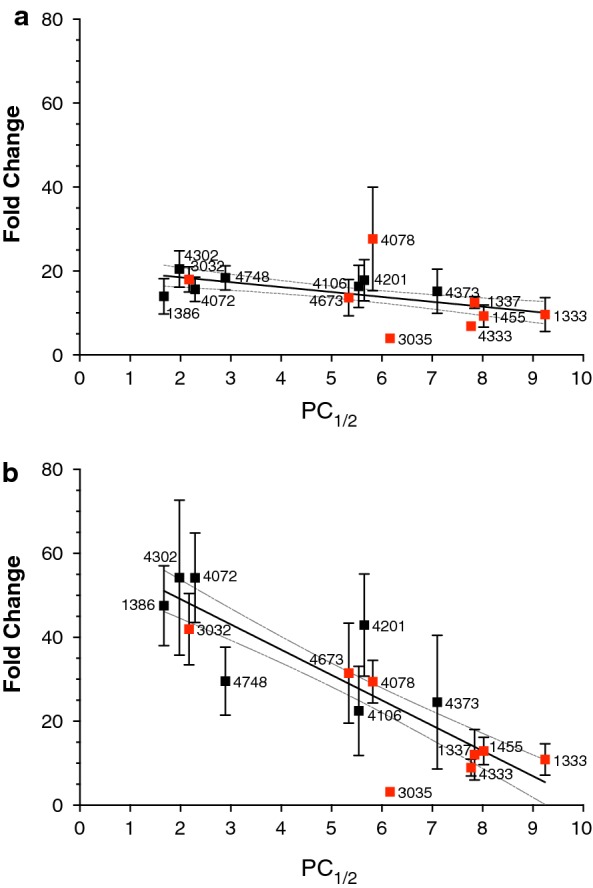
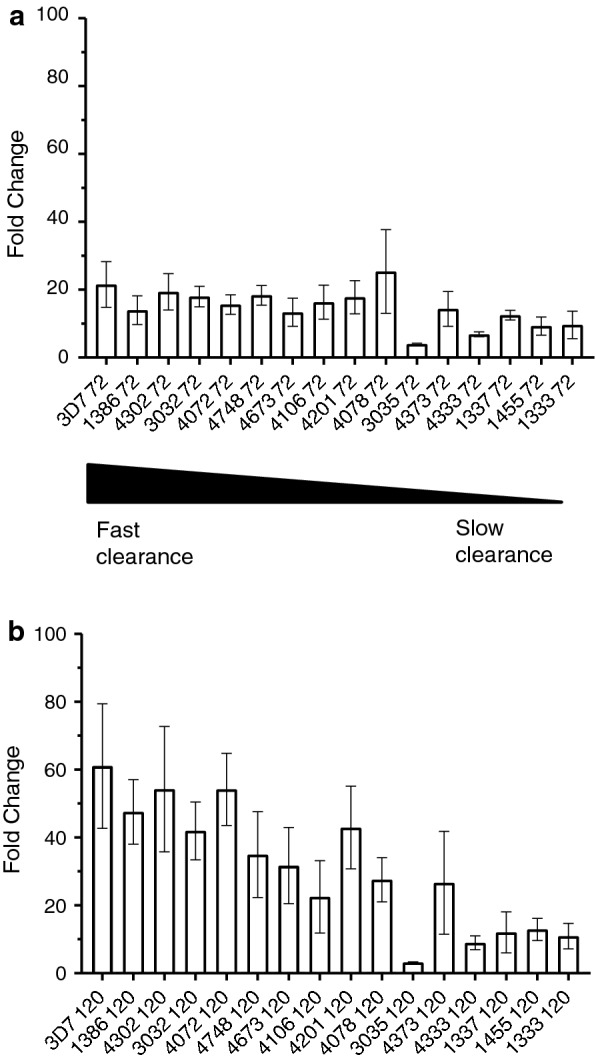
15 cloned patient isolates from Southeast Asia with a range of patient clearance half-lives were assayed using the eRRSA. Due to the large number of pyknotic and dying parasites at 66 h post-exposure (72 h sample), parasites were grown for an additional cell cycle (114 h post-exposure, 120 h sample), which drastically improved correlation with patient clearance half-life compared to the 66 h post-exposure sample. A Spearman correlation of - 0.8393 between fold change and patient clearance half-life was identified in these 15 isolates from Southeast Asia, which is the strongest correlation reported to date.
eRRSA drastically increases the efficiency and accuracy of in vitro artemisinin resistance phenotyping compared to the traditional RSA, which paves the way for extensive in vitro phenotyping of hundreds of artemisinin resistant parasites.
跟踪和了解青蒿素耐药性对于防止全球消除疟疾工作的倒退至关重要。环体生存检测(RSA)是目前体外青蒿素耐药表型检测的金标准。然而,RSA 存在几个缺点:它的通量相对较低,由于显微镜读数而存在较大的差异,并且与当前体内耐药性的基准(青蒿素治疗后患者清除半衰期)相关性较差。这里提出了一种改良的 RSA,即扩展的恢复环体生存检测(eRRSA),使用来自东南亚的 15 个克隆患者分离株,这些分离株具有不同的患者清除半衰期,包括具有和不具有 kelch13 突变的寄生虫分离株。
在红细胞内发育周期的裂殖体阶段,用单层 Percoll 对疟原虫培养物进行同步化。让培养物重新侵入早期环体阶段,并使用流式细胞术定量寄生虫血症。将培养物稀释至 2%的红细胞压积和 0.5%的寄生虫血症,在 96 孔板中开始检测,从而提高了通量并降低了生物重复之间的变异性。用 700 nM 的双氢青蒿素或 0.02%的二甲亚砜(DMSO)处理寄生虫 6 小时,用无药物的培养基洗涤三次,然后孵育 66 或 114 小时,此时收集样本并冷冻用于 PCR 扩增。使用 SYBR Green 定量 PCR 方法来定量处理和未处理样本之间的倍差。
使用 eRRSA 对来自东南亚的 15 个具有不同患者清除半衰期的克隆患者分离株进行了检测。由于在暴露后 66 小时(72 小时样本)有大量固缩和死亡的寄生虫,因此将寄生虫再培养一个细胞周期(暴露后 114 小时,120 小时样本),这与患者清除半衰期的相关性比 66 小时后暴露的样本有了明显的提高。在来自东南亚的这 15 个分离株中,fold change 和患者清除半衰期之间的 Spearman 相关系数为-0.8393,这是迄今为止报道的最强相关性。
与传统的 RSA 相比,eRRSA 大大提高了体外青蒿素耐药表型检测的效率和准确性,为广泛进行数百种青蒿素耐药寄生虫的体外表型检测铺平了道路。