Ataíde Ricardo, Powell Rosanna, Moore Kerryn, McLean Alistair, Phyo Aung Pyae, Nair Shalini, White Marina, Anderson Tim J, Beeson James G, Simpson Julie A, Nosten Francois, Fowkes Freya J I
Disease Elimination Program, Burnet Institute.
Shoklo Malaria Research Unit, Mahidol-Oxford Tropical Medicine Research Unit, Faculty of Tropical Medicine, Mahidol University, Mae Sot,Thailand.
J Infect Dis. 2017 Sep 15;216(6):723-731. doi: 10.1093/infdis/jix371.
Reductions in malaria transmission decrease naturally acquired immunity, which may influence the emergence of Plasmodium falciparum artemisinin-resistant phenotypes and genotypes over time.
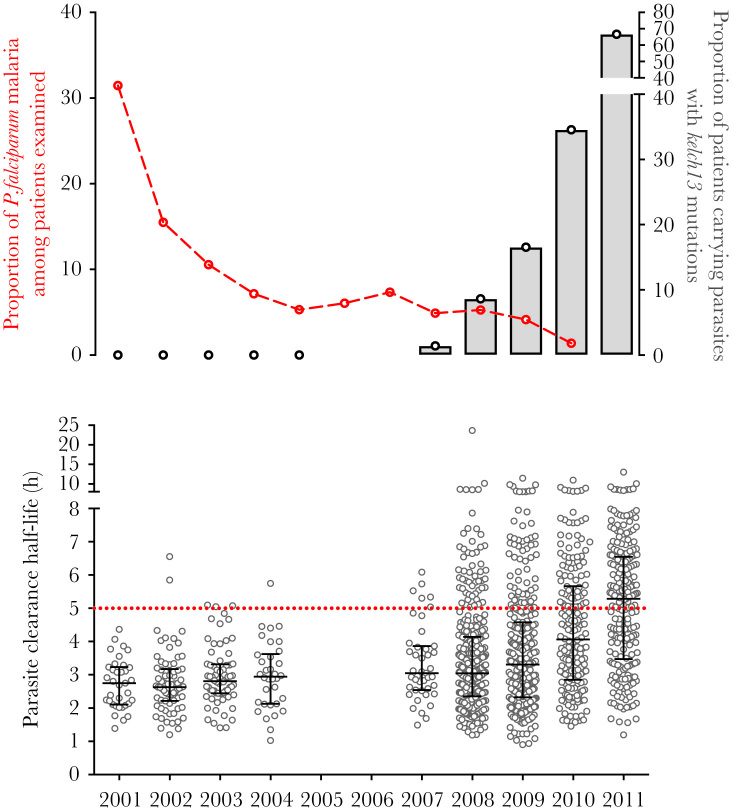
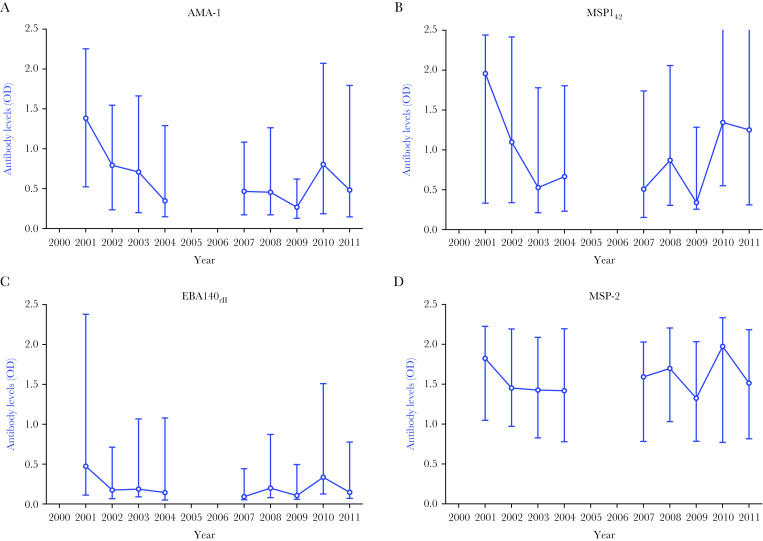
Antibodies specific for P. falciparum antigens were determined in uncomplicated hyperparasitemic malaria patients over a 10-year period of declining malaria transmission and emerging artemisinin resistance in northwestern Thailand. We investigated the association between antibody levels and both parasite clearance time (PCt½) and artemisinin resistance-associated kelch13 genotypes over time.
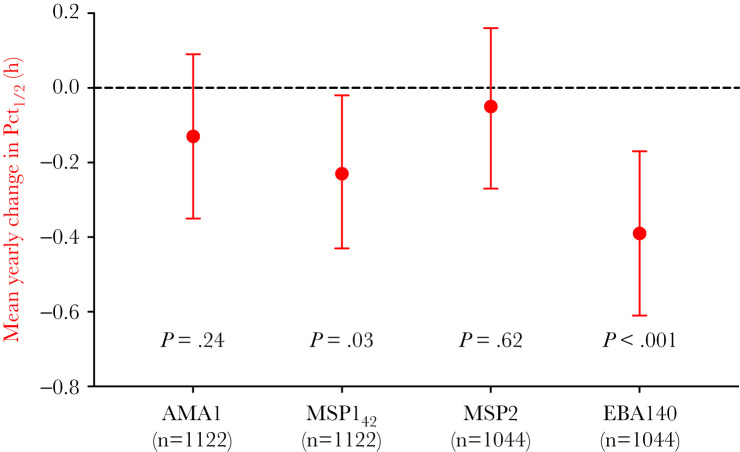
Immunity to P. falciparum declined prior to 2004, preceding the emergence of artemisinin resistance-associated genotypes and phenotypes (maximum mean change in antibody level per year: anti-MSP142 = -0.17; 95% confidence interval [CI] = -.31 to -.04; P = .01). In this period of declining immunity, and in the absence of kelch13 mutations, PCt½ increased. Between 2007 and 2011, levels of antibodies fluctuated, and higher antibody levels were associated with faster PCt½ (maximum yearly change in PCt½, in hours: EBA140rII = -0.39; 95% CI = -.61 to -.17; P < .001).
Understanding the impact of changing transmission and immunity on the emergence of artemisinin resistance is important particularly as increased malaria control and elimination activities may enhance immunological conditions for the expansion of artemisinin-resistant P. falciparum.
疟疾传播的减少会降低自然获得性免疫力,这可能会随着时间的推移影响恶性疟原虫青蒿素抗性表型和基因型的出现。
在泰国西北部疟疾传播下降和青蒿素抗性出现的10年期间,对非复杂性高疟原虫血症疟疾患者体内针对恶性疟原虫抗原的特异性抗体进行了测定。我们研究了抗体水平与寄生虫清除时间(PCt½)以及青蒿素抗性相关的kelch13基因型随时间的关联。
在2004年之前,对恶性疟原虫的免疫力下降,早于青蒿素抗性相关基因型和表型的出现(每年抗体水平的最大平均变化:抗MSP142 = -0.17;95%置信区间[CI] = -0.31至-0.04;P = 0.01)。在免疫力下降的这段时期,且在kelch13未发生突变的情况下,PCt½增加。在2007年至2011年期间,抗体水平波动,较高的抗体水平与更快的PCt½相关(PCt½的最大年度变化,以小时计:EBA140rII = -0.39;95% CI = -0.61至-0.17;P < 0.001)。
了解传播和免疫力变化对青蒿素抗性出现的影响非常重要,特别是因为加强疟疾控制和消除活动可能会改善有利于青蒿素抗性恶性疟原虫传播的免疫条件。