Hebei Key Laboratory of Animal Physiology, Biochemistry and Molecular Biology, College of Life Sciences, Hebei Normal University, Shijiazhuang, 050024, China.
Parasit Vectors. 2020 Jan 31;13(1):46. doi: 10.1186/s13071-020-3916-7.
The tick Haemaphysalis longicornis exhibits two separate reproductive populations: bisexual and parthenogenetic, which have diploid and triploid karyotypes, respectively. The parthenogenetic population can undergo engorgement without copulation and produce viable female-only offspring with a longer incubation period than the bisexual population. Three enzymes, cathepsin B, cathepsin D and acid phosphatase, were found to be involved in vitellin degradation during the embryonic development of bisexual H. longicornis. However, the expression and activity profiles of these enzymes during the embryonic development of parthenogenetic ticks remain unknown. In the present study, the transcriptional expression profile, enzyme activity and roles in embryogenesis of the three enzymes during the embryonic development of parthenogenetic H. longicornis were investigated.
Quantitative real-time polymerase chain reaction (qPCR) and fluorescence detection were used to analyze the dynamic changes in the three enzymes during embryogenesis. The roles of the three enzymes during embryogenesis were also explored using RNA interference (RNAi).
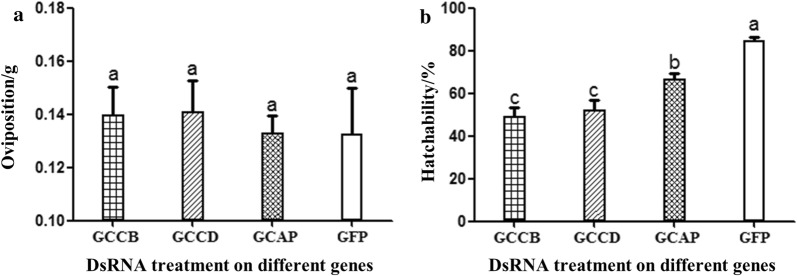
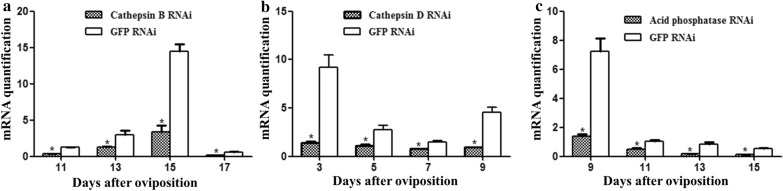
The three enzymes were all expressed during embryonic development in parthenogenetic H. longicornis. The expression of cathepsin B was highest on day 15, whereas that of cathepsin D was highest on day 3 and the peak of acid phosphatase expression occurred on day 9. The activity of cathepsin B was highest on day 3 and lowest on day 5, then gradually increased and remained stable. Cathepsin D activity was highest on day 1 and showed a gradually decreasing trend, whereas acid phosphatase showed the opposite trend and reached a peak on day 23. RNA interference experiments in engorged female ticks revealed that there was no significant difference in the number of eggs laid, but the hatching rate of the eggs was significantly decreased.
The three enzymes all play important roles in embryonic development of H. longicornis, but the expression patterns and changes in the activity of the enzymes in the bisexual and parthenogenetic populations are different. The results will help a better understanding of the similarities and differences underlying embryonic development in the bisexual and parthenogenetic populations and contribute to the future exploration of the development of the parthenogenetic population of H. longicornis.
长角血蜱表现出两种独立的生殖种群:两性生殖和孤雌生殖,它们分别具有二倍体和三倍体的核型。孤雌生殖种群在无需交配的情况下可以饱血,并产生具有更长孵化期的仅雌性可育后代。在两性长角血蜱的胚胎发育过程中,发现三种酶(组织蛋白酶 B、组织蛋白酶 D 和酸性磷酸酶)参与卵黄蛋白的降解。然而,孤雌生殖蜱胚胎发育过程中这些酶的表达和活性谱尚不清楚。在本研究中,研究了三种酶在孤雌生殖长角血蜱胚胎发育过程中的转录表达谱、酶活性及其在胚胎发生中的作用。
使用定量实时聚合酶链反应(qPCR)和荧光检测分析三种酶在胚胎发生过程中的动态变化。还使用 RNA 干扰(RNAi)探索了这三种酶在胚胎发生过程中的作用。
三种酶在孤雌生殖长角血蜱的胚胎发育过程中均有表达。组织蛋白酶 B 的表达在第 15 天最高,而组织蛋白酶 D 的表达在第 3 天最高,酸性磷酸酶的表达高峰出现在第 9 天。组织蛋白酶 B 的活性在第 3 天最高,在第 5 天最低,然后逐渐增加并保持稳定。组织蛋白酶 D 的活性在第 1 天最高,呈逐渐下降趋势,而酸性磷酸酶则相反,在第 23 天达到高峰。饱血雌蜱的 RNAi 实验表明,产卵数量没有显著差异,但卵的孵化率显著降低。
三种酶在长角血蜱的胚胎发育中均发挥重要作用,但两性生殖和孤雌生殖种群中酶的表达模式和活性变化不同。研究结果将有助于更好地理解两性生殖和孤雌生殖种群胚胎发育的异同,为未来探索长角血蜱孤雌生殖种群的发育奠定基础。