Novo Nordisk A/S, Quantitative Clinical Pharmacology, Søborg, Denmark.
Department of Drug Design and Pharmacology, Faculty of Health and Medical Sciences, University of Copenhagen, Copenhagen, Denmark.
Diabetes Obes Metab. 2020 Jun;22(6):969-977. doi: 10.1111/dom.13985. Epub 2020 Feb 19.
To investigate the impact on weight loss of the treatment changes in overweight or obese people that may be needed in case of gastrointestinal (GI) tolerability issues during escalation of the glucagon-like peptide-1 analogue liraglutide.
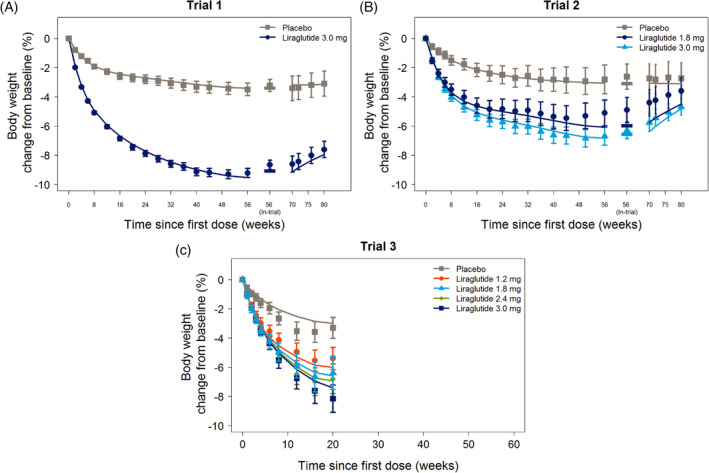
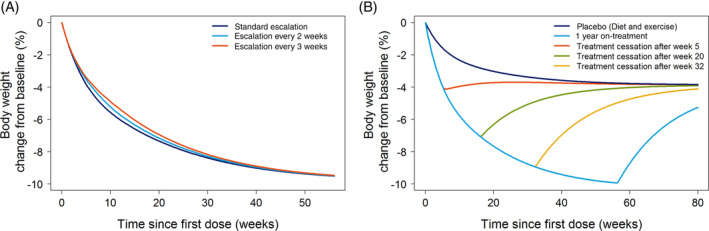
The individual longitudinal body weight data from the main trial periods of three phase II/III trials in overweight or obese patients (56-week treatment with once-daily liraglutide 1.2, 1.8, 2.4 or 3.0 mg or placebo, n = 4952) were analysed using a non-linear mixed-effect modelling approach. Individual pharmacokinetic profiles were derived based on published pharmacokinetic models. Baseline body weight, baseline glycated haemoglobin (HbA1c), age, gender, diabetes status (no diabetes, prediabetes or type 2 diabetes), race and trial region were investigated as covariates. As a form of external validation, the model was used to predict the weight regain after treatment cessation at week 56 (data not included in model development).
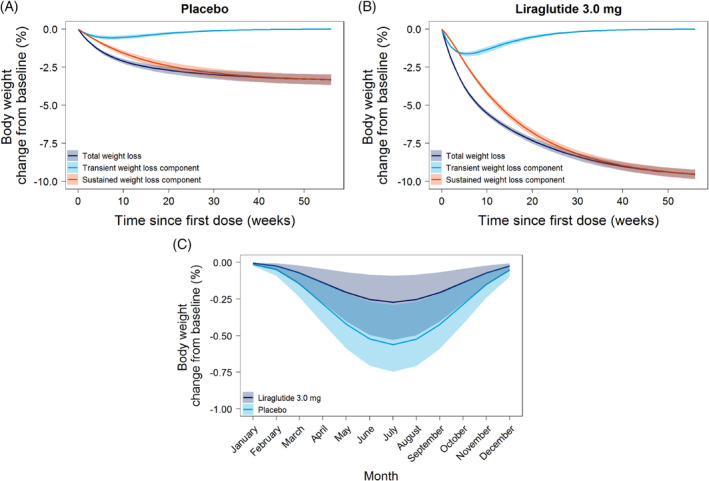
A pharmacokinetic/pharmacodynamic model provided an adequate description of the weight loss trajectories for all studied doses. Gender and diabetes status were identified as the most influential covariates, and an underlying seasonal weight fluctuation was identified. Slower than that recommended, one-week dose-escalation algorithms led up to 2 weeks slower initial weight loss but similar long-term weight loss trajectories.
The relationship between liraglutide systemic exposure and weight loss was successfully established in overweight or obese people. The model could predict the time course of weight regain after treatment cessation and suggests that GI tolerability can be mitigated by slower escalation with only minor impact on the weight loss trajectory.
研究在超重或肥胖人群中,由于胃肠道(GI)耐受性问题,可能需要在升级胰高血糖素样肽-1 类似物利拉鲁肽时进行治疗改变,对体重减轻的影响。
对超重或肥胖患者(56 周治疗,每日一次利拉鲁肽 1.2、1.8、2.4 或 3.0mg 或安慰剂,n=4952)的三个 II/III 期临床试验的主要治疗期的个体纵向体重数据进行了分析,使用非线性混合效应模型方法。根据已发表的药代动力学模型,得出个体药代动力学曲线。基线体重、基线糖化血红蛋白(HbA1c)、年龄、性别、糖尿病状态(无糖尿病、糖尿病前期或 2 型糖尿病)、种族和试验区域均被视为协变量进行研究。作为外部验证的一种形式,该模型用于预测治疗停止后第 56 周的体重反弹(未包含在模型开发中的数据)。
药代动力学/药效学模型为所有研究剂量的体重减轻轨迹提供了充分的描述。性别和糖尿病状态被确定为最具影响力的协变量,并确定了潜在的季节性体重波动。与推荐的每周剂量递增算法相比,一周剂量递增算法导致初始体重减轻速度慢 2 周,但长期体重减轻轨迹相似。
在超重或肥胖人群中成功建立了利拉鲁肽全身暴露与体重减轻之间的关系。该模型可以预测治疗停止后体重反弹的时间过程,并表明通过较慢的递增可以减轻 GI 耐受性,而对体重减轻轨迹的影响较小。