Lagos-Cabré Raúl, Burgos-Bravo Francesca, Avalos Ana María, Leyton Lisette
Cellular Communication Laboratory, Programa de Biología Celular y Molecular, Instituto de Ciencias Biomédicas (ICBM), Facultad de Medicina, Universidad de Chile, Santiago, Chile.
Advanced Center for Chronic Diseases (ACCDiS), Center for Studies on Exercise, Metabolism and Cancer (CEMC), Facultad de Medicina, Instituto de Ciencias Biomédicas (ICBM), Universidad de Chile, Santiago, Chile.
Front Pharmacol. 2020 Jan 15;10:1546. doi: 10.3389/fphar.2019.01546. eCollection 2019.
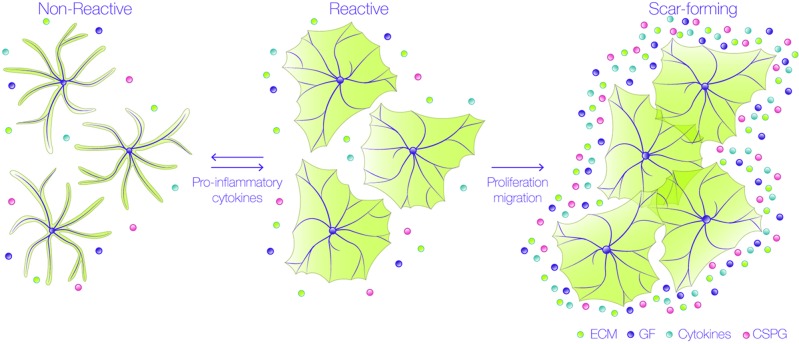
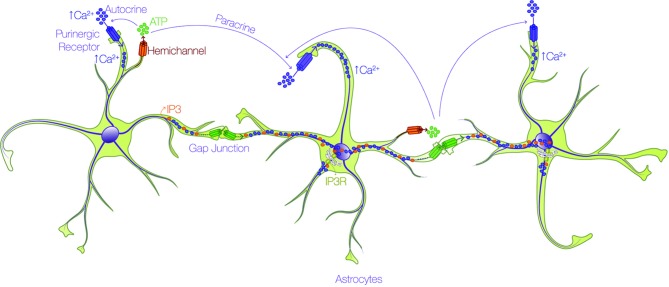
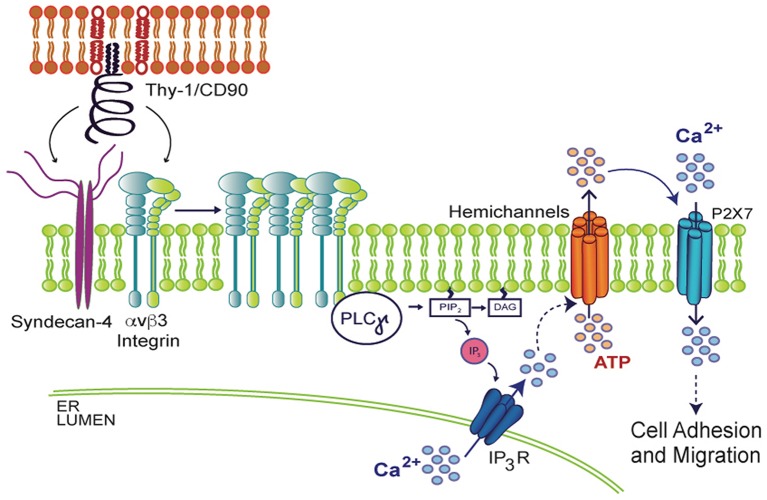
Astrocytes have long been considered the supportive cells of the central nervous system, but during the last decades, they have gained much more attention because of their active participation in the modulation of neuronal function. For example, after brain damage, astrocytes become reactive and undergo characteristic morphological and molecular changes, such as hypertrophy and increase in the expression of glial fibrillary acidic protein (GFAP), in a process known as astrogliosis. After severe damage, astrocytes migrate to the lesion site and proliferate, which leads to the formation of a glial scar. At this scar-forming stage, astrocytes secrete many factors, such as extracellular matrix proteins, cytokines, growth factors and chondroitin sulfate proteoglycans, stop migrating, and the process is irreversible. Although reactive gliosis is a normal physiological response that can protect brain cells from further damage, it also has detrimental effects on neuronal survival, by creating a hostile and non-permissive environment for axonal repair. The transformation of astrocytes from reactive to scar-forming astrocytes highlights migration as a relevant regulator of glial scar formation, and further emphasizes the importance of efficient communication between astrocytes in order to orchestrate cell migration. The coordination between astrocytes occurs mainly through Connexin (Cx) channels, in the form of direct cell-cell contact (gap junctions, GJs) or contact between the extracellular matrix and the astrocytes (hemichannels, HCs). Reactive astrocytes increase the expression levels of several proteins involved in astrocyte migration, such as αβ Integrin, Syndecan-4 proteoglycan, the purinergic receptor P2X7, Pannexin1, and Cx43 HCs. Evidence has indicated that Cx43 HCs play a role in regulating astrocyte migration through the release of small molecules to the extracellular space, which then activate receptors in the same or adjacent cells to continue the signaling cascades required for astrocyte migration. In this review, we describe the communication of astrocytes through Cxs, the role of Cxs in inflammation and astrocyte migration, and discuss the molecular mechanisms that regulate Cx43 HCs, which may provide a therapeutic window of opportunity to control astrogliosis and the progression of neurodegenerative diseases.
长期以来,星形胶质细胞一直被视为中枢神经系统的支持细胞,但在过去几十年里,由于它们积极参与神经元功能的调节,受到了更多关注。例如,脑损伤后,星形胶质细胞会发生反应,经历形态和分子特征性变化,如肥大以及胶质纤维酸性蛋白(GFAP)表达增加,这一过程称为星形胶质细胞增生。严重损伤后,星形胶质细胞迁移至损伤部位并增殖,导致形成胶质瘢痕。在这个瘢痕形成阶段,星形胶质细胞分泌许多因子,如细胞外基质蛋白、细胞因子、生长因子和硫酸软骨素蛋白聚糖,停止迁移,且该过程不可逆。尽管反应性胶质增生是一种正常的生理反应,可保护脑细胞免受进一步损伤,但它也会通过为轴突修复创造不利和不容许的环境,对神经元存活产生有害影响。星形胶质细胞从反应性向瘢痕形成性星形胶质细胞的转变突出了迁移作为胶质瘢痕形成的相关调节因子的作用,并进一步强调了星形胶质细胞之间有效通讯以协调细胞迁移的重要性。星形胶质细胞之间的协调主要通过连接蛋白(Cx)通道以直接细胞 - 细胞接触(间隙连接,GJs)或细胞外基质与星形胶质细胞之间的接触(半通道,HCs)的形式发生。反应性星形胶质细胞会增加参与星形胶质细胞迁移的几种蛋白质的表达水平,如αβ整合素、Syndecan - 4蛋白聚糖、嘌呤能受体P2X7、Pannexin1和Cx43 HCs。有证据表明,Cx43 HCs通过向细胞外空间释放小分子来调节星形胶质细胞迁移,这些小分子随后激活相同或相邻细胞中的受体,以继续星形胶质细胞迁移所需的信号级联反应。在本综述中,我们描述了星形胶质细胞通过Cxs的通讯、Cxs在炎症和星形胶质细胞迁移中的作用,并讨论调节Cx43 HCs的分子机制,这可能为控制星形胶质细胞增生和神经退行性疾病的进展提供一个治疗机会窗口。