Liu Yi, Wang Junjun, Hou Haijun, Chen Gang, Liu Hongwei, Liu Xueduan, Shen Li
Key Laboratory of Agro-ecological Processes in Subtropical Regions and Taoyuan Station of Agro-ecology Research, Institute of Subtropical Agriculture, Chinese Academy of Sciences, Changsha, China.
School of Minerals Processing and Bioengineering, Central South University, Changsha, China.
Front Microbiol. 2020 Jan 15;10:3034. doi: 10.3389/fmicb.2019.03034. eCollection 2019.
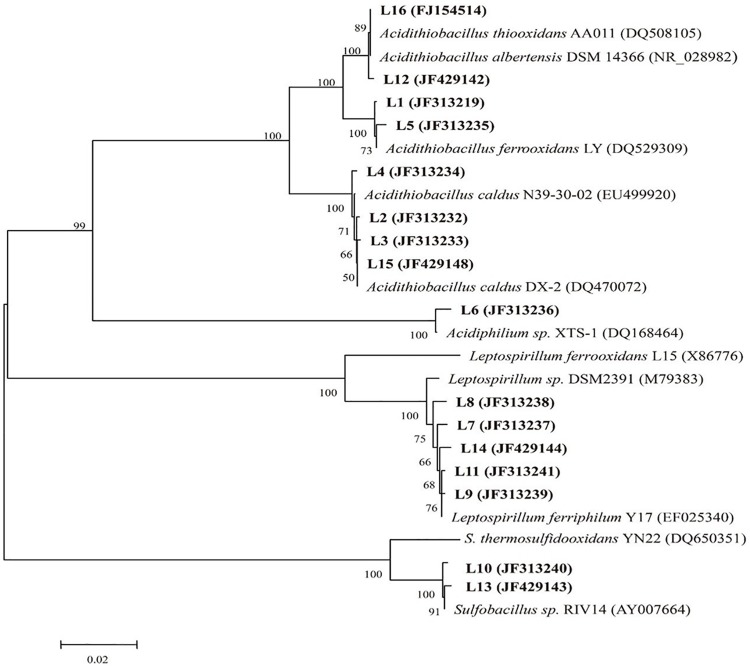
The introduction of A01 strengthens the positive interactions between physiologically distinct microorganisms and enhances the bioleaching ability of the consortium. However, the effect of introducing an exogenous strain, A01 on the structure and function of the adsorbed and planktonic microbial consortia during bioleaching of low-grade copper sulfide remains unclear. In this study, A01 was introduced into an indigenous leaching microbial community on the 0th (group B), 24th (group C), and 36th day (group D). Results revealed that the copper leaching efficiency was highest in group D, in which the Cu concentration in the solution reached 251.5 mg/L on day 48, which was 18.5% higher than that of the control (group A, no addition of A01). Restriction fragment length polymorphism (RFLP) analysis of the microbial community in group D revealed the presence of , , , sp., spp., and before introduction of A01 on the 36th or 48th day; however, was absent on day 48 in group A. Further, the proportion of dominant , , and became altered. The results of real-time PCR in group D showed that A01 was primarily adsorbed on the surface of the ore, with the adsorption reaching the maxima on day 42; while the free A01 in solution grew slowly, reaching its maximum concentration on day 45. Compared with that in the control group, the abundance of both free and attached and sp. decreased following the introduction of A01, while that of , , and sp. increased. Functional gene arrays data indicated that the abundance of genes involved in sulfide and iron oxidation in and , as well as that of the metal (loid) resistance genes of , , and sp. increased, while the abundance of genes involved in sulfur metabolism in and spp. decreased. Taken together, these results provide useful information for application of bioleaching of copper sulfide in industry.
A01的引入增强了生理特性不同的微生物之间的积极相互作用,并提高了该菌群的生物浸出能力。然而,在低品位硫化铜生物浸出过程中,引入外源菌株A01对吸附态和浮游态微生物菌群的结构和功能的影响仍不清楚。在本研究中,分别在第0天(B组)、第24天(C组)和第36天(D组)将A01引入本地浸出微生物群落。结果显示,D组的铜浸出效率最高,在第48天溶液中的铜浓度达到251.5 mg/L,比对照组(A组,未添加A01)高18.5%。对D组微生物群落的限制性片段长度多态性(RFLP)分析表明,在第36天或第48天引入A01之前,存在 、 、 、 属、 属和 ;然而,A组在第48天时不存在 。此外,优势菌 、 和 的比例发生了变化。D组的实时PCR结果表明,A01主要吸附在矿石表面,在第42天吸附量达到最大值;而溶液中的游离A01生长缓慢,在第45天达到最大浓度。与对照组相比,引入A01后,游离态和附着态的 和 属的丰度均降低,而 、 和 属的丰度增加。功能基因阵列数据表明, 属和 属中参与硫化物和铁氧化的基因丰度,以及 、 和 属的金属(类金属)抗性基因丰度增加,而 属和 属中参与硫代谢的基因丰度降低。综上所述,这些结果为硫化铜生物浸出在工业中的应用提供了有用信息。