Liu Zhiyong, Liu Jing, Wei Ying, Xu Jing, Wang Zhaoning, Wang Peng, Sun Hao, Song Zhijing, Liu Qian
Department of Cardiology, Dezhou People's Hospital, Dezhou, Shandong 253014, P.R. China.
Department of Cardiology, Shandong Provincial Qianfoshan Hospital, Shandong University, Jinan, Shandong 250000, P.R. China.
Exp Ther Med. 2020 Feb;19(2):990-998. doi: 10.3892/etm.2019.8309. Epub 2019 Dec 9.
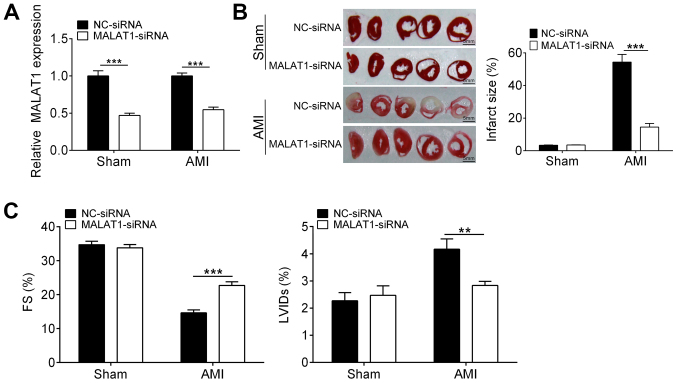
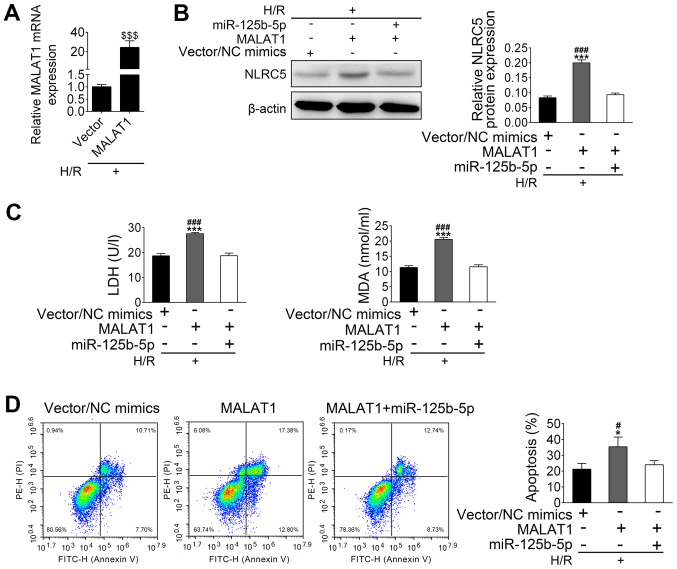
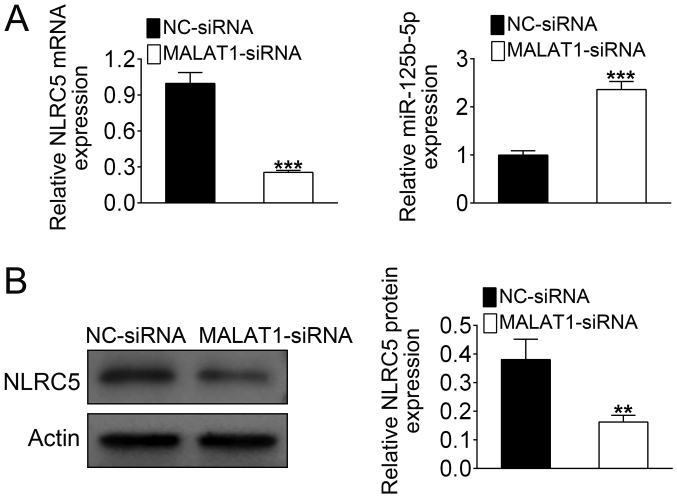
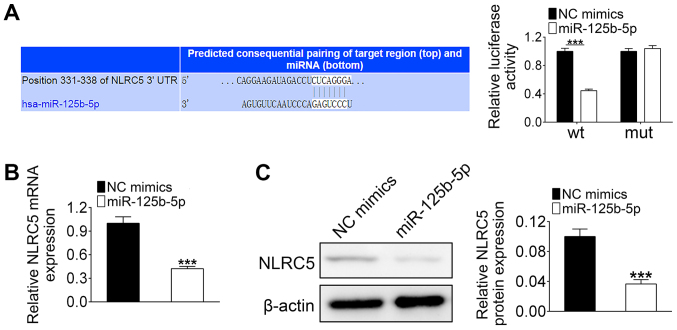
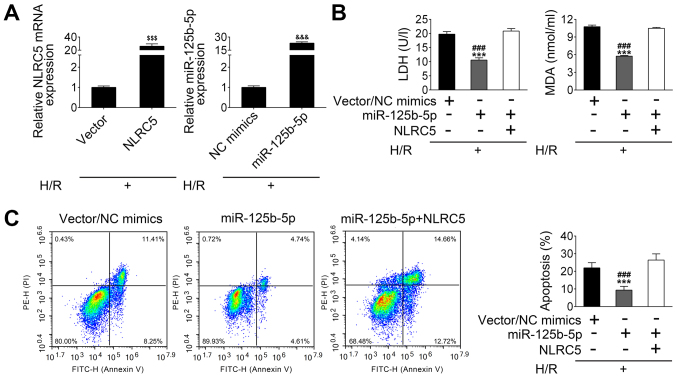
Acute myocardial infarction (AMI), as the first manifestation of ischemic heart disease, is the most common cause of death in developed countries. A recent study showed that metastasis associated lung adenocarcinoma transcript 1 (MALAT1), a prognostic marker for lung cancer metastasis, could promote myocardial ischemia-reperfusion injury by regulating the levels of microRNA (miR)-145. In order to elucidate the biological function of MALAT1 in the pathogenesis of AMI and to explore the mechanisms underlying its action, an AMI rat model was established by ligation of the left anterior descending coronary artery. Downregulation of MALAT1 by siRNA transfection attenuated heart damage in an AMI model rat. The mouse cardiomyocyte cell line HL-1 was used to show that downregulation of nucleotide binding and oligomerization domain-like receptor C5 (NLRC5) and upregulation of miR-125b-5p were the results of MALAT1 silencing. TargetScan and a dual-luciferase reporter assay indicated that NLRC5 is a direct target of miR-125b-5p. Overexpression of miR-125b-5p significantly reduced hypoxia/reperfusion-induced apoptosis of HL-1 cells, an effect that could be blocked by NLCR5 overexpression. Taken together, these results suggest that MALAT1 reduced the protective effect of miR-125b-5p on injured cells through upregulation of NLCR5. This study highlights the role of MALAT1 in the pathogenesis of AMI and may guide future genetic therapeutic strategies for AMI treatment.
急性心肌梗死(AMI)作为缺血性心脏病的首发表现,是发达国家最常见的死亡原因。最近一项研究表明,转移相关肺腺癌转录本1(MALAT1)作为肺癌转移的一个预后标志物,可通过调节微小RNA(miR)-145的水平来促进心肌缺血再灌注损伤。为了阐明MALAT1在AMI发病机制中的生物学功能,并探索其作用的潜在机制,通过结扎左冠状动脉前降支建立了AMI大鼠模型。在AMI模型大鼠中,通过小干扰RNA转染下调MALAT1可减轻心脏损伤。利用小鼠心肌细胞系HL-1表明,核苷酸结合寡聚化结构域样受体C5(NLRC5)的下调和miR-125b-5p的上调是MALAT1沉默的结果。TargetScan和双荧光素酶报告基因检测表明,NLRC5是miR-125b-5p的直接靶点。miR-125b-5p的过表达显著减少了缺氧/复氧诱导的HL-1细胞凋亡,NLCR5过表达可阻断这一效应。综上所述,这些结果表明MALAT1通过上调NLCR5降低了miR-125b-5p对损伤细胞的保护作用。本研究突出了MALAT1在AMI发病机制中的作用,并可能为未来AMI治疗的基因治疗策略提供指导。