Aberuyi Narges, Rahgozar Soheila, Ghodousi Elaheh Sadat, Ghaedi Kamran
Division of Cellular and Molecular Biology, Department of Cell and Molecular Biology & Microbiology, Faculty of Biological Sciences and Technologies, University of Isfahan, Isfahan, Iran.
Front Oncol. 2020 Jan 17;9:1496. doi: 10.3389/fonc.2019.01496. eCollection 2019.
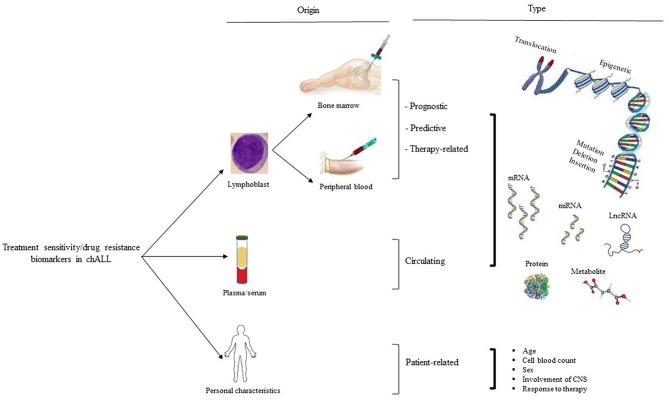
Biomarkers are biological molecules found in body fluids or tissues, which can be considered as indications of a normal or abnormal process, or of a condition or disease. There are various types of biomarkers based on their application and molecular alterations. Treatment-sensitivity or drug resistance biomarkers include prognostic and predictive molecules with utmost importance in selecting appropriate treatment protocols and improving survival rates. Acute lymphoblastic leukemia (ALL) is the most prevalent hematological malignancy diagnosed in children with nearly 80% cure rate. Despite the favorable survival rates of childhood ALL (chALL), resistance to chemotherapeutic agents and, as a consequence, a dismal prognosis develops in a significant number of patients. Therefore, there are urgent needs to have robust, sensitive, and disease-specific molecular prognostic and predictive biomarkers, which could allow better risk classification and then better clinical results. In this article, we review the currently known drug resistance biomarkers, including somatic or germ line nucleic acids, epigenetic alterations, protein expressions and metabolic variations. Moreover, biomarkers with potential clinical applications are discussed.
生物标志物是在体液或组织中发现的生物分子,可被视为正常或异常过程、状况或疾病的指标。根据其应用和分子改变,生物标志物有多种类型。治疗敏感性或耐药性生物标志物包括在选择合适的治疗方案和提高生存率方面至关重要的预后和预测分子。急性淋巴细胞白血病(ALL)是儿童中最常见的血液系统恶性肿瘤,治愈率近80%。尽管儿童ALL(chALL)的生存率良好,但相当数量的患者会出现对化疗药物的耐药性,进而导致预后不佳。因此,迫切需要有强大、敏感且疾病特异性的分子预后和预测生物标志物,以便能进行更好的风险分类,从而取得更好的临床结果。在本文中,我们综述了目前已知的耐药生物标志物,包括体细胞或种系核酸、表观遗传改变、蛋白质表达和代谢变化。此外,还讨论了具有潜在临床应用价值的生物标志物。