Hoffberg Adam S, Stearns-Yoder Kelly A, Brenner Lisa A
Department of Veterans Affairs, Rocky Mountain Mental Illness, Research, Education and Clinical Center, Aurora, CO, United States.
Department of Physical Medicine and Rehabilitation, University of Colorado, Anschutz Medical Campus, Aurora, CO, United States.
Front Public Health. 2020 Jan 17;7:399. doi: 10.3389/fpubh.2019.00399. eCollection 2019.
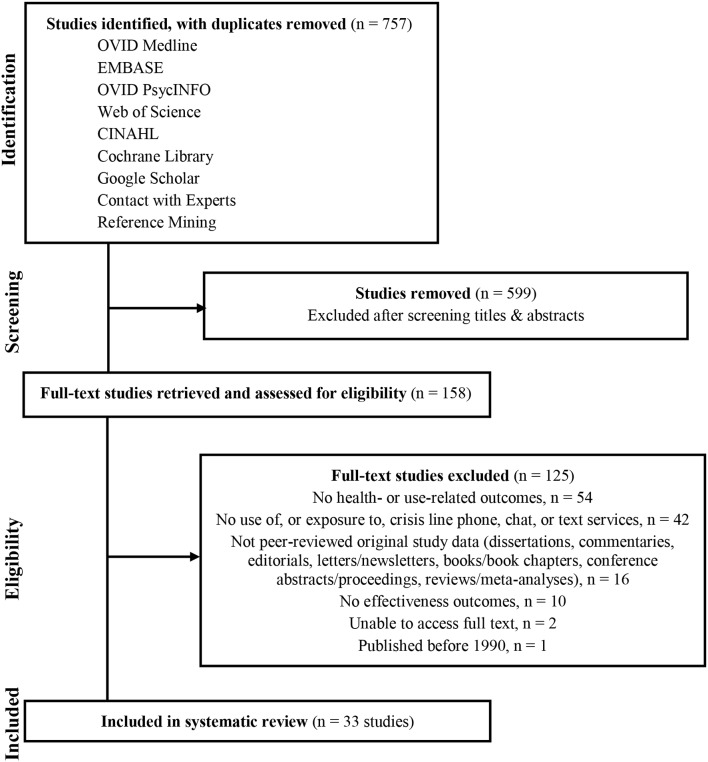
Crisis lines are a standard component of a public health approach to suicide prevention. Clinical aims include reducing individuals' crisis states, psychological distress, and risk of suicide. Efforts may also include enhancing access and facilitating connections to behavioral health care. This review examines models of crisis line services for demonstrated effectiveness. Literature searches of Medline, EMBASE, PsycINFO, Web of Science, CINAHL, Cochrane Library, and Google Scholar were conducted from January 1, 1990, to May 7, 2018. Experts were contacted, and references were mined for additional studies. Eligible studies provided health- or utilization-related effectiveness outcome(s). Results were graded according to the Oxford Centre for Evidence-Based Medicine and evaluated for risk of bias using the Effective Public Health Practice Project quality assessment tool for quantitative studies. Thirty-three studies yielded effectiveness outcomes. In most cases findings regarding crisis calls vs. other modalities were presented. Evaluation approaches included user- and helper-reported data, silent monitoring, and analyses of administrative records. About half of studies reported immediate proximal outcomes (during the crisis service), and the remaining reported distal outcomes (up to four years post-contact). Most studies were rated at Oxford level four evidence and 80% were assessed at high risk of bias. High quality evidence demonstrating crisis line effectiveness is lacking. Moreover, most approaches to demonstrating impact only measured proximal outcomes. Research should focus on innovative strategies to assess proximal and distal outcomes, with a specific focus on behavioral health treatment engagement and future self-directed violence.
危机热线是预防自杀公共卫生方法的一个标准组成部分。临床目标包括减轻个体的危机状态、心理困扰和自杀风险。相关工作还可能包括增加获得行为健康护理的机会并促进与之建立联系。本综述考察危机热线服务模式的已证实有效性。对1990年1月1日至2018年5月7日期间的Medline、EMBASE、PsycINFO、Web of Science、CINAHL、Cochrane图书馆和谷歌学术进行了文献检索。联系了专家,并挖掘参考文献以寻找更多研究。符合条件的研究提供了与健康或利用相关的有效性结果。根据牛津循证医学中心对结果进行分级,并使用有效公共卫生实践项目定量研究质量评估工具评估偏倚风险。33项研究得出了有效性结果。在大多数情况下,呈现了关于危机热线呼叫与其他方式的研究结果。评估方法包括用户和帮助者报告的数据、无声监测以及行政记录分析。约一半的研究报告了即时近端结果(在危机服务期间),其余的报告了远端结果(接触后长达四年)。大多数研究被评为牛津四级证据,80%被评估为高偏倚风险。缺乏高质量证据证明危机热线的有效性。此外,大多数证明影响的方法仅测量近端结果。研究应侧重于评估近端和远端结果的创新策略,特别关注行为健康治疗参与度和未来的自我暴力行为。