Mazzer Kelly, Curll Sonia, Barzinjy Hakar, Goecke Roland, Larsen Mark, Batterham Philip J, Titov Nickolai, Rickwood Debra
Faculty of Health, University of Canberra, 11 Kirinari Street, Bruce, Canberra, 2611, Australia, 610262015266.
School of Systems & Computing, University of New South Wales, Canberra, Australia.
JMIR Form Res. 2025 Jun 20;9:e63257. doi: 10.2196/63257.
Mental health challenges are escalating globally, with increasing numbers of individuals accessing crisis helplines through various modalities. Despite this growing demand, there is limited understanding of how crisis helplines benefit help-seekers over the course of a conversation. Affective computing has the potential to transform this area of research, yet it remains relatively unexplored, partly due to the scarcity of available helpline data.
This study aimed to explore the feasibility of using lexical analysis to track dynamic changes in the mental state of help-seekers during online chat conversations with a crisis helpline.
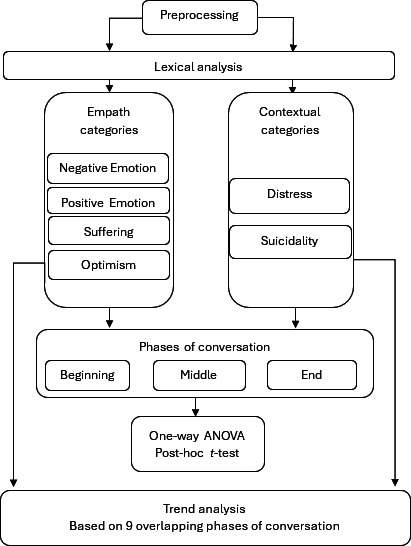
Lexical analysis was conducted on 6618 deidentified online chat transcripts collected by Lifeline Australia between April and June 2023 using the validated Empath lexical categories of Positive Emotion, Negative Emotion, Suffering, and Optimism. Furthermore, 2 context-specific categories, Distress and Suicidality, were also developed and analyzed to reflect crisis support language. Correlation analyses evaluated the relationships between the 6 lexical categories. One-way ANOVAs assessed changes in each lexical category across 3 conversation phases (beginning, middle, and end). Trend analyses using regression modeling examined the direction and strength of changes in lexical categories across 9 overlapping conversation windows (20% size and 50% step overlap).
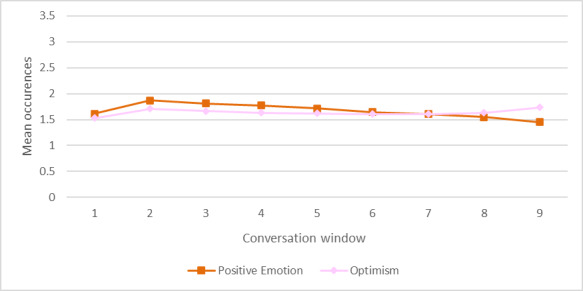
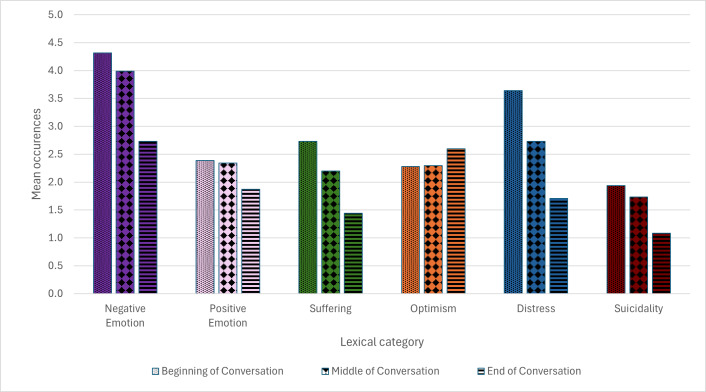
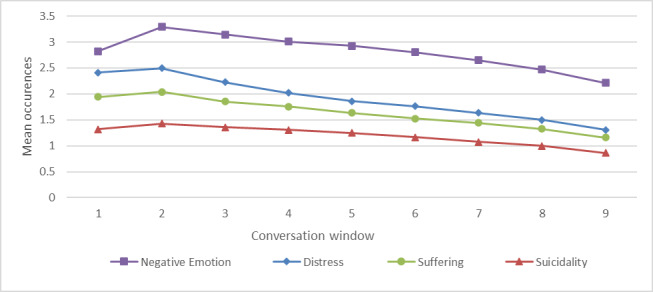
Significant changes were observed across conversation phases. The context-specific categories showed the strongest improvements from the beginning to end phase of conversation, with a large reduction in Distress (d=0.79) and a moderate reduction in Suicidality (d=0.49). The most frequently occurring terms representing Distress were "hard," "bad," and "down," and for Suicidality were "suicide," "stop," and "hurt." The negatively framed Empath categories also significantly reduced, with moderate effect sizes for Suffering (d=0.49) and Negative Emotion (d=0.39). There were also significant but small reductions in the positively framed Empath categories of Positive Emotion (d=0.15) and Optimism (d=0.07) from the beginning to end phase of conversation. Correlation coefficients indicated the lexical categories captured related but distinct constructs (r=.34 to r=0.82). Trend analyses revealed a consistent downward trajectory across most lexical categories. Distress showed the steepest decline (slope=-0.15, R²=0.97), followed by Suffering (slope=-0.11, R²=0.96), Negative Emotion (slope=-0.10, R²=0.69), and Suicidality (slope=-0.06, R²=0.88). Positive Emotion showed a slight negative trend (slope=-0.04, R²=0.54), while Optimism remained relatively stable across the conversation windows (slope=0.01, R²=0.13).
This study demonstrates the feasibility of using lexical analysis to represent and monitor mental state changes during online crisis support interactions. The findings highlight the potential for integrating affective computing into crisis helplines to enhance service delivery and outcome measurement. Future research should focus on validating these findings and exploring how lexical analysis can be applied to improve real-time support to those in crisis.
心理健康挑战在全球范围内不断升级,通过各种方式拨打危机求助热线的人数日益增加。尽管需求不断增长,但对于危机求助热线在对话过程中如何使求助者受益,人们的了解仍然有限。情感计算有潜力改变这一研究领域,但仍相对未被充分探索,部分原因是可用的求助热线数据稀缺。
本研究旨在探讨使用词汇分析来追踪求助者在与危机求助热线进行在线聊天对话期间心理状态动态变化的可行性。
使用经过验证的Empath词汇类别(积极情绪、消极情绪、痛苦和乐观),对澳大利亚生命线组织在2023年4月至6月期间收集的6618份匿名在线聊天记录进行词汇分析。此外,还开发并分析了2个特定情境类别(困扰和自杀倾向),以反映危机支持语言。相关性分析评估了这6个词汇类别之间的关系。单向方差分析评估了每个词汇类别在3个对话阶段(开始、中间和结束)的变化。使用回归模型的趋势分析研究了9个重叠对话窗口(大小为20%,步长重叠为50%)中词汇类别的变化方向和强度。
在对话阶段观察到了显著变化。特定情境类别在对话开始到结束阶段显示出最显著的改善,困扰大幅减少(d = 0.79),自杀倾向适度减少(d = 0.49)。代表困扰的最常出现的词汇是“hard”、“bad”和“down”,代表自杀倾向的是“suicide”、“stop”和“hurt”。负面框架的Empath类别也显著减少,痛苦的效应量适中(d = 0.49),消极情绪的效应量适中(d = 0.39)。从对话开始到结束阶段,积极框架的Empath类别中的积极情绪(d = 0.15)和乐观(d = 0.07)也有显著但较小的减少。相关系数表明这些词汇类别捕捉到了相关但不同的结构(r = 0.34至r = 0.82)。趋势分析显示,大多数词汇类别呈现出一致的下降趋势。困扰下降最为陡峭(斜率 = -0.15,R² = 0.97),其次是痛苦(斜率 = -0.11,R² = 0.96)、消极情绪(斜率 = -0.10,R² = 0.69)和自杀倾向(斜率 = -0.06,R² = 0.88)。积极情绪呈现轻微的负趋势(斜率 = -0.04,R² = 0.54),而乐观在整个对话窗口中保持相对稳定(斜率 = 0.01,R² = 0.13)。
本研究证明了使用词汇分析来表示和监测在线危机支持互动期间心理状态变化的可行性。研究结果突出了将情感计算整合到危机求助热线以提高服务提供和结果测量的潜力。未来的研究应侧重于验证这些发现,并探索如何应用词汇分析来改善对处于危机中的人的实时支持。