Collingwood Abigail, Blostein Freida, Seekatz Anna M, Wobus Christiane E, Woods Robert J, Foxman Betsy, Bachman Michael A
Department of Pathology, University of Michigan, Ann Arbor, Michigan, USA.
University of Michigan School of Public Health, Ann Arbor, Michigan, USA.
Open Forum Infect Dis. 2020 Jan 12;7(1):ofaa012. doi: 10.1093/ofid/ofaa012. eCollection 2020 Jan.
Prior colonization by and vancomycin-resistant (VRE) is associated with subsequent infection, particularly in intensive care unit (ICU) populations. Screening for VRE colonization, but not , is routinely performed in some health care systems. Identification of patient factors associated with colonization could enable infection prevention.
ICU patients were screened for VRE and by rectal swab culture over 2 time periods: July-October 2014 (n = 1209) and January-May 2016 (n = 1243). Patient demographics, baseline laboratory data, comorbidities, and outcomes were analyzed. 16S rRNA gene-based analysis was performed on a subset of patients (n = 248) to identify microbiota characteristics associated with VRE and colonization.
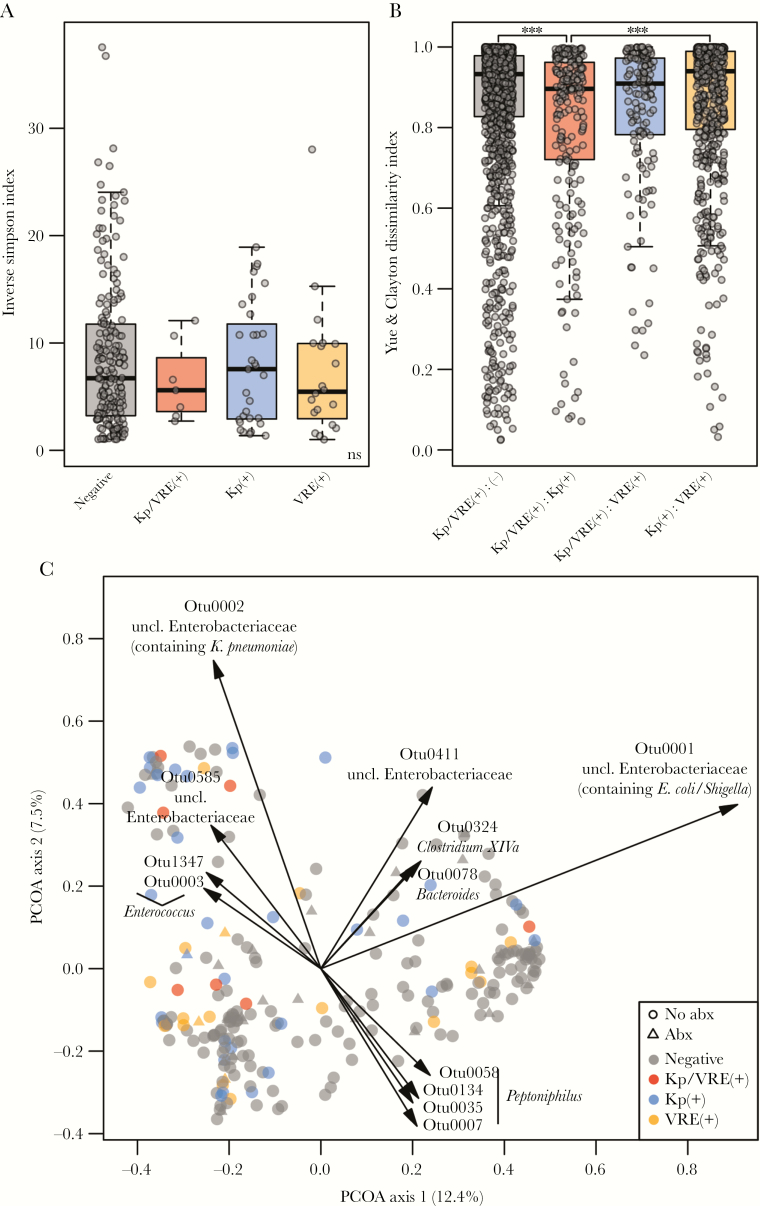
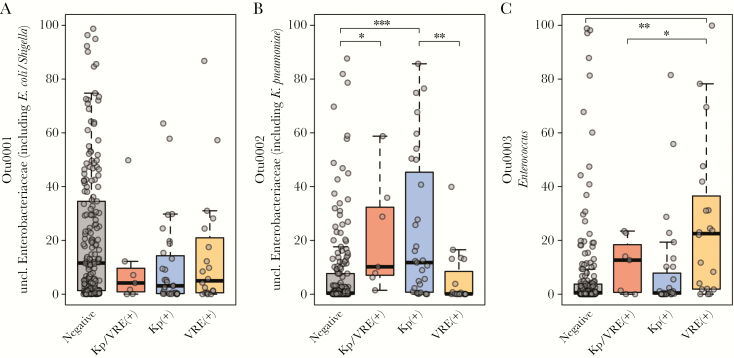
colonization (17.3% of patients in the 2014 cohort, 7.3% in 2016) was significantly associated with VRE colonization in multivariable analysis ( = .03 in 2016; = .08 in 2014). VRE colonization was associated with poor underlying health, whereas colonization was associated with advanced age. The most prevalent operational taxonomic units were spp., and , consistent with high rates of detectable and VRE by culture. Microbial community structure in noncolonized patients was significantly different from those with VRE, or both, attributable to differences in the relative abundance of and .
co-colonizes with VRE and is a predominant taxon in ICU patients, but colonization was not associated with significant comorbidities. Screening for and VRE simultaneously could be an efficient approach for novel infection prevention strategies.
先前被屎肠球菌和耐万古霉素肠球菌(VRE)定植与随后的感染相关,尤其是在重症监护病房(ICU)患者中。在一些医疗系统中,常规对VRE定植进行筛查,但不对屎肠球菌进行筛查。识别与屎肠球菌定植相关的患者因素有助于预防感染。
在两个时间段通过直肠拭子培养对ICU患者进行VRE和屎肠球菌筛查:2014年7月至10月(n = 1209)和2016年1月至5月(n = 1243)。分析患者人口统计学、基线实验室数据、合并症和结局。对一部分患者(n = 248)进行基于16S rRNA基因的分析,以识别与VRE和屎肠球菌定植相关的微生物群特征。
在多变量分析中,屎肠球菌定植(2014年队列中患者的17.3%,2016年为7.3%)与VRE定植显著相关(2016年P = 0.03;2014年P = 0.08)。VRE定植与基础健康状况差相关,而屎肠球菌定植与高龄相关。最常见的操作分类单位是肠球菌属、葡萄球菌属和假单胞菌属,这与培养法检测到的屎肠球菌和VRE的高发生率一致。未定植患者的微生物群落结构与VRE定植、屎肠球菌定植或两者兼有的患者显著不同,这归因于葡萄球菌属和肠球菌属相对丰度的差异。
屎肠球菌与VRE共同定植,是ICU患者中的主要分类群,但屎肠球菌定植与显著的合并症无关。同时筛查屎肠球菌和VRE可能是一种有效的新型感染预防策略。