Laboratory for Chemistry and Life Science, Institute of Innovative Research, Tokyo Institute of Technology, 4259 Nagatsutacho, Midori-ku, Yokohama, Kanagawa 226-8503, Japan.
Division of Particle Radiation Oncology, Particle Radiation Oncology Research Center, Institute for Integrated Radiation and Nuclear Science, Kyoto University, 2-1010 Asashiro-nishi, Kumatori-cho, Sennan-gun, Osaka 590-0494, Japan.
Sci Adv. 2020 Jan 22;6(4):eaaz1722. doi: 10.1126/sciadv.aaz1722. eCollection 2020 Jan.
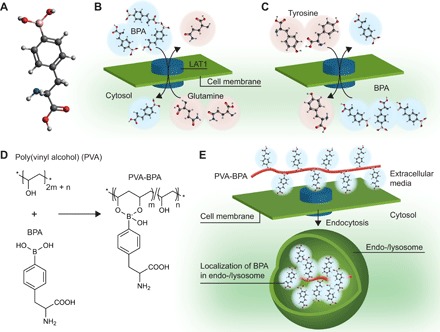
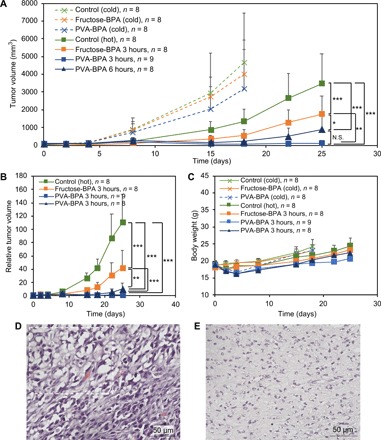
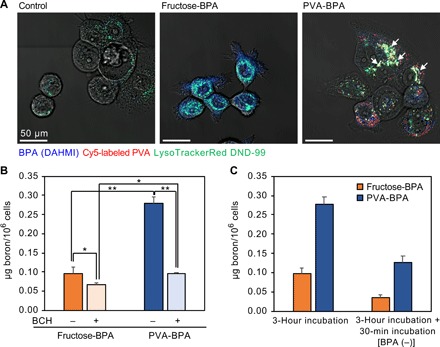
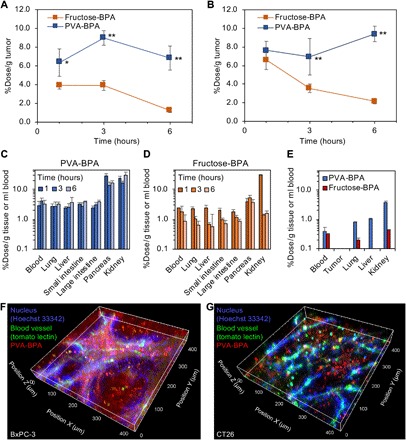
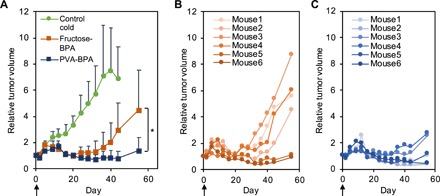
In the current clinical boron neutron capture therapy (BNCT), -boronophenylalanine (BPA) has been the most powerful drug owing to its ability to accumulate selectively within cancers through cancer-related amino acid transporters including LAT1. However, the therapeutic success of BPA has been sometimes compromised by its unfavorable efflux from cytosol due to their antiport mechanism. Here, we report that poly(vinyl alcohol) (PVA) can form complexes with BPA through reversible boronate esters in aqueous solution, and the complex termed PVA-BPA can be internalized into cancer cells through LAT1-mediated endocytosis, thereby enhancing cellular uptake and slowing the untoward efflux. In in vivo study, compared with clinically used fructose-BPA complexes, PVA-BPA exhibited efficient tumor accumulation and prolonged tumor retention with quick clearance from bloodstream and normal organs. Ultimately, PVA-BPA showed critically enhanced antitumor activity in BNCT. The facile technique proposed in this study offers an approach for drug delivery focusing on drug metabolism.
在当前的临床硼中子俘获治疗(BNCT)中,由于 - 硼苯丙氨酸(BPA)能够通过包括 LAT1 在内的癌症相关氨基酸转运体选择性地在癌症中积累,因此它是最有效的药物。然而,由于它们的反转运机制,BPA 从细胞质中的不利外排有时会影响其治疗效果。在这里,我们报告聚(乙烯醇)(PVA)可以在水溶液中与 BPA 形成复合物,通过可逆硼酸酯,该复合物称为 PVA-BPA 可以通过 LAT1 介导的内吞作用进入癌细胞,从而增强细胞摄取并减缓不利的外排。在体内研究中,与临床使用的果糖-BPA 复合物相比,PVA-BPA 表现出高效的肿瘤积累和延长的肿瘤保留,从血液和正常器官中快速清除。最终,PVA-BPA 在 BNCT 中表现出了显著增强的抗肿瘤活性。本研究提出的简便技术为药物代谢为重点的药物输送提供了一种方法。