Liu Regina, Relan Anju, Napolitano Jason
David Geffen School of Medicine, University of California, Los Angeles, Los Angeles, CA, USA.
UCLA Medical Center, Los Angeles, CA, USA.
J Med Educ Curric Dev. 2020 Jan 21;7:2382120519897031. doi: 10.1177/2382120519897031. eCollection 2020 Jan-Dec.
As online learning develops an increasingly important role in medical education, new online teaching modalities are arising all the time. One such teaching modality that is gaining popularity among medical students is the "inked" video, a type of animated video that utilizes a virtual blackboard. Student reviews suggest that the dynamic style of the inked video allows it to teach more efficiently than traditional teaching modalities, but currently there is no quantitative evidence to support or guide the use of this teaching modality.
When compared to the traditional recorded PowerPoint lecture, online inked videos teach the same pathophysiology concepts to pre-clerkship medical students in a shorter amount of time.
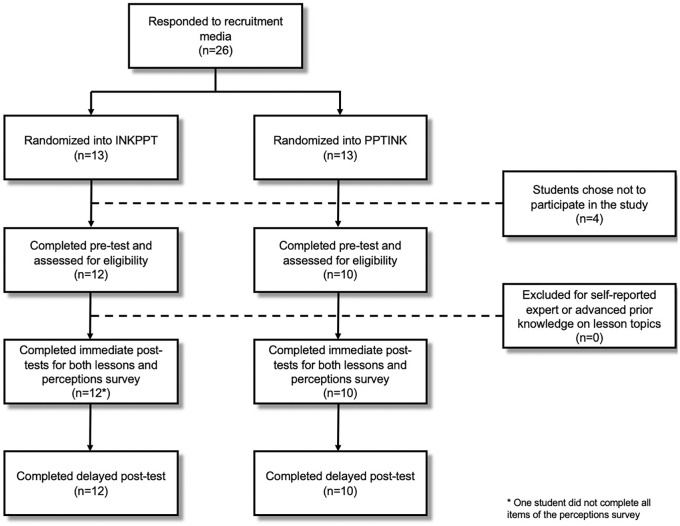
A randomized, crossover-design study was conducted with second-year medical students at the David Geffen School of Medicine at University of California, Los Angeles (n = 22). Students were randomized to 2 groups. Each group received 2 lessons on 2 different pathophysiology topics: one via a shorter inked video and the other via a longer recorded PowerPoint lecture. Two sets of dependent variables were used to test modality effects: immediate post-tests scores and delayed retention post-test scores. A perceptions survey was also administered to assess student preferences between the 2 teaching modalities.
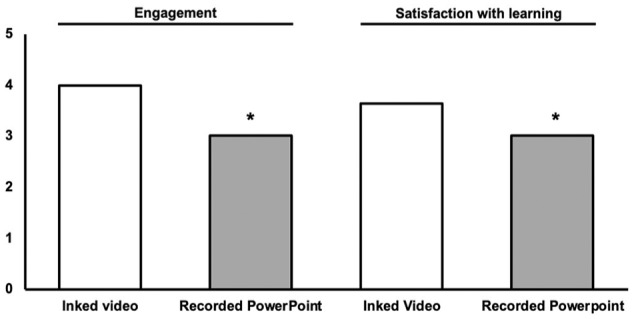
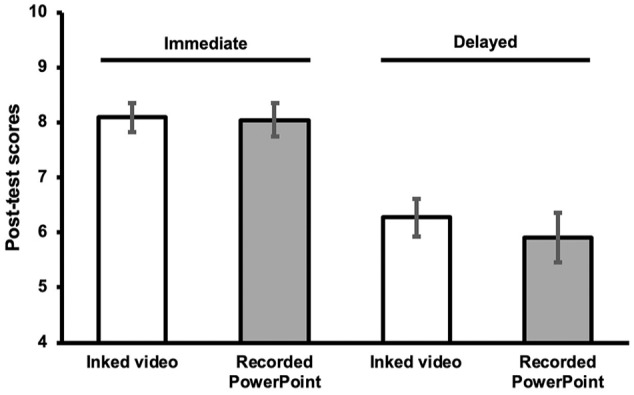
Students performed similarly on immediate and delayed post-tests for the shorter inked videos and the longer recorded PowerPoint lectures ( > .05). Students reported greater engagement ( < .05) and greater satisfaction with learning ( < .05) with the inked videos than the recorded PowerPoint lectures.
This study, although limited by its small-scale and single-institution design, provides preliminary evidence that online inked videos may be a more efficient and non-inferior alternative to recorded PowerPoint lectures.
随着在线学习在医学教育中发挥着越来越重要的作用,新的在线教学模式不断涌现。一种在医学生中越来越受欢迎的教学模式是“墨迹”视频,这是一种利用虚拟黑板的动画视频。学生评价表明,墨迹视频的动态风格使其比传统教学模式教学效率更高,但目前尚无定量证据支持或指导这种教学模式的使用。
与传统的PowerPoint录制讲座相比,在线墨迹视频能在更短的时间内向见习前的医学生传授相同的病理生理学概念。
对加利福尼亚大学洛杉矶分校大卫·格芬医学院的二年级医学生(n = 22)进行了一项随机交叉设计研究。学生被随机分为两组。每组接受关于两个不同病理生理学主题的两节课:一节通过较短的墨迹视频,另一节通过较长的PowerPoint录制讲座。使用两组因变量来测试模式效果:即时测试后分数和延迟保留测试后分数。还进行了一项认知调查,以评估学生对两种教学模式的偏好。
在较短的墨迹视频和较长的PowerPoint录制讲座的即时和延迟测试后,学生的表现相似(>0.05)。与PowerPoint录制讲座相比,学生报告称对墨迹视频的参与度更高(<0.05),对学习的满意度更高(<0.05)。
本研究虽然受限于小规模和单机构设计,但提供了初步证据,表明在线墨迹视频可能是PowerPoint录制讲座更高效且非劣效的替代方式。