Department of Translational Research in Psychiatry, Max Planck Institute of Psychiatry, Munich, Germany.
Institute of Computational Biology, Helmholtz Zentrum München, Neuherberg, Germany.
PLoS Comput Biol. 2020 Feb 3;16(2):e1007616. doi: 10.1371/journal.pcbi.1007616. eCollection 2020 Feb.
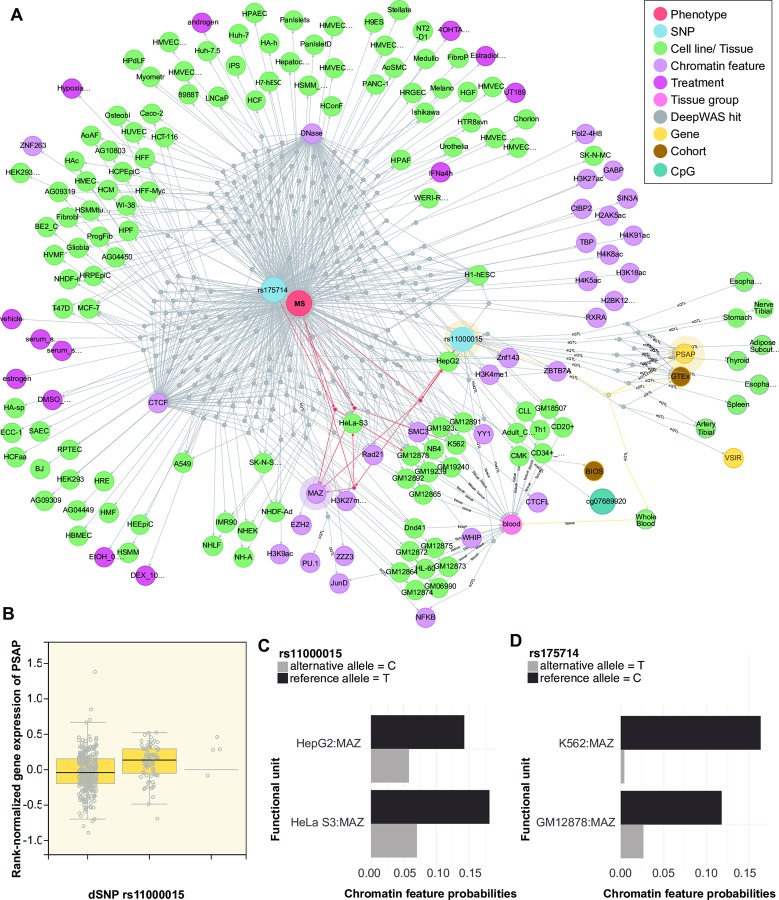
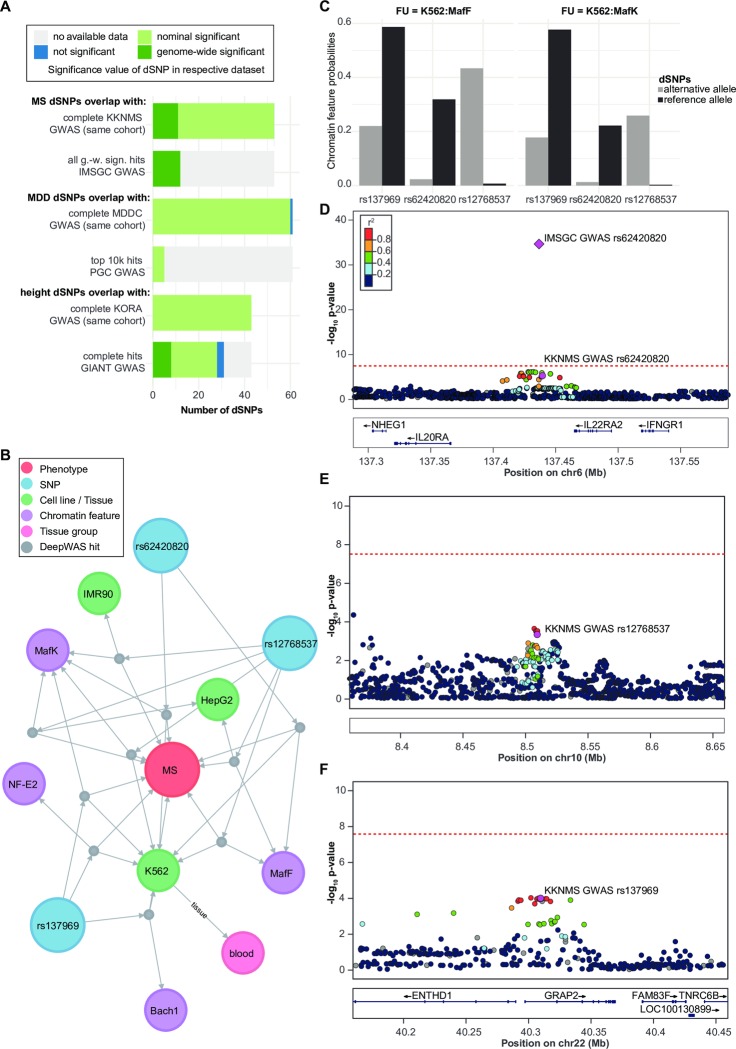
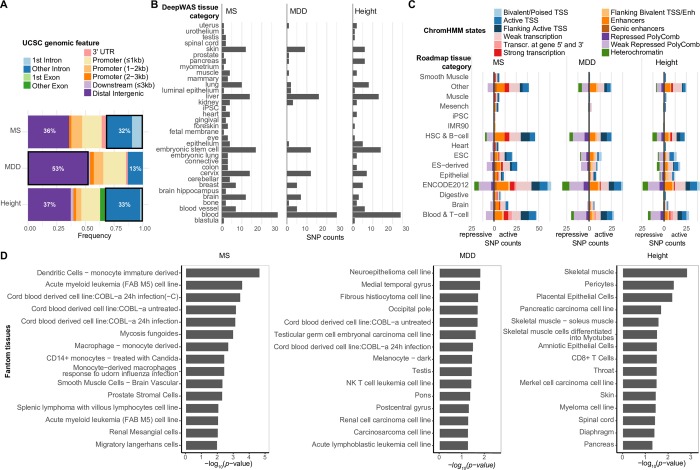
Genome-wide association studies (GWAS) identify genetic variants associated with traits or diseases. GWAS never directly link variants to regulatory mechanisms. Instead, the functional annotation of variants is typically inferred by post hoc analyses. A specific class of deep learning-based methods allows for the prediction of regulatory effects per variant on several cell type-specific chromatin features. We here describe "DeepWAS", a new approach that integrates these regulatory effect predictions of single variants into a multivariate GWAS setting. Thereby, single variants associated with a trait or disease are directly coupled to their impact on a chromatin feature in a cell type. Up to 61 regulatory SNPs, called dSNPs, were associated with multiple sclerosis (MS, 4,888 cases and 10,395 controls), major depressive disorder (MDD, 1,475 cases and 2,144 controls), and height (5,974 individuals). These variants were mainly non-coding and reached at least nominal significance in classical GWAS. The prediction accuracy was higher for DeepWAS than for classical GWAS models for 91% of the genome-wide significant, MS-specific dSNPs. DSNPs were enriched in public or cohort-matched expression and methylation quantitative trait loci and we demonstrated the potential of DeepWAS to generate testable functional hypotheses based on genotype data alone. DeepWAS is available at https://github.com/cellmapslab/DeepWAS.
全基因组关联研究(GWAS)确定与性状或疾病相关的遗传变异。GWAS 从不直接将变体与调控机制联系起来。相反,变体的功能注释通常通过事后分析来推断。一类特定的基于深度学习的方法允许针对几种细胞类型特异性染色质特征预测每个变体的调控效应。我们在这里描述“DeepWAS”,这是一种将这些单个变体的调控效应预测整合到多变量 GWAS 环境中的新方法。通过这种方法,与性状或疾病相关的单个变体直接与其在细胞类型中的染色质特征的影响相关联。多达 61 个称为 dSNP 的调控 SNP 与多发性硬化症 (MS,4888 例病例和 10395 例对照)、重度抑郁症 (MDD,1475 例病例和 2144 例对照) 和身高 (5974 人) 相关联。这些变体主要是非编码的,在经典的 GWAS 中至少达到了名义上的显著性。对于 91%的全基因组显著、MS 特异性 dSNP,DeepWAS 的预测准确性高于经典 GWAS 模型。dSNP 在公共或队列匹配的表达和甲基化数量性状基因座中富集,我们证明了 DeepWAS 基于基因型数据生成可测试的功能假设的潜力。DeepWAS 可在 https://github.com/cellmapslab/DeepWAS 上获得。