Mazzoccoli Gianluigi, Vinciguerra Manlio, Carbone Annalucia, Relógio Angela
Department of Medical Sciences and Chronobiology Laboratory, Fondazione IRCCS "Casa Sollievo della Sofferenza", 71013 San Giovanni Rotondo (FG), Italy.
Epigenetics, Metabolism and Aging (EMA) research group, International Clinical Research Center, St. Anne's University Hospital, 656 91 Brno, Czech Republic.
Pathogens. 2020 Jan 27;9(2):83. doi: 10.3390/pathogens9020083.
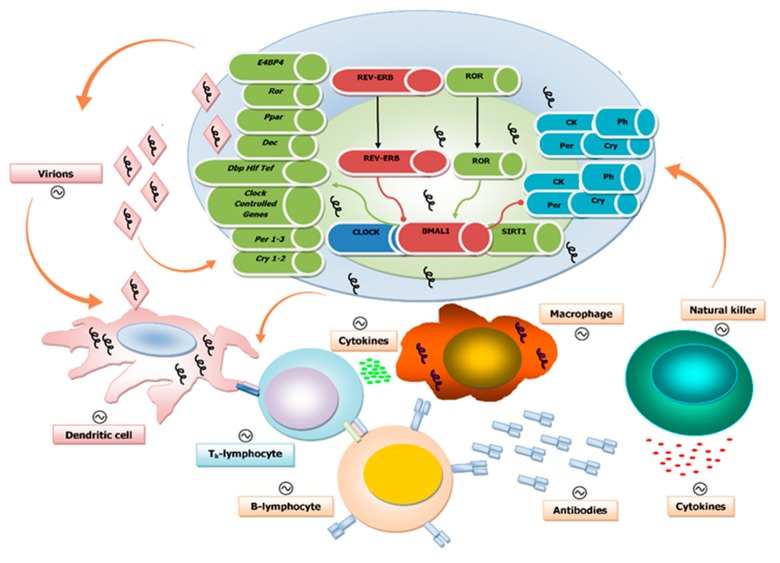
Living beings spend their lives and carry out their daily activities interacting with environmental situations that present space-time variations and that involve contact with other life forms, which may behave as commensals or as invaders and/or parasites. The characteristics of the environment, as well as the processes that support the maintenance of life and that characterize the execution of activities of daily life generally present periodic variations, which are mostly synchronized with the light-dark cycle determined by Earth's rotation on its axis. These rhythms with 24-h periodicity, defined as circadian, influence events linked to the interaction between hosts and hosted microorganisms and can dramatically determine the outcome of this interplay. As for the various pathological conditions resulting from host-microorganism interactions, a particularly interesting scenario concerns infections by viruses. When a viral agent enters the body, it alters the biological processes of the infected cells in order to favour its replication and to spread to various tissues. Though our knowledge concerning the mutual influence between the biological clock and viruses is still limited, recent studies start to unravel interesting aspects of the clock-virus molecular interplay. Three different aspects of this interplay are addressed in this mini-review and include the circadian regulation of both innate and adaptive immune systems, the impact of the biological clock on viral infection itself, and finally the putative perturbations that the virus may confer to the clock leading to its deregulation.
生物在其生命过程中以及进行日常活动时,会与呈现时空变化且涉及与其他生命形式接触的环境状况相互作用,这些其他生命形式可能以共生体、入侵者和/或寄生虫的形式存在。环境的特征以及支持生命维持和表征日常生活活动执行的过程通常呈现周期性变化,这些变化大多与地球绕轴自转所决定的昼夜循环同步。这些具有24小时周期性的节律,定义为昼夜节律,影响与宿主和寄居微生物之间相互作用相关的事件,并能极大地决定这种相互作用的结果。至于由宿主 - 微生物相互作用导致的各种病理状况,一个特别有趣的情况涉及病毒感染。当病毒因子进入人体时,它会改变被感染细胞的生物过程,以利于其复制并扩散到各种组织。尽管我们关于生物钟与病毒之间相互影响的知识仍然有限,但最近的研究开始揭示生物钟 - 病毒分子相互作用的有趣方面。本综述探讨了这种相互作用的三个不同方面,包括先天免疫系统和适应性免疫系统的昼夜节律调节、生物钟对病毒感染本身的影响,以及病毒可能对生物钟造成的导致其失调的假定干扰。