Department of Genetics and Genome Biology, University of Leicester, Leicester LE1 7RH, UK.
Genes (Basel). 2020 Jan 27;11(2):133. doi: 10.3390/genes11020133.
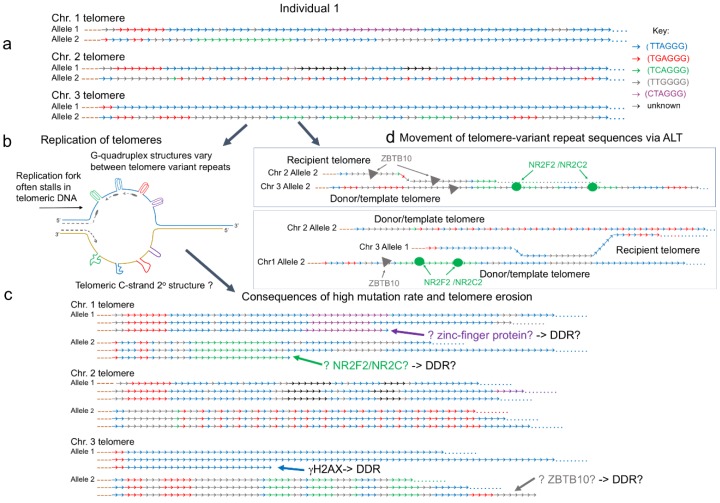
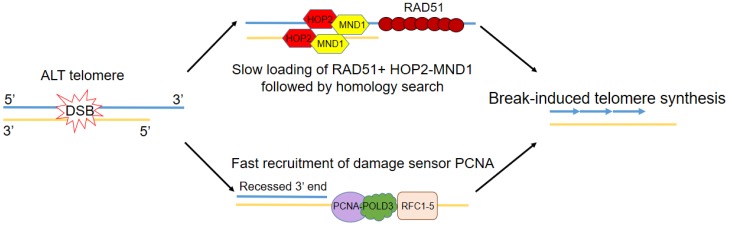
One of the hallmarks of cancer cells is their indefinite replicative potential, made possible by the activation of a telomere maintenance mechanism (TMM). The majority of cancers reactivate the reverse transcriptase, telomerase, to maintain their telomere length but a minority (10% to 15%) utilize an alternative lengthening of telomeres (ALT) pathway. Here, we review the phenotypes and molecular markers specific to ALT, and investigate the significance of telomere mutations and sequence variation in ALT cell lines. We also look at the recent advancements in understanding the different mechanisms behind ALT telomere elongation and finally, the progress made in identifying potential ALT-targeted therapies, including those already in use for the treatment of both hematological and solid tumors
癌细胞的一个标志是其无限的复制潜力,这是通过激活端粒维持机制 (TMM) 实现的。大多数癌症会重新激活逆转录酶端粒酶来维持端粒长度,但少数癌症(10% 到 15%)会利用替代性端粒延长 (ALT) 途径。在这里,我们回顾了 ALT 特有的表型和分子标记,并研究了端粒突变和序列变异在 ALT 细胞系中的意义。我们还研究了最近在理解 ALT 端粒伸长背后的不同机制方面取得的进展,最后,还研究了鉴定潜在的 ALT 靶向治疗方法的进展,包括已经用于治疗血液系统和实体肿瘤的治疗方法。