Department of Chemistry, University of Turku, Vatselankatu 2, 20500 Turku, Finland.
Anal Chem. 2020 Mar 3;92(5):3512-3516. doi: 10.1021/acs.analchem.9b05712. Epub 2020 Feb 12.
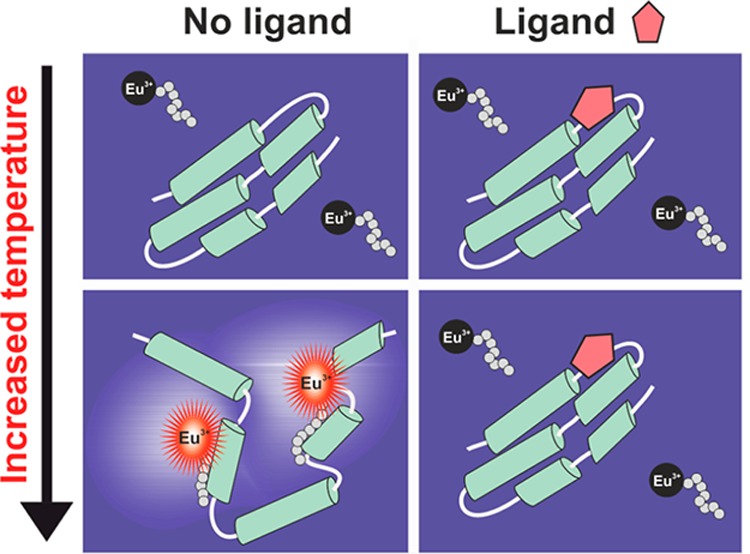
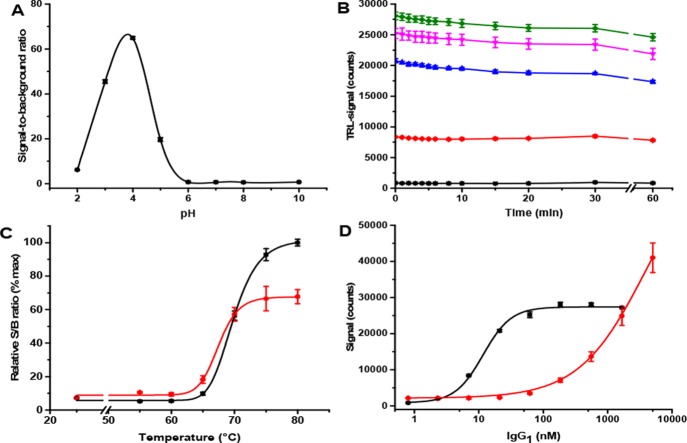
In modern biochemistry, protein stability and ligand interactions are of high interest. These properties are often studied with methods requiring labeled biomolecules, as the existing methods utilizing luminescent external probes suffer from low sensitivity. Currently available label-free technologies, e.g., thermal shift assays, circular dichroism, and differential scanning calorimetry, enable studies on protein unfolding and protein-ligand interactions (PLI). Unfortunately, the required micromolar protein concentration increases the costs and predisposes these methods for spontaneous protein aggregation. Here, we report a time-resolved luminescence method for protein unfolding and PLI detection with nanomolar sensitivity. The Protein-Probe method is based on highly luminescent europium chelate-conjugated probe, which is the key component in sensing the hydrophobic regions exposed to solution after protein unfolding. With the same Eu-probe, we also demonstrate ligand-interaction induced thermal stabilization with model proteins. The developed Protein-Probe method provides a sensitive approach overcoming the problems of the current label-free methodologies.
在现代生物化学中,蛋白质稳定性和配体相互作用是研究的热点。这些性质通常需要使用标记的生物分子进行研究,因为现有的利用荧光外部探针的方法存在灵敏度低的问题。目前可用的无标记技术,如热转移分析、圆二色性和差示扫描量热法,可用于研究蛋白质的展开和蛋白质-配体相互作用(PLI)。然而,所需的微摩尔级别的蛋白质浓度增加了成本,并使这些方法容易发生自发的蛋白质聚集。在这里,我们报告了一种具有纳摩尔灵敏度的用于蛋白质展开和 PLI 检测的时间分辨荧光方法。蛋白质-探针方法基于高发光的铕螯合物结合探针,该探针是在蛋白质展开后暴露于溶液中的疏水区检测的关键组成部分。我们还使用相同的 Eu 探针,演示了配体相互作用诱导的模型蛋白热稳定性。所开发的蛋白质-探针方法提供了一种敏感的方法,克服了当前无标记方法学的问题。