Division of Cardiology, Children's National Medical Center, W3-200, 111 Michigan Ave NW, Washington, DC, 20010, USA.
Children's Research Institute, Children's National Medical Center, 111 Michigan Ave NW, Washington, DC, USA.
J Cardiovasc Magn Reson. 2020 Feb 3;22(1):11. doi: 10.1186/s12968-020-0602-z.
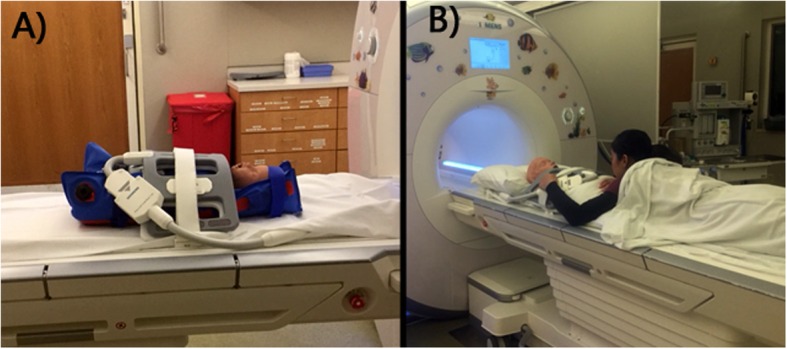
Pediatric z scores are necessary to describe size and structure of the heart in growing children, however, development of an accurate z score calculator requires robust normal datasets, which are difficult to obtain with cardiovascular magnetic resonance (CMR) in children. Motion-corrected (MOCO) cines from re-binned, reconstructed real-time cine offer a free-breathing, rapid acquisition resulting in cines with high spatial and temporal resolution. In combination with child-friendly positioning and entertainment, MOCO cine technique allows for rapid cine volumetry in patients of all ages without sedation. Thus, our aim was to prospectively enroll normal infants and children birth-12 years for creation and validation of a z score calculator describing normal right ventricular (RV) and left ventricular (LV) size.
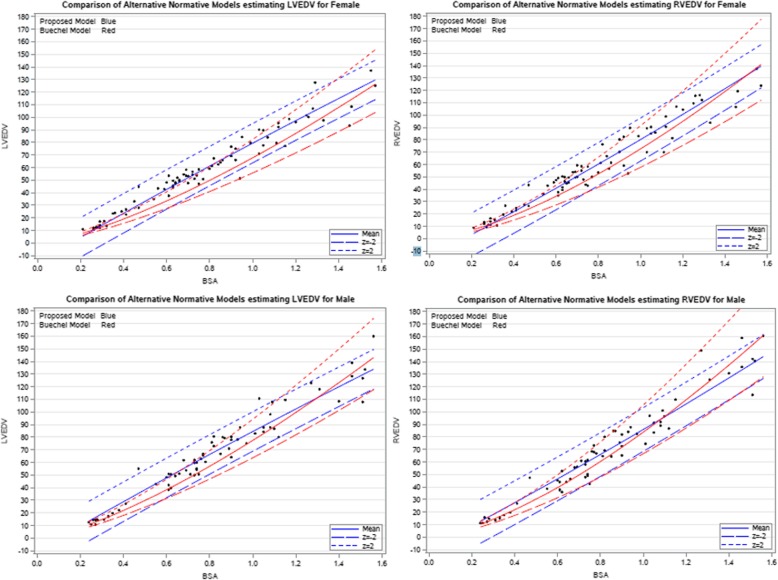
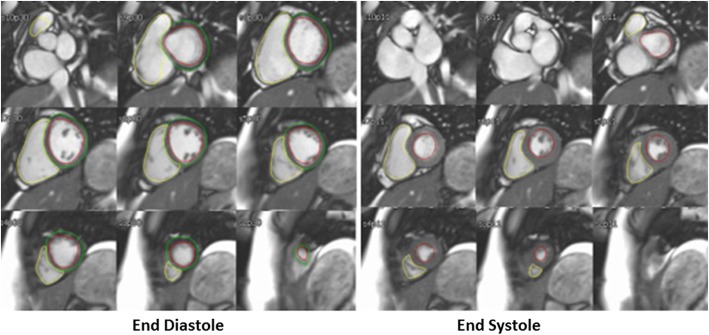
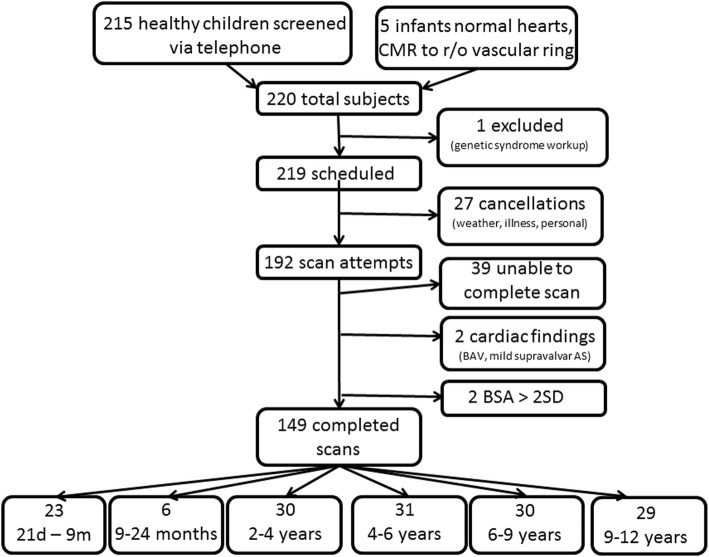
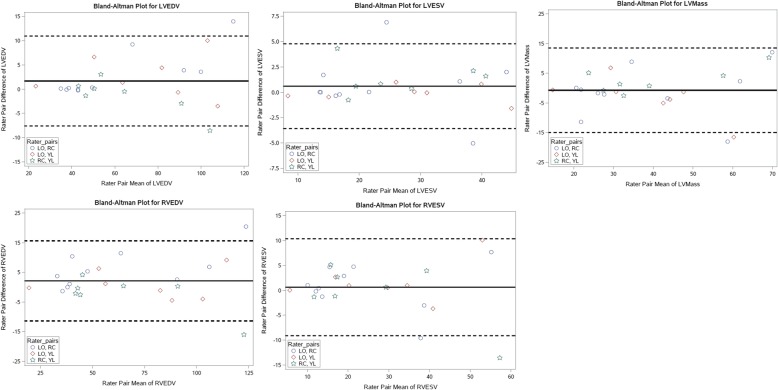
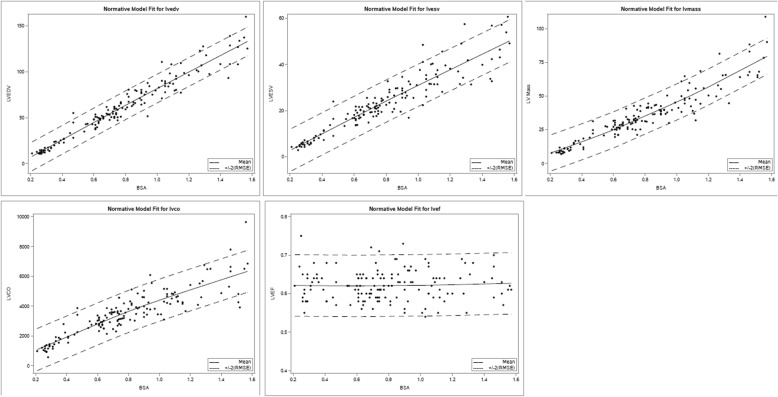
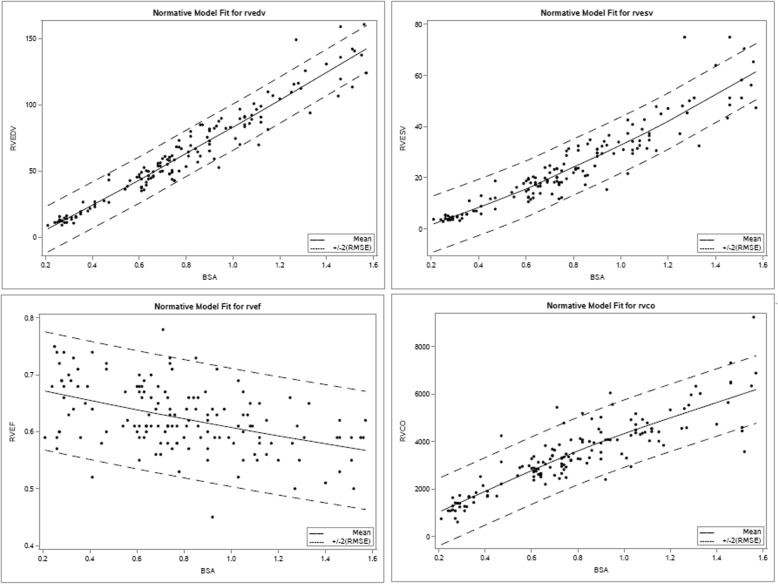
With IRB approval and consent/assent, 149 normal children successfully underwent a brief noncontrast CMR on a 1.5 T scanner including MOCO cines in the short axis, and RV and LV volumes were measured. 20% of scans were re-measured for interobserver variability analyses. A general linear modeling (GLM) framework was employed to identify and properly represent the relationship between CMR-based assessments and anthropometric data. Scatter plots of model fit and Akaike's information criteria (AIC) results were used to guide the choice among alternative models.
A total of 149 subjects aged 22 days-12 years (average 5.1 ± 3.6 years), with body surface area (BSA) range 0.21-1.63 m (average 0.8 ± 0.35 m) were scanned. All ICC values were > 95%, reflecting excellent agreement between raters. The model that provided the best fit of volume measure to the data included BSA with higher order effects and gender as independent variables. Compared with earlier z score models, there is important additional growth inflection in early toddlerhood with similar z score prediction in later childhood.
Free-breathing, MOCO cines allow for accurate, reliable RV and LV volumetry in a wide range of infants and children while awake. Equations predicting fit between LV and RV normal values and BSA are reported herein for purposes of creating z scores.
clinicaltrials.gov NCT02892136, Registered 7/21/2016.
儿科 z 分数对于描述生长儿童的心脏大小和结构是必要的,然而,准确的 z 分数计算器的开发需要强大的正常数据集,这在儿童心血管磁共振(CMR)中很难获得。重排重建实时电影的运动校正(MOCO)电影提供了一种自由呼吸、快速采集的方法,可获得具有高空间和时间分辨率的电影。结合儿童友好的定位和娱乐,MOCO 电影技术允许在无需镇静的情况下对所有年龄段的患者进行快速电影体积测量。因此,我们的目的是前瞻性地招募正常婴儿和儿童(出生至 12 岁),以创建和验证描述正常右心室(RV)和左心室(LV)大小的 z 分数计算器。
在机构审查委员会批准和同意/同意的情况下,149 名正常儿童成功地在 1.5T 扫描仪上进行了短暂的非对比 CMR 检查,包括短轴的 MOCO 电影,并且测量了 RV 和 LV 容积。20%的扫描用于观察者间变异性分析的重新测量。采用广义线性模型(GLM)框架来识别和正确表示基于 CMR 的评估与人体测量数据之间的关系。模型拟合的散点图和 Akaike 信息准则(AIC)结果用于指导在替代模型之间进行选择。
共扫描了 149 名年龄为 22 天至 12 岁(平均 5.1±3.6 岁)的受试者,体表面积(BSA)范围为 0.21-1.63m(平均 0.8±0.35m)。所有 ICC 值均>95%,反映了评分者之间的良好一致性。为数据提供最佳体积测量拟合的模型包括 BSA 作为独立变量,具有更高阶效应和性别。与早期的 z 分数模型相比,在幼儿期早期有重要的额外生长拐点,在后期儿童期有类似的 z 分数预测。
在清醒状态下,自由呼吸的 MOCO 电影可以在广泛的婴儿和儿童中进行准确、可靠的 RV 和 LV 容积测量。此处报告了预测 LV 和 RV 正常值与 BSA 之间拟合的方程,用于创建 z 分数。
clinicaltrials.gov NCT02892136,注册于 2016 年 7 月 21 日。