Centre de Recherche Saint-Antoine, CRSA, AP-HP, Hôpital Saint Antoine, Service de Gastroenterologie, Sorbonne Université, Inserm, 75012, Paris, France.
Department of Gastroenterology, Saint Antoine Hospital, Assitance Publique-Hopitaux de Paris (APHP), 184 rue du Faubourg Saint-Antoine, 75571, Paris, CEDEX 12, France.
Microbiome. 2020 Feb 3;8(1):12. doi: 10.1186/s40168-020-0792-5.
The role of the gut microbiota in Crohn's disease (CD) is established and fecal microbiota transplantation (FMT) is an attractive therapeutic strategy. No randomized controlled clinical trial results are available. We performed a randomized, single-blind, sham-controlled pilot trial of FMT in adults with colonic or ileo-colonic CD.
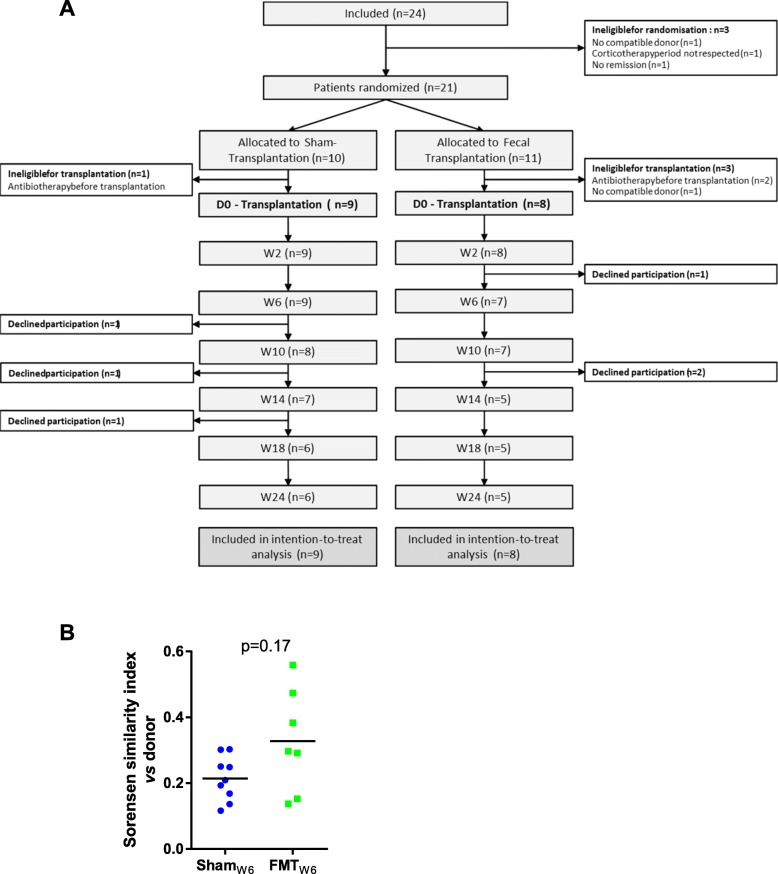
Patients enrolled while in flare received oral corticosteroid. Once in clinical remission, patients were randomized to receive either FMT or sham transplantation during a colonoscopy. Corticosteroids were tapered and a second colonoscopy was performed at week 6. The primary endpoint was the implantation of the donor microbiota at week 6 (Sorensen index > 0.6).
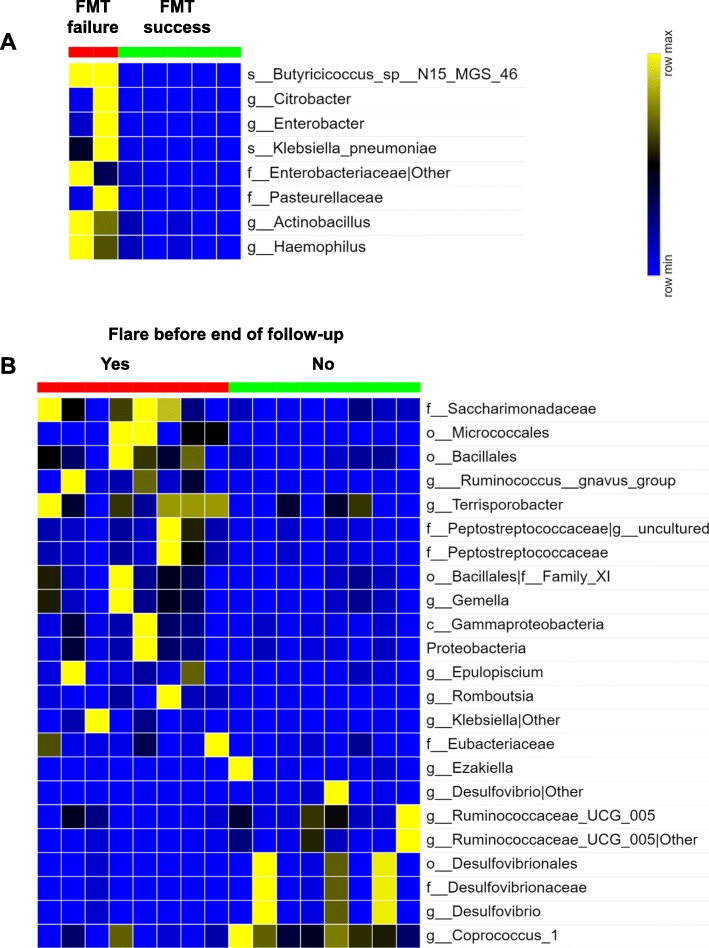
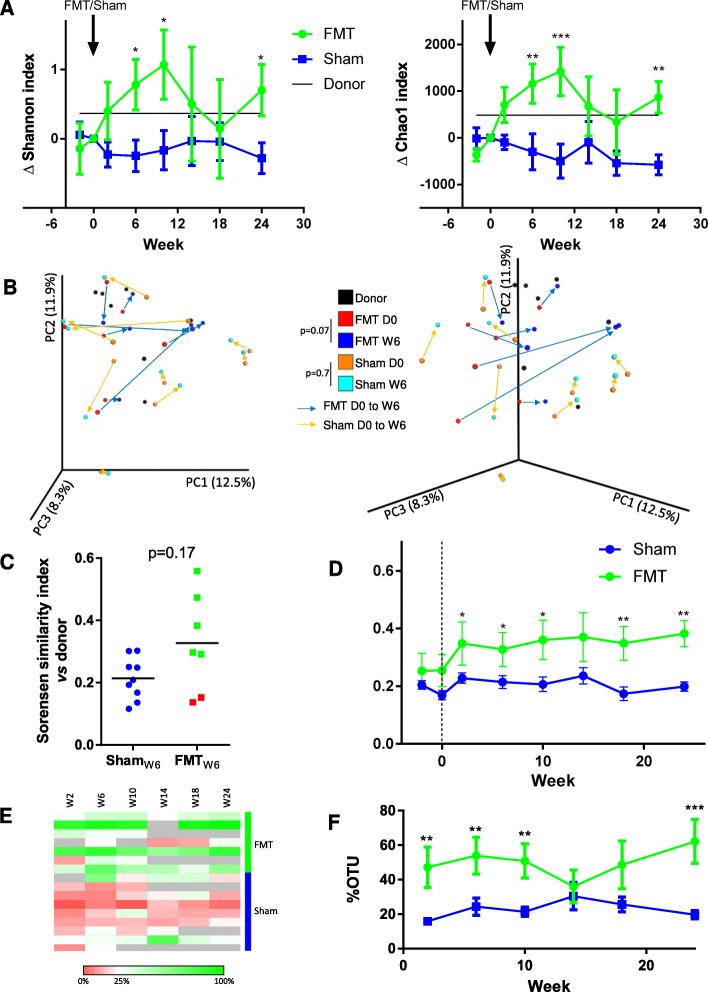
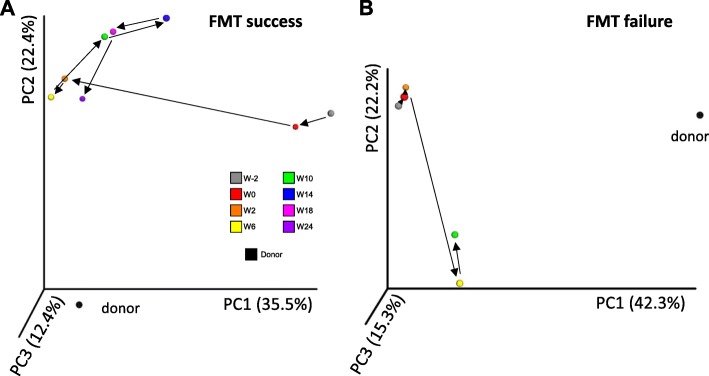
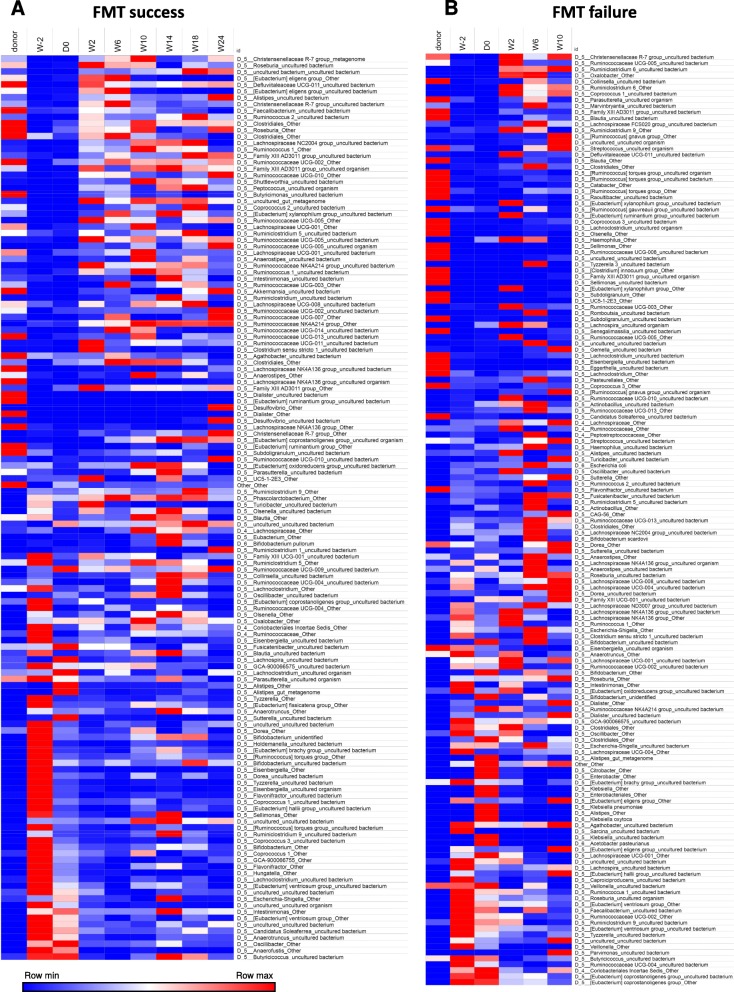
Eight patients received FMT and nine sham transplantation. None of the patients reached the primary endpoint. The steroid-free clinical remission rate at 10 and 24 weeks was 44.4% (4/9) and 33.3% (3/9) in the sham transplantation group and 87.5% (7/8) and 50.0% (4/8; one patient loss of follow-up while in remission at week 12 and considered in flare at week 24) in the FMT group. Crohn's Disease Endoscopic Index of Severity decreased 6 weeks after FMT (p = 0.03) but not after sham transplantation (p = 0.8). Conversely, the CRP level increased 6 weeks after sham transplantation (p = 0.008) but not after FMT (p = 0.5). Absence of donor microbiota engraftment was associated with flare. No safety signal was identified.
The primary endpoint was not reached for any patient. In this pilot study, higher colonization by donor microbiota was associated with maintenance of remission. These results must be confirmed in larger studies (NCT02097797). Video abstract.
肠道微生物群在克罗恩病(CD)中的作用已得到确立,粪便微生物群移植(FMT)是一种有吸引力的治疗策略。目前尚无随机对照临床试验结果。我们对成人结肠或回结肠 CD 患者进行了 FMT 的随机、单盲、假对照试验。
入组患者在发作期接受口服皮质类固醇。一旦临床缓解,患者在结肠镜检查期间随机接受 FMT 或假移植。皮质类固醇逐渐减量,第 6 周进行第二次结肠镜检查。主要终点是第 6 周时供体微生物群的定植(Sorensen 指数>0.6)。
8 例患者接受 FMT,9 例接受假移植。没有患者达到主要终点。假移植组第 10 周和第 24 周的无类固醇临床缓解率分别为 44.4%(4/9)和 33.3%(3/9),FMT 组分别为 87.5%(7/8)和 50.0%(4/8;1 例患者在缓解期第 12 周失访,第 24 周被认为在发作期)。FMT 后 6 周克罗恩病内镜严重指数下降(p=0.03),但假移植后无变化(p=0.8)。相反,CRP 水平在假移植后 6 周升高(p=0.008),而 FMT 后无变化(p=0.5)。供体微生物群定植缺失与发作有关。未发现安全信号。
没有患者达到主要终点。在这项初步研究中,更高的供体微生物群定植与缓解的维持有关。这些结果必须在更大的研究中得到证实(NCT02097797)。视频摘要。