Radhakrishnan Radhika C, Varughese Santosh, Chandran Abitha, Jacob Shibu, David Vinoi G, Alexander Suceena, Mohapatra Anjali, Valson Anna T, Gopal Basu, Palani C, Jose Arun, Antonisamy B, Tamilarasi V
Department of Nephrology, Christian Medical College, (Current Affiliation: Department of Pediatric Nephrology, Government Medical College, Thiruvananthapuram, Kerala), India.
Department of Nephrology, Christian Medical College, The Alfred Hospital, Melbourne, Australia), Australia.
Indian J Nephrol. 2020 Jan-Feb;30(1):3-7. doi: 10.4103/ijn.IJN_391_18. Epub 2019 Dec 27.
Individualized dialysate sodium prescription does affect weight gain, blood pressure (BP), and intradialytic complications. A prospective interventional trial (Dialysate Individualised Sodium (DISO) trial) was conducted to study this issue in Indian patients.
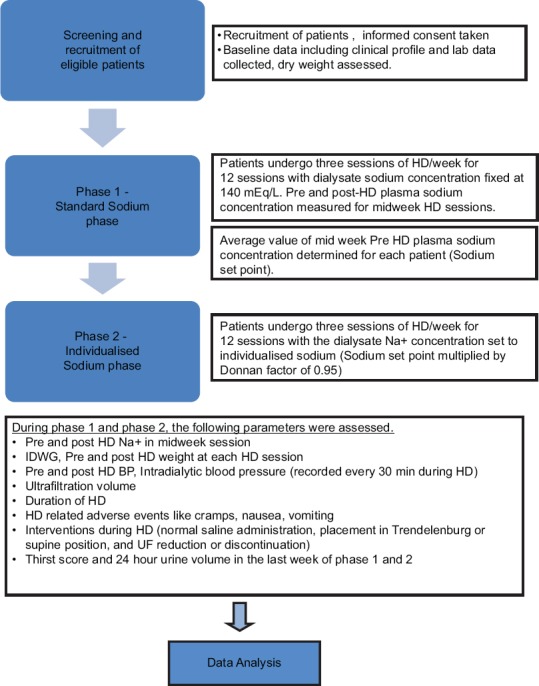
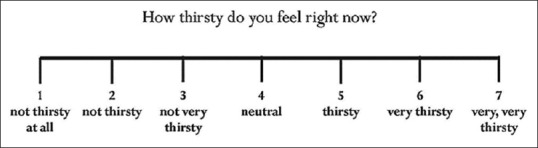
Forty patients on thrice-weekly maintenance hemodialysis (HD) for at least 6 weeks were enrolled. The study was performed in two different phases. In the first phase, 12 consecutive HD sessions were done with a standard dialysate sodium concentration of 140 mEq/L. In the second phase, 12 consecutive HD sessions were done with dialysate sodium concentration set to individualized value (mean of pre-HD sodium concentration multiplied by Donnan coefficient of 0.95). Differences in pre- and post-HD sodium, interdialytic weight gain (IDWG), pre- and post-HD BP, thirst scores, and intradialytic adverse events during both phases were assessed.
The mean age of patients was 45.65 years (24 males, 16 females). The mean serum pre-HD sodium level was 138.7 ± 1.7 meq/L in the standard phase and 138.2 ± 2.6meq/L in the individualized phase ( = 0.229). In the standard phase, the mean IDWG was 2.64 ± 1.56 kg and 2.13 ± 0.99 kg in the individualized phase ( = 0.008). The mean pre-HD systolic BP was 138 ± 18 mmHg and 134 ± 17 mmHg in the standard and individualized phases ( = 0.008). There was no difference in intradialytic symptoms, hypotensive episodes or requirement of interventions. Hypertension episodes occurred at a mean value of 2.2 and 1.2 in the standard and individualized phases, respectively ( = 0.010).
The use of individualized dialysate sodium level is safe and results in lower IDWG, pre-HD systolic BP, and intradialytic hypertension in patients on HD.
个体化透析液钠处方确实会影响体重增加、血压(BP)和透析期间并发症。一项前瞻性干预试验(透析液个体化钠(DISO)试验)在印度患者中开展以研究该问题。
纳入40例每周进行三次维持性血液透析(HD)至少6周的患者。该研究分两个不同阶段进行。在第一阶段,连续进行12次HD治疗,透析液钠浓度为标准的140 mEq/L。在第二阶段,连续进行12次HD治疗,透析液钠浓度设定为个体化值(HD前钠浓度平均值乘以Donnan系数0.95)。评估两个阶段HD前后钠的差异、透析间期体重增加(IDWG)、HD前后血压、口渴评分以及透析期间不良事件。
患者的平均年龄为45.65岁(24例男性,16例女性)。在标准阶段,HD前血清钠平均水平为138.7±1.7 meq/L,在个体化阶段为138.2±2.6 meq/L(P = 0.229)。在标准阶段,平均IDWG为2.64±1.56 kg,在个体化阶段为2.13±0.99 kg(P = 0.008)。在标准和个体化阶段,HD前平均收缩压分别为138±18 mmHg和134±17 mmHg(P = 0.008)。透析期间症状、低血压发作或干预需求无差异。高血压发作在标准阶段和个体化阶段的平均值分别为2.2和1.2(P = 0.010)。
使用个体化透析液钠水平是安全的,且能降低HD患者的IDWG、HD前收缩压和透析期间高血压。