Chen Yusheng, Yang Zhou, Deng Bo, Wu Dejun, Quan Yingjun, Min Zhijun
Department of General Surgery, Shanghai Pudong Hospital, Fudan University Pudong Medical Center, Shanghai 201399, P.R. China.
Division of Nephrology, Shanghai Ninth People's Hospital, School of Medicine, Shanghai Jiaotong University, Shanghai 200011, P.R. China.
Oncol Rep. 2020 Mar;43(3):908-918. doi: 10.3892/or.2020.7475. Epub 2020 Jan 22.
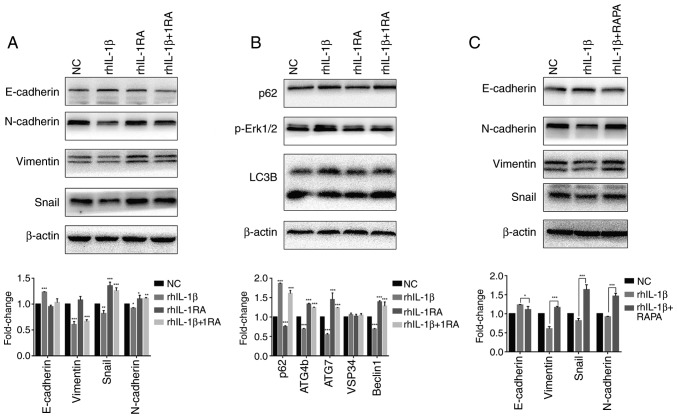
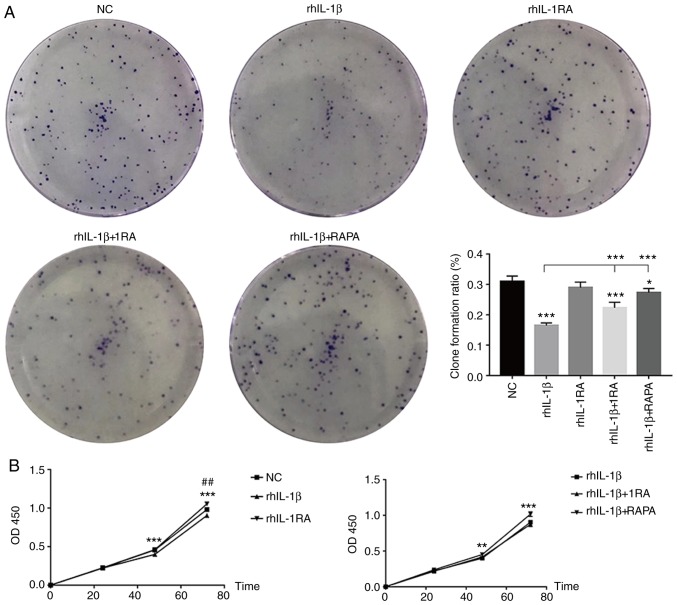
Interleukin (IL)‑1β is a member of the IL‑1 family of proteins. IL‑1 receptor antagonist (IL‑1RA) is an agent that binds to the IL‑1 receptor, preventing IL‑1 from transmitting signals to cells. The present study aimed to identify the role of the IL‑1β/1RA axis in epithelial‑mesenchymal transition (EMT), cell invasion, migration, proliferation and clone formation in colorectal cancer (CRC) and to determine its underlying mechanisms of action. Significantly increased expression of both IL‑1β and IL‑1RA was identified in CRC patient data uploaded in The Cancer Genome Atlas database, and in tumor tissues when compared with matched control tissue. High expression of IL‑1β was associated with an increased rate of overall survival and recurrence‑free survival. Further research revealed that the IL‑1β gene was co‑expressed with the IL‑1RA gene in tumors of CRC patients. It was additionally determined that recombinant human (rh)IL‑1β suppressed autophagy as well as EMT in HCT‑116 cells compared with control‑treated cells, whereas rhIL‑1RA exhibited the opposite effect. In addition, autophagy activator rapamycin (RAPA) rescued the inhibition of EMT in rhIL‑1β‑treated HCT‑116 cells. Moreover, rhIL‑1β inhibited cell invasion, migration, proliferation and colony‑formation ability, when compared with a control treatment. Compared with a control treatment rhIL‑1RA promoted cell invasion, migration, proliferation, but had no effect on clone formation ability. Furthermore, both rhIL‑1RA and RAPA rescued inhibition of cell invasion, migration and clone formation ability in rhIL‑1β‑treated HCT‑116 cells. RAPA, but not rhIL‑1RA, rescue inhibited proliferation in rhIL‑1β‑treated HCT‑116 cells compared with controls. In addition, it was confirmed that rhIL‑1β inhibited the growth of subcutaneous xenografts in nude mice, when compared with control treatments. These results indicated that upregulation of the IL‑1β/1RA axis in CRC regulated EMT, cell invasion and migration, proliferation and clone formation via autophagy.
白细胞介素(IL)-1β是IL-1蛋白家族的成员。IL-1受体拮抗剂(IL-1RA)是一种与IL-1受体结合的物质,可阻止IL-1向细胞传递信号。本研究旨在确定IL-1β/1RA轴在结直肠癌(CRC)上皮-间质转化(EMT)、细胞侵袭、迁移、增殖和克隆形成中的作用,并确定其潜在作用机制。在上传至癌症基因组图谱数据库的CRC患者数据以及与配对对照组织相比的肿瘤组织中,均发现IL-1β和IL-1RA的表达显著增加。IL-1β的高表达与总生存率和无复发生存率的增加相关。进一步研究表明,CRC患者肿瘤中IL-1β基因与IL-1RA基因共表达。此外,与对照处理的细胞相比,重组人(rh)IL-1β抑制了HCT-116细胞中的自噬以及EMT,而rhIL-1RA则表现出相反的作用。此外,自噬激活剂雷帕霉素(RAPA)挽救了rhIL-1β处理的HCT-116细胞中EMT的抑制。此外,与对照处理相比,rhIL-1β抑制细胞侵袭、迁移、增殖和集落形成能力。与对照处理相比,rhIL-1RA促进细胞侵袭、迁移、增殖,但对克隆形成能力无影响。此外,rhIL-1RA和RAPA均挽救了rhIL-1β处理的HCT-116细胞中细胞侵袭、迁移和克隆形成能力的抑制。与对照相比,RAPA而非rhIL-1RA挽救了rhIL- 1β处理的HCT-116细胞中的增殖抑制。此外,与对照处理相比,证实rhIL-1β抑制了裸鼠皮下异种移植物的生长。这些结果表明,CRC中IL-1β/1RA轴的上调通过自噬调节EMT、细胞侵袭和迁移、增殖和克隆形成。