Rheumatology and Immunology Department, Peking Union Medical College Hospital, Peking, China.
Rheumatology and Immunology Department, Hebei General Hospital, Shijiazhuang, China.
Adv Ther. 2020 Mar;37(3):1188-1202. doi: 10.1007/s12325-020-01244-x. Epub 2020 Feb 3.
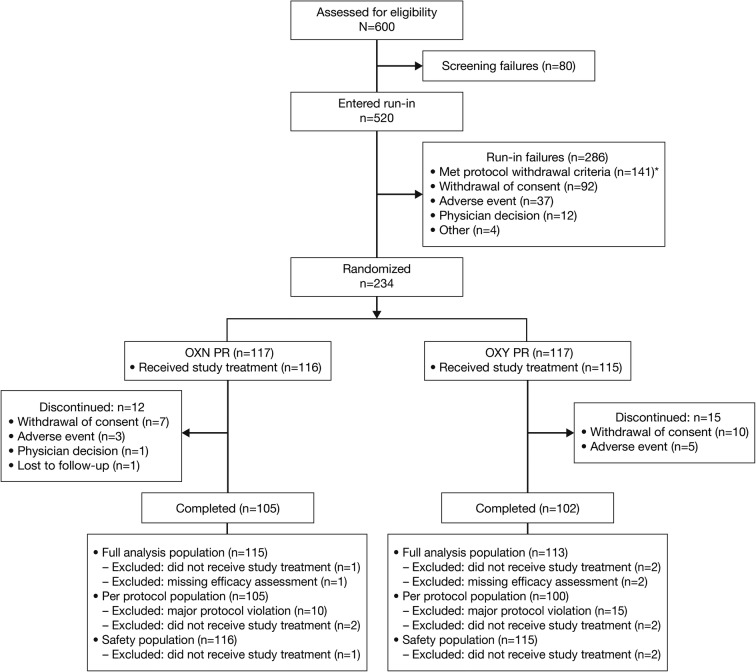
Prolonged-release oxycodone/naloxone (OXN PR), combining an opioid analgesic with selective blockade of enteric µ-opioid receptors, provided effective analgesia and improved bowel function in patients with moderate-to-severe pain and opioid-induced constipation in clinical trials predominantly conducted in Western countries. This double-blind randomized controlled trial investigated OXN PR (N = 116) versus prolonged-release oxycodone (OXY PR, N = 115) for 8 weeks at doses up to 50 mg/day in patients with moderate-to-severe, chronic, non-malignant musculoskeletal pain and opioid-induced constipation recruited in China.
A total of 234 patients at least 18 years of age with non-malignant musculoskeletal pain for more than 4 weeks that was moderate-to-severe in intensity and required round-the-clock opioid therapy were randomized (1:1) to OXN PR or OXY PR. The primary endpoint was bowel function using the Bowel Function Index (BFI). Secondary endpoints included safety, Brief Pain Inventory-Short Form (BPI-SF), use of analgesic and laxative rescue medication, and health-related quality of life (EQ-5D).
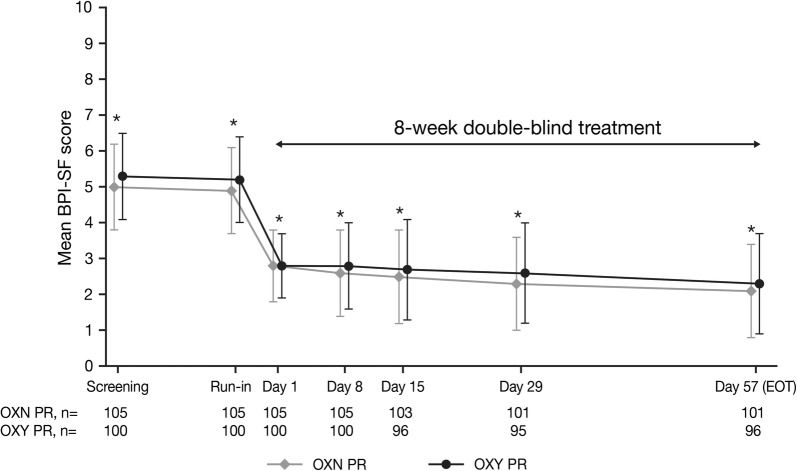
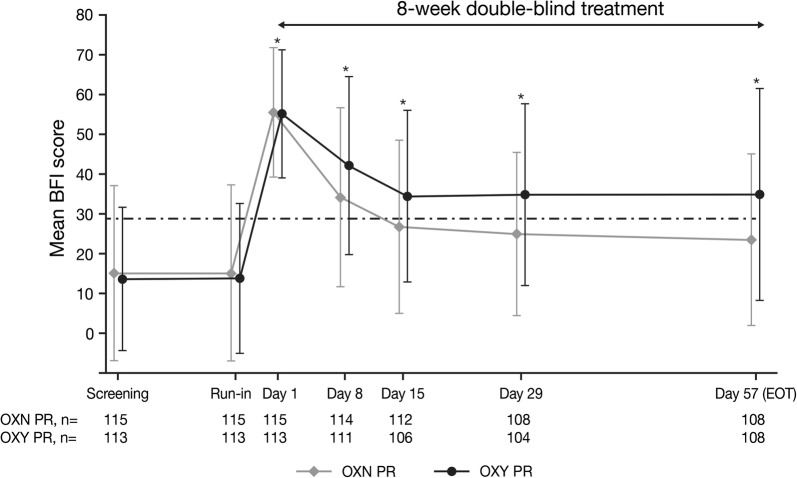
While BFI scores were comparable at baseline, at week 8 improvements were greater with OXN PR vs OXY PR (least squares mean [LSM] difference (95% CI) - 9.1 (- 14.0, - 4.2); P < 0.001. From weeks 2 to 8, mean BFI scores were in the range of normal bowel function (≤ 28.8) with OXN PR but were in the range of constipation (> 28.8) at all timepoints with OXY PR. Analgesia with OXN PR was similar and non-inferior to OXY PR on the basis of modified BPI-SF average 24-h pain scores at week 8: LSM difference (95% CI) - 0.3 (- 0.5, - 0.1); P < 0.001. The most frequent treatment-related AEs were nausea (OXN PR 5% vs OXY PR 6%) and dizziness (4% vs 4%).
OXN PR provided clinically meaningful improvements in bowel function and effective analgesia in Chinese patients with moderate-to-severe musculoskeletal pain and pre-existing opioid-induced constipation.
ClinicalTrials.gov, identifier NCT01918098.
在主要为西方国家开展的临床试验中,结合了阿片类镇痛药和选择性阻断肠内 μ 阿片受体的延长释放羟考酮/纳洛酮(OXN PR)为中重度疼痛和阿片类药物诱导性便秘的患者提供了有效的镇痛作用,并改善了肠道功能。这项双盲随机对照试验研究了 OXN PR(N=116)与延长释放羟考酮(OXY PR,N=115)在剂量高达 50mg/天时,在 8 周内治疗中国招募的中重度慢性非恶性肌肉骨骼疼痛和阿片类药物诱导性便秘患者的效果。
共有 234 名年龄至少 18 岁、非恶性肌肉骨骼疼痛持续超过 4 周、疼痛强度为中重度且需要全天阿片类药物治疗的患者被随机(1:1)分为 OXN PR 或 OXY PR 组。主要终点是使用肠道功能指数(BFI)评估肠道功能。次要终点包括安全性、简明疼痛量表-短表(BPI-SF)、镇痛药和通便药的使用以及健康相关生活质量(EQ-5D)。
虽然 BFI 评分在基线时相似,但在第 8 周时,OXN PR 组的改善优于 OXY PR 组(最小二乘均数差值[95%置信区间]:-9.1[-14.0,-4.2];P<0.001)。从第 2 周到第 8 周,OXN PR 组的平均 BFI 评分在正常肠道功能范围内(≤28.8),而 OXY PR 组在所有时间点的评分均在便秘范围内(>28.8)。基于第 8 周改良 BPI-SF 平均 24 小时疼痛评分,OXN PR 的镇痛作用与 OXY PR 相似且非劣效:LSM 差值(95%CI):-0.3[-0.5,-0.1];P<0.001)。最常见的与治疗相关的不良事件是恶心(OXN PR 5%比 OXY PR 6%)和头晕(4%比 4%)。
在中国中重度肌肉骨骼疼痛和存在阿片类药物诱导性便秘的患者中,OXN PR 可显著改善肠道功能和有效镇痛作用。
ClinicalTrials.gov,标识符 NCT01918098。