State Key Laboratory of Virology, Modern Virology Research Center, College of Life Sciences, Wuhan University, Wuhan, People's Republic of China.
Department of Laboratory Medicine, Zhongnan Hospital of Wuhan University, Wuhan, People's Republic of China.
Emerg Microbes Infect. 2020 Feb 5;9(1):313-319. doi: 10.1080/22221751.2020.1725399. eCollection 2020.
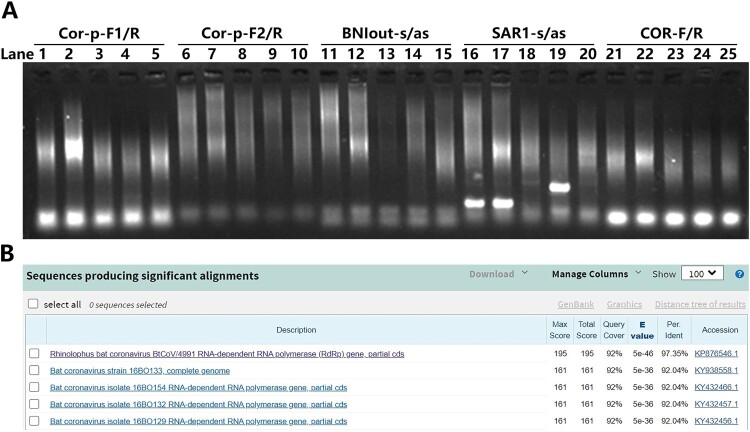
From December 2019, an outbreak of unusual pneumonia was reported in Wuhan with many cases linked to Huanan Seafood Market that sells seafood as well as live exotic animals. We investigated two patients who developed acute respiratory syndromes after independent contact history with this market. The two patients shared common clinical features including fever, cough, and multiple ground-glass opacities in the bilateral lung field with patchy infiltration. Here, we highlight the use of a low-input metagenomic next-generation sequencing (mNGS) approach on RNA extracted from bronchoalveolar lavage fluid (BALF). It rapidly identified a novel coronavirus (named 2019-nCoV according to World Health Organization announcement) which was the sole pathogens in the sample with very high abundance level (1.5% and 0.62% of total RNA sequenced). The entire viral genome is 29,881 nt in length (GenBank MN988668 and MN988669, Sequence Read Archive database Bioproject accession PRJNA601736) and is classified into β-coronavirus genus. Phylogenetic analysis indicates that 2019-nCoV is close to coronaviruses (CoVs) circulating in Rhinolophus (Horseshoe bats), such as 98.7% nucleotide identity to partial RdRp gene of bat coronavirus strain BtCoV/4991 (GenBank KP876546, 370 nt sequence of RdRp and lack of other genome sequence) and 87.9% nucleotide identity to bat coronavirus strain bat-SL-CoVZC45 and bat-SL-CoVZXC21. Evolutionary analysis based on ORF1a/1b, S, and N genes also suggests 2019-nCoV is more likely a novel CoV independently introduced from animals to humans.
自 2019 年 12 月以来,武汉报告了一起不寻常肺炎的爆发,许多病例与销售海鲜以及活体外来动物的华南海鲜市场有关。我们调查了两名在与该市场独立接触后出现急性呼吸综合征的患者。两名患者具有共同的临床特征,包括发热、咳嗽和双肺局灶性磨玻璃影伴斑片状浸润。在这里,我们强调了使用低投入宏基因组下一代测序(mNGS)方法对支气管肺泡灌洗液(BALF)中提取的 RNA 进行分析。它快速鉴定了一种新型冠状病毒(根据世界卫生组织的公告命名为 2019-nCoV),这是该样本中唯一的病原体,其丰度水平非常高(占测序总 RNA 的 1.5%和 0.62%)。病毒的全基因组长度为 29881nt(GenBank MN988668 和 MN988669,序列读取档案数据库 Bioproject 注册号 PRJNA601736),并被分类为β冠状病毒属。系统进化分析表明,2019-nCoV 与在菊头蝠(马蹄蝠)中循环的冠状病毒(CoVs)密切相关,例如与蝙蝠冠状病毒株 BtCoV/4991 的 RdRp 基因部分(GenBank KP876546,RdRp 的 370nt 序列和缺乏其他基因组序列)的核苷酸同一性为 98.7%,与蝙蝠冠状病毒株 bat-SL-CoVZC45 和 bat-SL-CoVZXC21 的核苷酸同一性为 87.9%。基于 ORF1a/1b、S 和 N 基因的进化分析也表明,2019-nCoV 更有可能是一种从动物独立引入人类的新型 CoV。