Australian Research Centre in Complementary and Integrative Medicine, Faculty of Health, University of Technology Sydney, Ultimo, Sydney, NSW, 2007, Australia.
Faculty of Pharmaceutical Sciences, College of Medicine and Allied Health Sciences, University of Sierra Leone, Freetown, Sierra Leone.
BMC Public Health. 2020 Feb 5;20(1):182. doi: 10.1186/s12889-020-8279-7.
We examined the magnitude and correlates of Ebola virus disease (EVD)-related stigma among EVD survivors in Sierra Leone since their return to their communities. In addition, we determined whether EVD-related stigma is a predictor of informal health care use among EVD survivors.
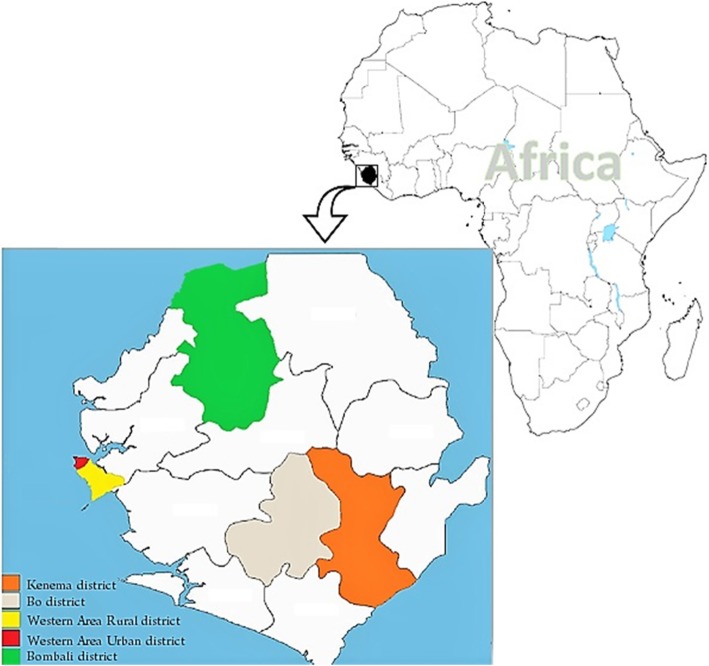
We conducted a cross-sectional study among 358 EVD survivors in five districts across all four geographic regions (Western Area, Northern Province, Eastern Province and Southern Province) of Sierra Leone. Ebola-related stigma was measured by adapting the validated HIV related stigma for people living with HIV/AIDS instrument. We also measured traditional and complementary medicine (T&CM) use (as a measure of informal healthcare use). Data were analysed using descriptive statistics and regression analysis.
EVD survivors report higher levels of internalised stigma (0.92 ± 0.77) compared to total enacted stigma (0.71 ± 0.61). Social isolation (0.96 ± 0.88) was the highest reported enacted stigma subscale. Ebola survivors who identified as Christians [AOR = 2.51, 95%CI: 1.15-5.49, p = 0.021], who perceived their health to be fair/poor [AOR = 2.58, 95%CI: 1.39-4.77. p = 0.003] and who reside in the northern region of Sierra Leone [AOR = 2.80, 95%CI: 1.29-6.07, p = 0.009] were more likely to experience internalised stigma. Verbal abuse [AOR = 1.95, 95%CI: 1.09-3.49, p = 0.025] and healthcare neglect [AOR = 2.35, 95%CI: 1.37-4.02, p = 0.002] were independent predictors of T&CM use among EVD survivors.
Our findings suggest EVD-related stigma (internalised and enacted) is prevalent among EVD survivors since their return to their communities. Religiosity, perceived health status and region were identified as independent predictors of internalised stigma. Verbal abuse and healthcare neglect predict informal healthcare use. EVD survivor-centred and community-driven anti-stigma programs are needed to promote EVD survivors' recovery and community re-integration.
我们考察了塞拉利昂埃博拉幸存者返回社区后埃博拉病毒病(EVD)相关耻辱感的严重程度及其相关因素。此外,我们还确定了 EVD 相关耻辱感是否是 EVD 幸存者非正规医疗保健使用的预测因素。
我们在塞拉利昂四个地理区域(西部地区、北方省、东方省和南方省)的五个区对 358 名 EVD 幸存者进行了横断面研究。通过改编经过验证的针对艾滋病毒感染者的与艾滋病毒相关的耻辱感工具,来衡量与埃博拉相关的耻辱感。我们还衡量了传统和补充医学(T&CM)的使用情况(作为非正规医疗保健使用的衡量标准)。使用描述性统计和回归分析来分析数据。
EVD 幸存者报告的内化耻辱感(0.92±0.77)高于总实施耻辱感(0.71±0.61)。社会孤立(0.96±0.88)是报告的最高实施耻辱感子量表。将自己认定为基督徒的 Ebola 幸存者[比值比(AOR)=2.51,95%置信区间(CI):1.15-5.49,p=0.021]、认为自己健康状况一般/较差的幸存者(AOR=2.58,95%CI:1.39-4.77,p=0.003)和居住在塞拉利昂北部地区的幸存者(AOR=2.80,95%CI:1.29-6.07,p=0.009)更有可能经历内化耻辱感。言语虐待(AOR=1.95,95%CI:1.09-3.49,p=0.025)和医疗保健忽视(AOR=2.35,95%CI:1.37-4.02,p=0.002)是 EVD 幸存者使用 T&CM 的独立预测因素。
我们的研究结果表明,自返回社区以来,EVD 幸存者中存在与 EVD 相关的耻辱感(内化和实施)。宗教信仰、感知健康状况和地区被确定为内化耻辱感的独立预测因素。言语虐待和医疗保健忽视预测了非正规医疗保健的使用。需要以 EVD 幸存者为中心并由社区驱动的抗耻辱感计划来促进 EVD 幸存者的康复和社区重新融入。