Cicely Saunders Institute of Palliative Care, Policy and Rehabilitation, London, United Kingdom.
King's College Hospital National Health Service Foundation Trust, Denmark Hill, London, United Kingdom.
J Clin Oncol. 2020 Mar 20;38(9):905-914. doi: 10.1200/JCO.19.00470. Epub 2020 Feb 5.
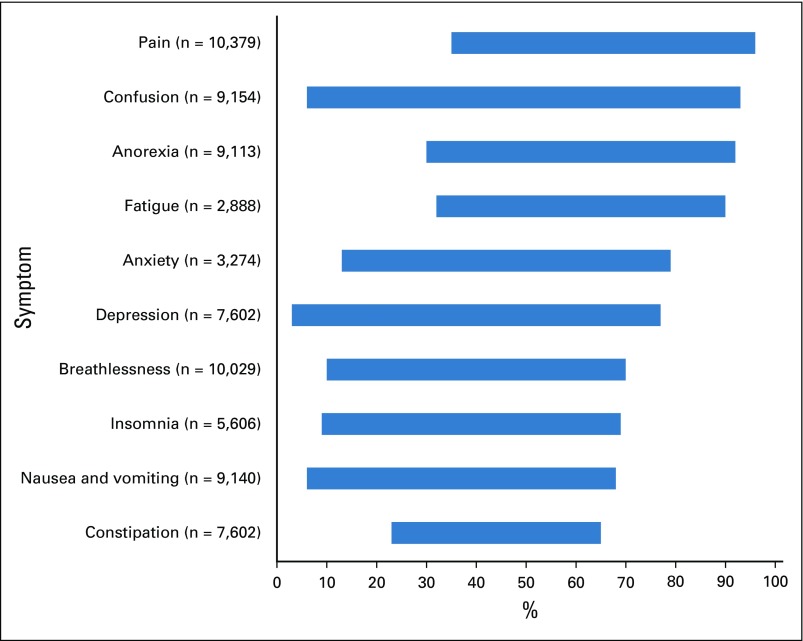
Good symptom management in oncology is associated with improved patient and family quality of life, greater treatment compliance, and may even offer survival advantages. With population growth and aging, the proportion of patients with multiple symptoms-both related and unrelated to their cancer-is anticipated to increase, supporting calls for a more routine and integrated approach to symptom management. This article presents a summary of the literature for the use of symptom assessment tools and reviews the management of four common and distressing symptoms commonly experienced by people with advanced cancer: pain, breathlessness, nausea and vomiting, and fatigue. We also discuss the role of palliative care in supporting a holistic approach to symptom management throughout the cancer trajectory.
肿瘤患者的良好症状管理与改善患者和家庭的生活质量、提高治疗依从性相关,甚至可能带来生存优势。随着人口增长和老龄化,预计同时存在与癌症相关和不相关的多种症状的患者比例将会增加,这也支持了对症状管理采取更常规和综合方法的呼吁。本文总结了症状评估工具的应用文献,并回顾了晚期癌症患者常经历的四种常见且令人痛苦的症状(疼痛、呼吸困难、恶心和呕吐以及疲劳)的管理。我们还讨论了姑息治疗在整个癌症病程中支持整体症状管理方法中的作用。