Li Jiakun, Chen Zeqiang, Yang Hua, Yi Zao, Chen Xifang, Yao Weitang, Duan Tao, Wu Pinghui, Li Gongfa, Yi Yougen
Joint Laboratory for Extreme Conditions Matter Properties, Southwest University of Science and Technology, Mianyang 621010, China.
Research Center for Photonic Technology, Fujian Key Laboratory for Advanced Micro-nano Photonics Technology and Devices & Key Laboratory of Information Functional Material for Fujian Higher Education, Quanzhou Normal University, Fujian 362000, China.
Nanomaterials (Basel). 2020 Feb 1;10(2):257. doi: 10.3390/nano10020257.
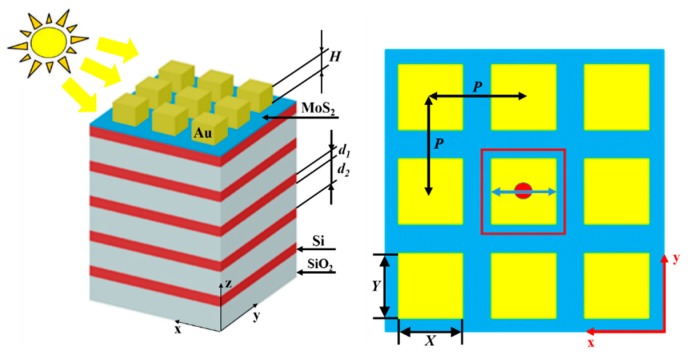
In order to significantly enhance the absorption capability of solar energy absorbers in the visible wavelength region, a novel monolayer molybdenum disulfide (MoS)-based nanostructure was proposed. Local surface plasmon resonances (LSPRs) supported by Au nanocubes (NCs) can improve the absorption of monolayer MoS. A theoretical simulation by a finite-difference time-domain method (FDTD) shows that the absorptions of proposed MoS-based absorbers are above 94.0% and 99.7% at the resonant wavelengths of 422 and 545 nm, respectively. In addition, the optical properties of the proposed nanostructure can be tuned by the geometric parameters of the periodic Au nanocubes array, distributed Bragg mirror (DBR) and polarization angle of the incident light, which are of great pragmatic significance for improving the absorption efficiency and selectivity of monolayer MoS. The absorber is also able to withstand a wide range of incident angles, showing polarization-independence. Similar design ideas can also be implemented to other transition-metal dichalcogenides (TMDCs) to strengthen the interaction between light and MoS. This nanostructure is relatively simple to implement and has a potentially important application value in the development of high-efficiency solar energy absorbers and other optoelectronic devices.
为了显著提高太阳能吸收器在可见光波长区域的吸收能力,提出了一种新型的基于单层二硫化钼(MoS)的纳米结构。金纳米立方体(NCs)支持的局域表面等离子体共振(LSPRs)可以提高单层MoS的吸收。通过时域有限差分法(FDTD)进行的理论模拟表明,所提出的基于MoS的吸收器在422和545nm的共振波长处的吸收率分别高于94.0%和99.7%。此外,所提出的纳米结构的光学性质可以通过周期性金纳米立方体阵列、分布布拉格反射镜(DBR)的几何参数以及入射光的偏振角来调节,这对于提高单层MoS的吸收效率和选择性具有重要的实际意义。该吸收器还能够承受宽范围的入射角,表现出偏振无关性。类似的设计思路也可以应用于其他过渡金属二硫属化物(TMDCs),以加强光与MoS之间的相互作用。这种纳米结构实施起来相对简单,在高效太阳能吸收器和其他光电器件的开发中具有潜在的重要应用价值。