Lee Eui Young, Kim Sung Shin, Park Ga Young, Lee Sun Hyang
Department of Pediatrics, Soonchunhyang University Bucheon Hospital, Soonchunhyang University College of Medicine, Bucheon, Korea.
Clin Exp Pediatr. 2020 Feb;63(2):56-62. doi: 10.3345/kjp.2019.00990. Epub 2020 Feb 6.
Red blood cell (RBC) transfusion improves cardiorespiratory status of preterm infants by increasing circulating hemoglobin, improving tissue oxygenation, and reducing cardiac output. However, RBC transfusion itself has also been suggested to negatively affect short-term outcomes such as intraventricular hemorrhage (IVH), bronchopulmonary dysplasia (BPD), retinopathy of prematurity (ROP), and necrotizing enterocolitis (NEC) in premature infants.
This study aimed to analyze the relationship between RBC transfusion and short-term outcomes in very low birth weight (VLBW) infants (birth weight, <1,500 g).
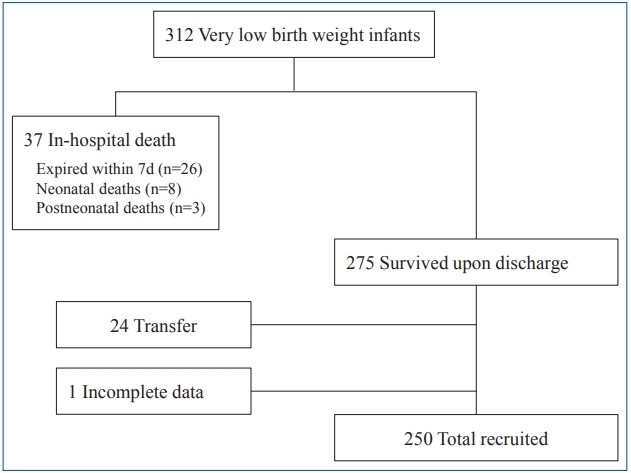
We retrospectively reviewed the medical records of VLBW infants admitted to the Soonchunhyang University Bucheon Hospital between October 2010 and December 2017. Infants who died during hospitalization were excluded. The infants were divided into 2 groups according to RBC transfusion status. We investigated the relationship between RBC transfusion and short-term outcomes including BPD, ROP, NEC, and IVH.
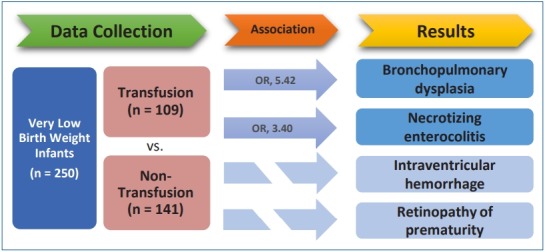
Of the 250 enrolled VLBW infants, 109 (43.6%) underwent transfusion. Univariate analysis revealed that all shortterm outcomes except early-onset sepsis and patent ductus arteriosus were associated with RBC transfusion. In multivariate analysis adjusted for gestational age, birth weight and Apgar score at 1 minute, RBC transfusion was significantly correlated with BPD (odds ratio [OR], 5.42; P<0.001) and NEC (OR, 3.40; P= 0.009).
RBC transfusion is significantly associated with adverse clinical outcomes such as NEC and BPD in VLBW infants. Careful consideration of the patient's clinical condition and appropriate guidelines is required before administration of RBC transfusions.
红细胞(RBC)输血通过增加循环血红蛋白、改善组织氧合和降低心输出量来改善早产儿的心肺状况。然而,红细胞输血本身也被认为会对早产儿的短期结局产生负面影响,如脑室内出血(IVH)、支气管肺发育不良(BPD)、早产儿视网膜病变(ROP)和坏死性小肠结肠炎(NEC)。
本研究旨在分析极低出生体重(VLBW)婴儿(出生体重<1500g)红细胞输血与短期结局之间的关系。
我们回顾性分析了2010年10月至2017年12月入住顺天乡大学富川医院的极低出生体重婴儿的病历。排除住院期间死亡的婴儿。根据红细胞输血状况将婴儿分为两组。我们研究了红细胞输血与包括BPD、ROP、NEC和IVH在内的短期结局之间的关系。
在纳入的250例极低出生体重婴儿中,109例(43.6%)接受了输血。单因素分析显示,除早发型败血症和动脉导管未闭外,所有短期结局均与红细胞输血有关。在对胎龄、出生体重和1分钟阿氏评分进行校正的多因素分析中,红细胞输血与BPD(优势比[OR],5.42;P<0.001)和NEC(OR,3.40;P=0.009)显著相关。
红细胞输血与极低出生体重婴儿的NEC和BPD等不良临床结局显著相关。在进行红细胞输血之前,需要仔细考虑患者的临床状况并遵循适当的指南。