Acquifer is a division of Ditabis, Digital Biomedical Imaging Systems AG, Pforzheim, Germany.
Centre of Paediatrics and Adolescent Medicine, University Hospital Heidelberg, Heidelberg, Germany.
BMC Bioinformatics. 2020 Feb 5;21(1):44. doi: 10.1186/s12859-020-3363-7.
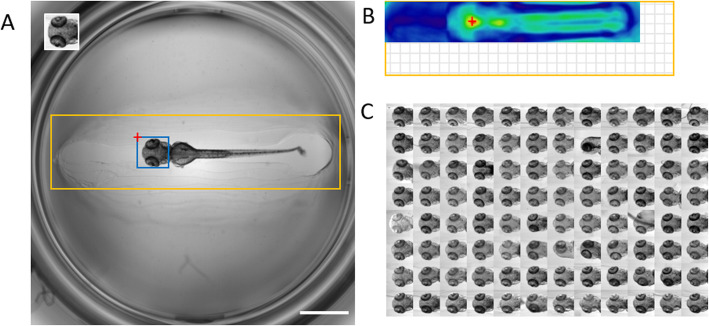
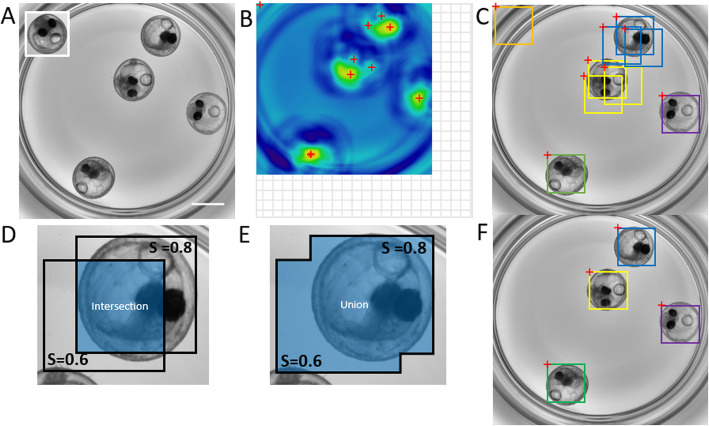
The localization of objects of interest is a key initial step in most image analysis workflows. For biomedical image data, classical image-segmentation methods like thresholding or edge detection are typically used. While those methods perform well for labelled objects, they are reaching a limit when samples are poorly contrasted with the background, or when only parts of larger structures should be detected. Furthermore, the development of such pipelines requires substantial engineering of analysis workflows and often results in case-specific solutions. Therefore, we propose a new straightforward and generic approach for object-localization by template matching that utilizes multiple template images to improve the detection capacity.
We provide a new implementation of template matching that offers higher detection capacity than single template approach, by enabling the detection of multiple template images. To provide an easy-to-use method for the automatic localization of objects of interest in microscopy images, we implemented multi-template matching as a Fiji plugin, a KNIME workflow and a python package. We demonstrate its application for the localization of entire, partial and multiple biological objects in zebrafish and medaka high-content screening datasets. The Fiji plugin can be installed by activating the Multi-Template-Matching and IJ-OpenCV update sites. The KNIME workflow is available on nodepit and KNIME Hub. Source codes and documentations are available on GitHub (https://github.com/multi-template-matching).
The novel multi-template matching is a simple yet powerful object-localization algorithm, that requires no data-pre-processing or annotation. Our implementation can be used out-of-the-box by non-expert users for any type of 2D-image. It is compatible with a large variety of applications including, for instance, analysis of large-scale datasets originating from automated microscopy, detection and tracking of objects in time-lapse assays, or as a general image-analysis step in any custom processing pipelines. Using different templates corresponding to distinct object categories, the tool can also be used for classification of the detected regions.
在大多数图像分析工作流程中,目标物的定位是关键的初始步骤。对于生物医学图像数据,通常使用经典的图像分割方法,如阈值处理或边缘检测。虽然这些方法对标记的目标物表现良好,但当样本与背景对比度较差,或者只需要检测较大结构的部分时,它们已经达到了极限。此外,这些流水线的开发需要大量的分析工作流工程,并且通常导致特定于案例的解决方案。因此,我们提出了一种新的、简单的、通用的基于模板匹配的目标物定位方法,该方法利用多个模板图像来提高检测能力。
我们提供了一种新的模板匹配实现方法,通过启用多个模板图像的检测,比单一模板方法提供了更高的检测能力。为了提供一种易于使用的方法,用于自动定位显微镜图像中的感兴趣目标物,我们将多模板匹配实现为一个 Fiji 插件、一个 KNIME 工作流和一个 python 包。我们演示了它在斑马鱼和青鳉高内涵筛选数据集的整个、部分和多个生物目标物的定位中的应用。可以通过激活 Multi-Template-Matching 和 IJ-OpenCV 更新站点来安装 Fiji 插件。KNIME 工作流可在 nodepit 和 KNIME Hub 上获得。源代码和文档可在 GitHub(https://github.com/multi-template-matching)上获得。
新型的多模板匹配是一种简单而强大的目标物定位算法,不需要数据预处理或注释。我们的实现可以由非专家用户直接使用,适用于任何类型的 2D 图像。它与各种应用程序兼容,例如,源自自动化显微镜的大规模数据集的分析、时程测定中目标物的检测和跟踪,或者作为任何自定义处理流水线中的一般图像分析步骤。通过使用对应于不同目标物类别的不同模板,该工具还可以用于检测区域的分类。