Department of Public Health, University of Helsinki, P.O. Box 20, 00014, Helsinki, Finland.
Finnish Institute of Occupational Health, Helsinki, Finland.
BMC Public Health. 2020 Feb 5;20(1):184. doi: 10.1186/s12889-020-8241-8.
Declining response rates are a common challenge to epidemiological research. Response rates further are particularly low among young people. We thus aimed to identify factors associated with health survey response among young employees using different data collection methods.
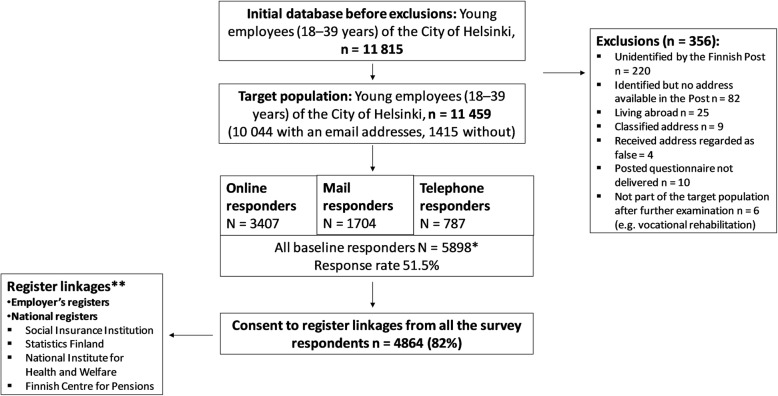
We included fully register-based data to identify key socioeconomic, workplace and health-related factors associated with response to a health survey collected via online and mailed questionnaires. Additionally, telephone interviews were conducted for those who had not responded via online or to the mailed survey. The survey data collection was done in autumn 2017 among young employees of the City of Helsinki, Finland (18-39 years, target population n = 11,459).
The overall response to the survey was 51.5% (n = 5898). The overall findings suggest that differences in the distributions of socioeconomic, workplace and health-related factors between respondents in the online or mailed surveys, or telephone interviews, are relatively minor. Telephone interview respondents were of lower socioeconomic position, which helped improve representativeness of the entire cohort. Despite the general broad representativeness of the data, some socioeconomic and health-related factors contributed to response. Thus, non-respondents were more often men, manual workers, from the lowest income quartile, had part-time jobs, and had more long sickness absence spells. In turn, job contract (permanent or temporary) and employment sector did not affect survey response.
Despite a general representativeness of data of the target population, socioeconomically more disadvantaged and those with long sickness absence, are slightly overrepresented among non-respondents. This suggests that when studying the associations between social factors and health, the associations can be weaker than if complete data were available representing all socioeconomic groups.
应答率下降是流行病学研究中常见的挑战。年轻人的应答率尤其低。因此,我们旨在使用不同的数据收集方法,确定与年轻员工健康调查应答相关的因素。
我们纳入了基于登记的完整数据,以确定与通过在线和邮寄问卷收集的健康调查应答相关的关键社会经济、工作场所和健康相关因素。此外,对于那些未通过在线或邮寄调查应答的人,进行了电话访谈。调查数据收集于 2017 年秋季在芬兰赫尔辛基市的年轻员工中进行(18-39 岁,目标人群 n=11459)。
调查的总体应答率为 51.5%(n=5898)。总体结果表明,在线或邮寄调查或电话访谈中应答者的社会经济、工作场所和健康相关因素分布的差异相对较小。电话访谈应答者的社会经济地位较低,这有助于提高整个队列的代表性。尽管数据具有广泛的代表性,但一些社会经济和健康相关因素对应答产生了影响。因此,未应答者更多为男性、体力劳动者、来自收入最低四分位数的人、从事兼职工作且病假时间较长。相反,工作合同(永久或临时)和就业部门并不影响调查应答。
尽管数据具有目标人群的一般代表性,但社会经济地位较低和病假时间较长的人在未应答者中略有过度代表。这表明,在研究社会因素与健康之间的关联时,如果没有完整的数据代表所有社会经济群体,那么关联可能会较弱。