Department of Biology, University of Turku, Turku, 20014, Finland.
Myanma Timber Enterprise, Ministry of Natural Resources and Environmental Conservation, Yangon, Insein Township, Myanmar.
Sci Rep. 2020 Feb 5;10(1):1889. doi: 10.1038/s41598-020-58590-7.
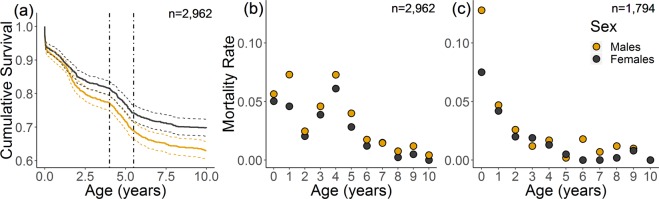
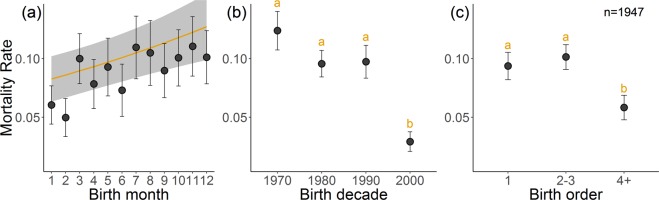
Understanding factors preventing populations of endangered species from being self-sustaining is vital for successful conservation, but we often lack sufficient data to understand dynamics. The global Asian elephant population has halved since the 1950s, however >25% currently live in captivity and effective management is essential to maintain viable populations. Here, we study the largest semi-captive Asian elephant population, those of the Myanma timber industry (~20% global captive population), whose population growth is heavily limited by juvenile mortality. We assess factors associated with increased mortality of calves aged 4.0-5.5 years, the taming age in Myanmar, a process affecting ~15,000 captive elephants to varying degrees worldwide. Using longitudinal survival data of 1,947 taming-aged calves spanning 43 years, we showed that calf mortality risk increased by >50% at the taming age of four, a peak not seen in previous studies on wild African elephants. Calves tamed at younger ages experienced higher mortality risk, as did calves with less experienced mothers. Taming-age survival greatly improved after 2000, tripling since the 1970's. Management should focus on reducing risks faced by vulnerable individuals such as young and first-born calves to further improve survival. Changes associated with reduced mortality here are important targets for improving the sustainability of captive populations.
了解哪些因素会阻止濒危物种的种群实现自我维持,对于成功保护它们至关重要,但我们往往缺乏足够的数据来了解这些物种的动态变化。自 20 世纪 50 年代以来,全球亚洲象数量减少了一半,但目前仍有超过 25%的亚洲象生活在圈养环境中,因此有效管理对于维持其种群的生存能力至关重要。在这里,我们研究了全球最大的半圈养亚洲象种群,即缅甸木材行业的亚洲象种群(约占全球圈养亚洲象种群的 20%),其种群增长受到幼象死亡率的严重限制。我们评估了与 4.0-5.5 岁(缅甸驯服年龄)幼象死亡率增加相关的因素,这一过程在全球范围内影响着约 15000 头圈养大象,不同程度地影响着它们。利用 43 年来 1947 头处于驯服年龄的幼象的纵向生存数据,我们发现,在 4 岁的驯服年龄时,幼象的死亡率风险增加了 50%以上,这一峰值在之前对野生非洲象的研究中并未出现。驯服年龄较小的幼象死亡率风险更高,母亲经验较少的幼象也是如此。自 2000 年以来,驯服年龄的存活率大大提高,是 20 世纪 70 年代的三倍。管理应重点关注减少弱势个体(如年幼和初产的幼象)面临的风险,以进一步提高存活率。这里与死亡率降低相关的变化是提高圈养种群可持续性的重要目标。