• 文献检索
  • 文档翻译
  • 深度研究
  • 学术资讯
  • Suppr Zotero 插件Zotero 插件
  • 邀请有礼
  • 套餐&价格
  • 历史记录
应用&插件
Suppr Zotero 插件Zotero 插件浏览器插件Mac 客户端Windows 客户端微信小程序
定价
高级版会员购买积分包购买API积分包
服务
文献检索文档翻译深度研究API 文档MCP 服务
关于我们
关于 Suppr公司介绍联系我们用户协议隐私条款
关注我们

Suppr 超能文献

核心技术专利:CN118964589B侵权必究
粤ICP备2023148730 号-1Suppr @ 2026

文献检索

告别复杂PubMed语法,用中文像聊天一样搜索,搜遍4000万医学文献。AI智能推荐,让科研检索更轻松。

立即免费搜索

文件翻译

保留排版,准确专业,支持PDF/Word/PPT等文件格式,支持 12+语言互译。

免费翻译文档

深度研究

AI帮你快速写综述,25分钟生成高质量综述,智能提取关键信息,辅助科研写作。

立即免费体验

调查最大半圈养亚洲象种群处理系统内的变化。

Investigating changes within the handling system of the largest semi-captive population of Asian elephants.

机构信息

Department of Biology, University of Turku, Turku, Finland.

Myanma Timber Enterprise, Yangon, Myanmar.

出版信息

PLoS One. 2019 Jan 31;14(1):e0209701. doi: 10.1371/journal.pone.0209701. eCollection 2019.

DOI:10.1371/journal.pone.0209701
PMID:30703121
原文链接:https://pmc.ncbi.nlm.nih.gov/articles/PMC6354975/
Abstract

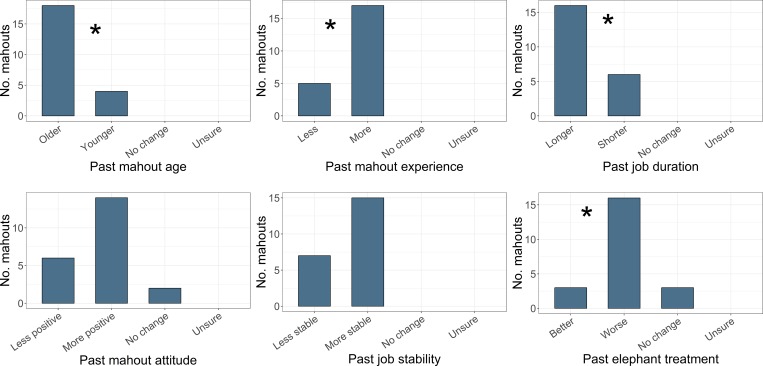
The current extinction crisis leaves us increasingly reliant on captive populations to maintain vulnerable species. Approximately one third of Asian elephants (Elephas maximus) are living in semi-captive conditions in range countries. Their relationship with humans stretches back millennia, yet elephants have never been fully domesticated. We rely on the expertise of traditional handlers (mahouts) to manage these essentially wild animals, yet this profession may be threatened in the modern day. Here, we study the handling system of semi-captive timber elephants in Myanmar; the largest global semi-captive population (~5 000). We investigate how recent changes in Myanmar may have affected the keeping system and mahout-elephant interactions. Structured interviews investigated changes to mahout attitude and experience over the last two decades, as perceived by those who had worked in the industry for at least 10 years (n = 23) and as evaluated in current mahouts (n = 210), finding mahouts today are younger (median age 22yrs), less experienced (median experience 3yrs), and change elephants frequently, threatening traditional knowledge transfer. Mahout-elephant interactions manifested as 5 components ('job appreciation'; 'experience is necessary'; 'human-elephant interaction'; 'own knowledge'; 'elephant relationship'), according to Principal Components Analysis. Experienced mahouts and mahouts of bulls and younger elephants were more likely to agree that 'experience is necessary' to be a mahout. Mahouts with difficult elephants scored lower on 'human-elephant interaction' and a mahout's perception of their 'own knowledge' increased with more experience. Our finding of change in terms of mahout experience, age and commitment in the largest semi-captive elephant population suggests need for formal training and assessment of impacts on elephant welfare; these are findings applicable to thousands of elephants under similar management.

摘要

当前的物种灭绝危机使得我们越来越依赖圈养种群来维持脆弱物种。大约三分之一的亚洲象(Elephas maximus)生活在分布国家的半圈养环境中。它们与人类的关系可以追溯到几千年前,但大象从未被完全驯化。我们依靠传统驯象师(mahouts)的专业知识来管理这些本质上仍处于野生状态的动物,但这个职业在现代可能受到威胁。在这里,我们研究了缅甸半圈养木材象的饲养系统;这是全球最大的半圈养种群(约 5000 头)。我们调查了缅甸最近的变化如何影响饲养系统和驯象师与大象的互动。通过结构访谈,我们调查了过去 20 年中驯象师态度和经验的变化,这些变化是由在该行业工作至少 10 年的人(n=23)感知到的,以及当前的驯象师(n=210)评估的,发现现在的驯象师年龄更小(中位数年龄为 22 岁),经验更少(中位数经验为 3 年),并且经常更换大象,威胁到传统知识的传授。驯象师与大象的互动表现为 5 个组成部分(“工作欣赏”;“经验是必要的”;“人象互动”;“自己的知识”;“象关系”),根据主成分分析。有经验的驯象师和公牛和年轻大象的驯象师更有可能同意“经验是必要的”才能成为驯象师。与难驯大象的驯象师在“人象互动”方面得分较低,而驯象师对自己的“知识”的感知随着经验的增加而增加。在最大的半圈养大象种群中,我们发现了驯象师经验、年龄和承诺方面的变化,这表明需要对大象福利的影响进行正式培训和评估;这些发现适用于数千头处于类似管理下的大象。
https://cdn.ncbi.nlm.nih.gov/pmc/blobs/544b/6354975/042c25a48750/pone.0209701.g001.jpg

相似文献

1
Investigating changes within the handling system of the largest semi-captive population of Asian elephants.调查最大半圈养亚洲象种群处理系统内的变化。
PLoS One. 2019 Jan 31;14(1):e0209701. doi: 10.1371/journal.pone.0209701. eCollection 2019.
2
Mahout Perspectives on Asian Elephants and Their Living Conditions.对亚洲象及其生活条件的马胡特观点。
Animals (Basel). 2019 Oct 29;9(11):879. doi: 10.3390/ani9110879.
3
Influence of handler relationships and experience on health parameters, glucocorticoid responses and behaviour of semi-captive Asian elephants.饲养员关系和经验对半圈养亚洲象的健康参数、糖皮质激素反应及行为的影响
Conserv Physiol. 2021 Jan 6;9(1):coaa116. doi: 10.1093/conphys/coaa116. eCollection 2021.
4
Causes and correlates of calf mortality in captive Asian elephants (Elephas maximus).圈养亚洲象(Elephas maximus)幼象死亡的原因及相关因素。
PLoS One. 2012;7(3):e32335. doi: 10.1371/journal.pone.0032335. Epub 2012 Mar 1.
5
Ethno-veterinary practices in Southern India for captive Asian elephant ailments.印度南部针对圈养亚洲象疾病的民族兽医学实践。
J Ethnopharmacol. 2017 Mar 22;200:182-204. doi: 10.1016/j.jep.2017.02.039. Epub 2017 Feb 27.
6
Evaluating the personality structure of semi-captive Asian elephants living in their natural habitat.评估生活在自然栖息地的半圈养亚洲象的性格结构。
R Soc Open Sci. 2018 Feb 7;5(2):172026. doi: 10.1098/rsos.172026. eCollection 2018 Feb.
7
Taming age mortality in semi-captive Asian elephants.半圈养亚洲象的老龄化死亡率控制。
Sci Rep. 2020 Feb 5;10(1):1889. doi: 10.1038/s41598-020-58590-7.
8
Use of genital inspection and female urine tests to detect oestrus in captive Asian elephants.利用生殖器检查和雌性尿液检测来检测圈养亚洲象的发情期。
Anim Reprod Sci. 2009 Oct;115(1-4):267-78. doi: 10.1016/j.anireprosci.2008.11.017. Epub 2008 Dec 3.
9
Males have more aggressive and less sociable personalities than females in semi-captive Asian elephants.在半圈养的亚洲象中,雄性比雌性具有更具攻击性和更少的社交性的个性。
Sci Rep. 2019 Feb 25;9(1):2668. doi: 10.1038/s41598-019-39915-7.
10
Assessing the Psychological Priorities for Optimising Captive Asian Elephant () Welfare.评估优化圈养亚洲象福利的心理优先事项
Animals (Basel). 2019 Dec 23;10(1):39. doi: 10.3390/ani10010039.

引用本文的文献

1
Tusks, testosterone and personality in male Asian elephants ().雄性亚洲象的长牙、睾酮与个性()
R Soc Open Sci. 2025 Aug 27;12(8):250490. doi: 10.1098/rsos.250490. eCollection 2025 Aug.
2
Seasonal variation in molecular and physiological stress markers in Asian elephants.亚洲象分子和生理应激标志物的季节性变化
Conserv Physiol. 2023 May 19;11(1):coad029. doi: 10.1093/conphys/coad029. eCollection 2023.
3
Effect of the COVID-19 pandemic and international travel ban on elephant tourist camp management in northern Thailand.

本文引用的文献

1
Changing trends in elephant camp management in northern Thailand and implications for welfare.泰国北部大象营地管理的变化趋势及其对福利的影响。
PeerJ. 2018 Nov 23;6:e5996. doi: 10.7717/peerj.5996. eCollection 2018.
2
Distances between individuals in an artificial herd of African elephants (Loxodonta africana africana) during resource utilisation in a semi-captive environment.在半圈养环境中资源利用期间,人工饲养的非洲象群(Loxodonta africana africana)中个体之间的距离。
Res Vet Sci. 2017 Aug;113:122-129. doi: 10.1016/j.rvsc.2017.09.014. Epub 2017 Sep 14.
3
Untangling the proximate causes and underlying drivers of deforestation and forest degradation in Myanmar.
新冠疫情及国际旅行禁令对泰国北部大象旅游营地管理的影响。
Front Vet Sci. 2022 Dec 2;9:1038855. doi: 10.3389/fvets.2022.1038855. eCollection 2022.
4
Current and Future Approaches to Mitigate Conflict between Humans and Asian Elephants: The Potential Use of Aversive Geofencing Devices.减轻人类与亚洲象冲突的当前及未来方法:厌恶式地理围栏设备的潜在用途
Animals (Basel). 2022 Oct 28;12(21):2965. doi: 10.3390/ani12212965.
5
Human interventions in a behavioural experiment for Asian Elephants (Elephas maximus).人类对亚洲象(Elephas maximus)进行行为实验的干预。
Anim Cogn. 2023 Mar;26(2):393-404. doi: 10.1007/s10071-022-01668-8. Epub 2022 Aug 20.
6
Investigating associations between nematode infection and three measures of sociality in Asian elephants.调查亚洲象线虫感染与三种社会性指标之间的关联。
Behav Ecol Sociobiol. 2022;76(7):87. doi: 10.1007/s00265-022-03192-8. Epub 2022 Jun 24.
7
Influence of handler relationships and experience on health parameters, glucocorticoid responses and behaviour of semi-captive Asian elephants.饲养员关系和经验对半圈养亚洲象的健康参数、糖皮质激素反应及行为的影响
Conserv Physiol. 2021 Jan 6;9(1):coaa116. doi: 10.1093/conphys/coaa116. eCollection 2021.
8
Handler familiarity helps to improve working performance during novel situations in semi-captive Asian elephants.饲养员的熟悉度有助于提高半圈养亚洲象在新情况时的工作表现。
Sci Rep. 2021 Jul 29;11(1):15480. doi: 10.1038/s41598-021-95048-w.
9
Re: Asian Elephant Conservation: Too Elephantocentric? Towards a Biocultural Approach of Conservation-Response to Duffillot: a Long Road Ahead.关于:亚洲象保护:是否过于以大象为中心?迈向生物文化保护方法——对迪菲洛的回应:前路漫漫。
Asian Bioeth Rev. 2019 May 28;11(2):141-145. doi: 10.1007/s41649-019-00089-z. eCollection 2019 Jun.
10
Anthropogenic interferences lead to gut microbiome dysbiosis in Asian elephants and may alter adaptation processes to surrounding environments.人为干扰导致亚洲象肠道微生物群失调,并可能改变其对周围环境的适应过程。
Sci Rep. 2021 Jan 12;11(1):741. doi: 10.1038/s41598-020-80537-1.
厘清缅甸森林砍伐和森林退化的直接原因及潜在驱动因素。
Conserv Biol. 2017 Dec;31(6):1362-1372. doi: 10.1111/cobi.12984. Epub 2017 Oct 14.
4
Keeper-Animal Interactions: Differences between the Behaviour of Zoo Animals Affect Stockmanship.饲养员与动物的互动:动物园动物行为差异对饲养管理的影响。
PLoS One. 2015 Oct 28;10(10):e0140237. doi: 10.1371/journal.pone.0140237. eCollection 2015.
5
Asian Elephant (Elephas maximus), Pig-Tailed Macaque (Macaca nemestrina) and Tiger (Panthera tigris) Populations at Tourism Venues in Thailand and Aspects of Their Welfare.泰国旅游景点的亚洲象(印度象)、豚尾猕猴和老虎种群及其福利状况
PLoS One. 2015 Sep 25;10(9):e0139092. doi: 10.1371/journal.pone.0139092. eCollection 2015.
6
Health and human rights in eastern Myanmar after the political transition: a population-based assessment using multistaged household cluster sampling.缅甸东部政治转型后的健康与人权:基于多阶段家庭整群抽样的人群评估
PLoS One. 2015 May 13;10(5):e0121212. doi: 10.1371/journal.pone.0121212. eCollection 2015.
7
Elephant (Elephas maximus) Health and Management in Asia: Variations in Veterinary Perspectives.亚洲大象(印度象)的健康与管理:兽医观点的差异
Vet Med Int. 2015;2015:614690. doi: 10.1155/2015/614690. Epub 2015 Jan 19.
8
Beyond predictions: biodiversity conservation in a changing climate.超越预测:变化气候中的生物多样性保护。
Science. 2011 Apr 1;332(6025):53-8. doi: 10.1126/science.1200303.
9
Confirmed infection with intestinal schistosomiasis in semi-captive wild-born chimpanzees on Ngamba Island, Uganda.在乌干达恩冈贝岛上半圈养的野生出生的黑猩猩中确认感染了肠道血吸虫病。
Vector Borne Zoonotic Dis. 2011 Feb;11(2):169-76. doi: 10.1089/vbz.2010.0156. Epub 2011 Jan 13.
10
Species differences in responses to captivity: stress, welfare and the comparative method.物种对圈养的反应差异:应激、福利和比较方法。
Trends Ecol Evol. 2010 Dec;25(12):713-21. doi: 10.1016/j.tree.2010.08.011. Epub 2010 Oct 16.